




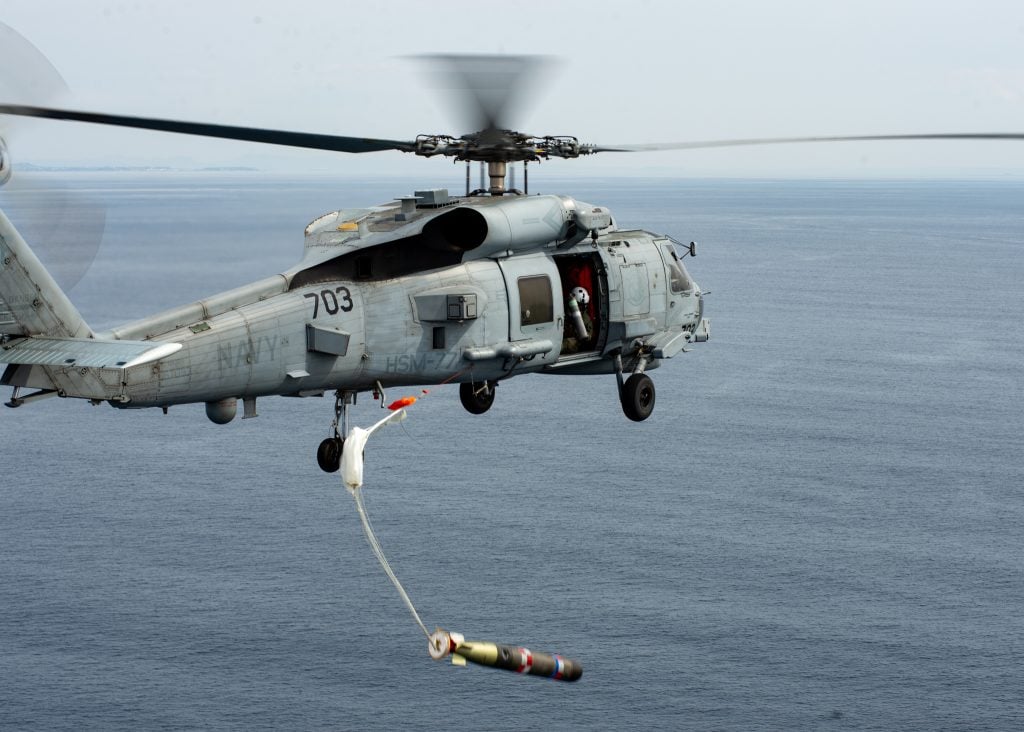
When modern warfare scenarios unfold, the stakes escalates, especially when a warship tracks a submarine lurking beneath the surface. In such critical moments, the MK 54 lightweight torpedo stands out as a highly capable solution designed to neutralize underwater threats with precision.
The MK 54 is a compact, multi-platform anti-submarine weapon engineered for seamless deployment from surface vessels, helicopters, and maritime patrol aircraft. Combining tried-and-tested technologies from previous models like the MK 50 and MK 46, it integrates advanced guidance, propulsion, and warhead systems to create a versatile, cost-effective package adaptable to various maritime environments. Its design allows for rapid upgrades, keeping pace with evolving underwater threats.
With a length of 2.7 meters (8.9 feet) and a diameter of 32.4 centimeters (12.9 inches), the torpedo weighs 276 kilograms (608.5 pounds) and can exceed speeds of 40 knots, covering ranges of approximately 9 kilometers (5.6 miles). Its warhead, weighing 45 kilograms (99.2 pounds), represents a potent threat to adversaries, employing an active and passive acoustic homing guidance system.
The inception of the MK 54 program in the 1990s was driven by the U.S. Navy’s need for a modern torpedo capable of tackling both diesel-electric and nuclear submarines amidst a backdrop of evolving maritime warfare. The initial goal was to merge the high-speed capabilities of the MK 50 with the reliable guidance features of the MK 46, offering an effective solution without overwhelming budget constraints. Raytheon and General Dynamics were key players in its development, conducting extensive tests from various platforms. By the early 2000s, the MK 54 was firmly established as a fundamental asset in anti-submarine warfare.
The torpedo comes in several variants to address differing operational requirements. The baseline MK 54 is designed for standard anti-submarine operations, utilizing active and passive acoustic guidance. Block upgrade variants enhance its technological features, improving signal processing and sonar sensitivity to engage stealthy submarines. There are also training versions equipped with inert or telemetry systems for crew proficiency exercises.
Among its key strengths is its advanced acoustic guidance, enabling the torpedo to track evasive submarine targets effectively. Its agile propulsion facilitates quick course corrections, enhancing engagement success rates. Compatibility with various launching platforms maximizes its operational versatility, making it suitable for deployment in both shallow coastal zones and expansive ocean theaters.
Despite its strengths, the MK 54 has limitations. Its operational range is capped at around 9 kilometers, necessitating precise targeting and execution. The performance can be affected by underwater noise and various countermeasures employed by adversaries. Furthermore, its lightweight design, while advantageous in speed and stealth, restricts the size of its warhead compared to heavier alternatives.
Over the years, the MK 54 has proven to be a crucial element in anti-submarine operations. The U.S. Navy routinely employs it aboard surface ships, MH-60R helicopters, and P-8 Poseidon patrol aircraft for both training exercises and real-world missions. Additionally, many allied navies, including those of Saudi Arabia, Canada, Norway, India, and South Korea, have adopted the torpedo, solidifying its status as a reliable asset in global naval arsenals.
Looking ahead, the MK 54 program aims to continuously evolve, with planned enhancements targeting sonar sensitivity, countermeasures, and integration with advanced platform technologies. Future iterations may include artificial intelligence-assisted targeting, improved acoustic processing, and enhanced data-sharing capabilities. This ongoing innovation ensures that the MK 54 remains a formidable tool against the emerging generation of submarines, securing its place as an essential component of allied naval strategies for decades to come.


