




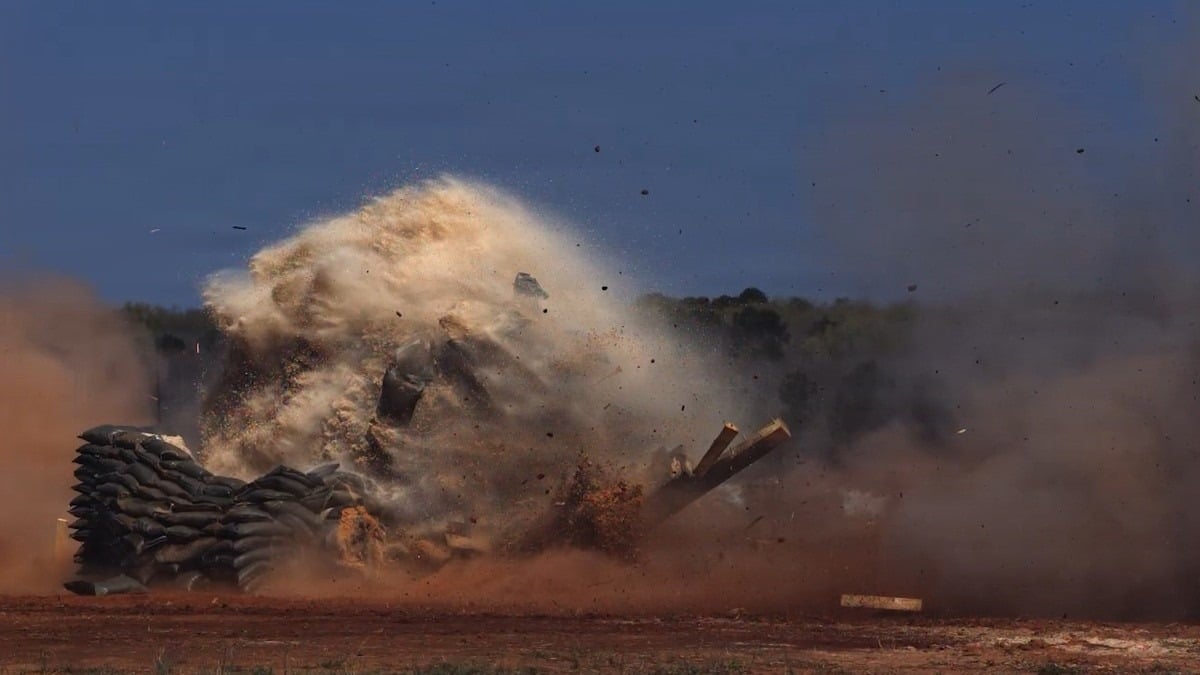
In a groundbreaking demonstration, the US Army has successfully tested a drone-delivered bunker-buster munition known as the Bunker Rupture and Kinetic Explosive Round (BRAKER). This advancement represents a significant leap in the field of drone warfare and illustrates the Army’s commitment to rapid innovation in response to modern battlefield challenges.
The BRAKER project was initiated in direct response to evolving military threats, particularly following the increasing use of drone-dropped munitions since their first deployment by militants in Syria in 2015. The technology has since been applied extensively in the conflict in Ukraine, but BRAKER aims to enhance this capability with improved penetration power.
Development of this advanced munition commenced with an aggressive timeline wherein the project team executed the entire process—from concept to live-fire testing—within a mere two weeks. Project Manager Close Combat Systems, Colonel Vincent Morris, emphasized the team’s swift execution, stating, “BRAKER proves our ability to rapidly develop and safely deliver devastating effects from small unmanned aircraft systems.”
Accompanying the munition’s development is an integration kit and interface mechanism designed to streamline the system for mass production. The goal is to create a robust architecture that can be readily adapted by the defense industry, enhancing operational effectiveness for warfighters.
The initiative has been led by the US Army Combat Capabilities Development Command Armaments Center, which has focused on creating a lightweight, robust warhead suitable for deployment from nimble drones. A notable aspect of this rapid development was the use of additive manufacturing, or 3D printing technology, which played a crucial role in condensing the timeline from design to testing.
Design efforts began in early March, progressing through phases of explosive pressing, housing manufacturing, and the integration of the warhead onto a low-cost, expendable drone platform. Following assembly, compatibility tests were conducted at Picatinny Arsenal, resulting in the production of about a dozen warheads. These were subsequently tested, including a successful trial against a makeshift bunker, culminating in a live demonstration at Redstone Arsenal in Alabama.
Anthony Sebasto, executive director of the Munitions Engineering and Technology Center, credited the swift advancements in lethality to years of technology investments and the technical expertise available within the Armaments Center. Such rapid advancements in munitions technology signal a pivotal shift in how the Army prepares to address future combat scenarios, ensuring that it remains at the forefront of military innovation.


