




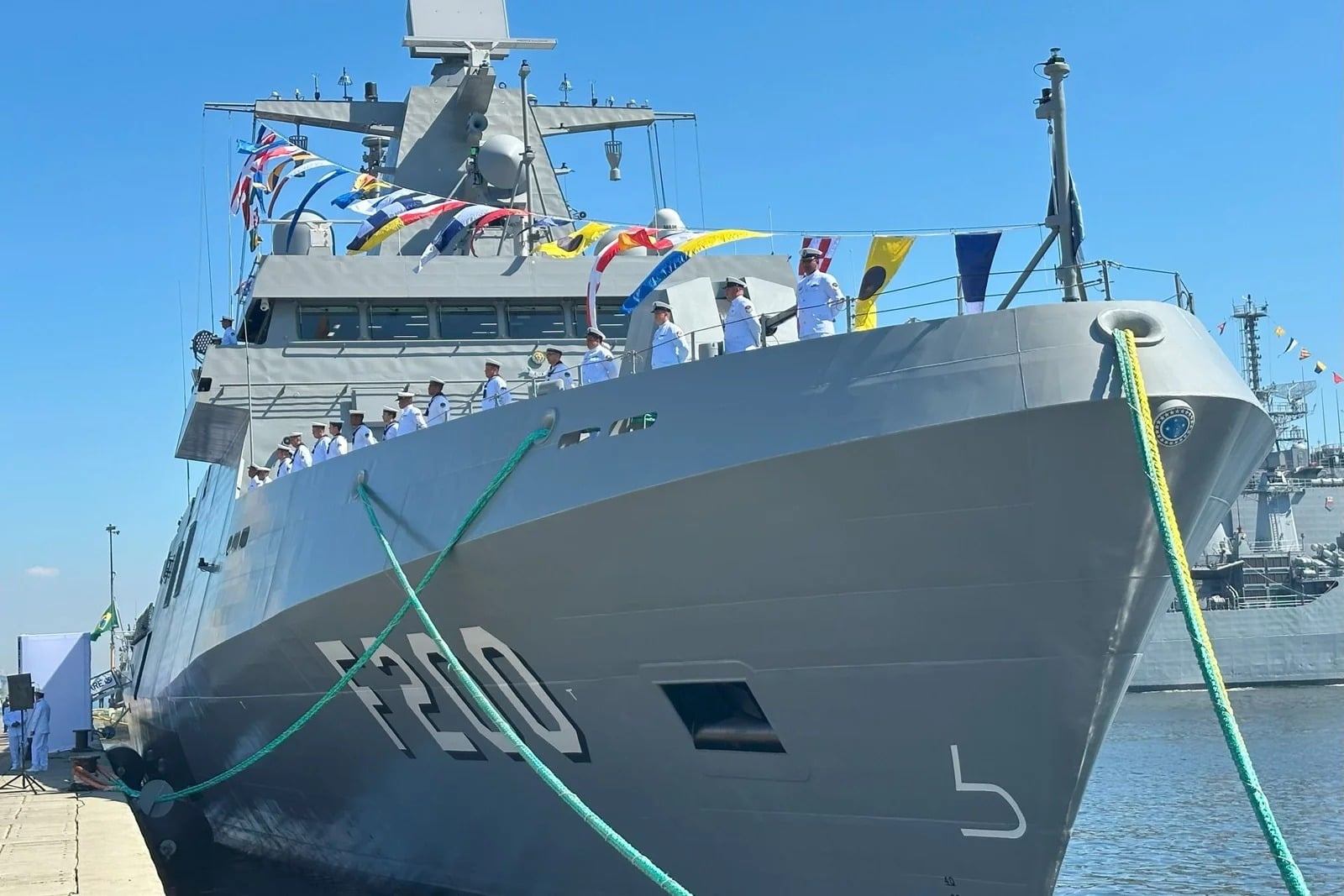
In a significant move to bolster its naval capabilities, Germany and Brazil have formalized an agreement for the procurement of an additional four Tamandaré-class frigates for the Brazilian Navy. This announcement came during Brazilian President Luiz Inácio Lula da Silva’s recent meeting with German Chancellor Friedrich Merz in Hannover, Germany.
The construction of these frigates will be managed by Águas Azuis, a joint venture that includes TKMS, Embraer Defence & Security, and Atech. This consortium is not only responsible for the new additional units but is also tasked with building the initial batch of frigates under the same program. According to President Lula, the first delivery from this procurement is anticipated by the year 2028.
The timing of this announcement follows shortly after the Brazilian Navy officially commissioned the first frigate of the Tamandaré class, the F200, into active service. This step underscores Brazil’s commitment to modernizing its naval forces and enhancing defense capabilities.
The Tamandaré Program, which is spearheaded by the Brazilian Navy and managed by EMGEPRON (Naval Projects Management Company), was initiated in March 2020 with an investment of 9.1 billion Brazilian reals, equivalent to approximately $1.82 billion. The program aims to systematically replace aging frigates including the Niterói-class vessels that have been operational since 1975 and the second-hand Broadsword-class frigates obtained from the UK during the 1990s, as well as the Inhaúma-class corvettes.
The Tamandaré-class frigates represent a Brazilian adaptation of the MEKO A-100 design created by TKMS. Each frigate measures 107 meters (351 feet) in length and has a beam of 16 meters (52 feet), with a full displacement of approximately 3,500 tonnes and accommodation for a crew of around 130 personnel. These vessels are armed with a variety of advanced weaponry, including a 76mm gun, a 30mm close-in weapon system, dual 12.7mm remote-controlled machine guns, anti-ship and surface-to-air missiles, and torpedoes. Additionally, they feature a flight deck suitable for operating medium helicopters or unmanned aerial systems.
As Brazil continues to invest in its naval modernization, this agreement with Germany marks an important step toward enhancing the country’s maritime defense posture and operational readiness in the face of contemporary challenges.


