




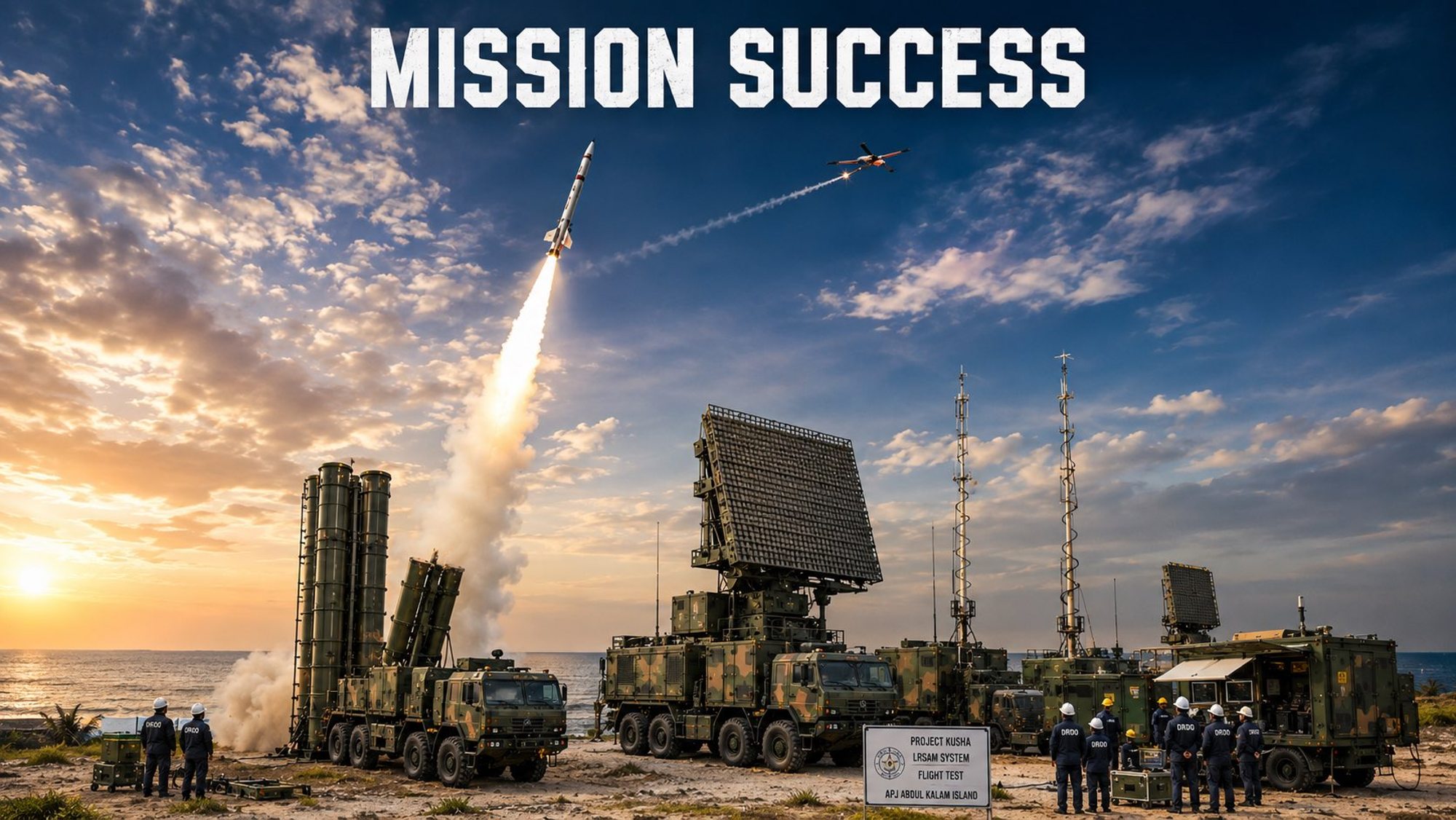
India has taken a significant step towards strengthening its air defence capabilities with the successful development and testing of Project Kusha, an indigenous Long-Range Surface-to-Air Missile (LR-SAM) system being developed by the Defence Research and Development Organisation (DRDO).
Project Kusha: India’s Indigenous Long-Range Air Defence Shield
The project is designed to provide India with a modern, multi-layered air defence network capable of protecting strategic military installations and vital civilian infrastructure from a wide range of aerial threats. The recent successful maiden flight test of the Kusha missile marks a major milestone in the programme’s development.
What is Project Kusha?
Project Kusha is India’s ambitious effort to build a long-range air defence system comparable in role to advanced foreign systems such as Russia’s S-400 Triumf. However, the system has been designed according to India’s own operational requirements and is intended to strengthen the country’s indigenous defence manufacturing capabilities. Unlike simply replicating an imported platform, Project Kusha focuses on developing technologies that can be integrated into India’s broader air defence architecture.
Three-Tier Missile System
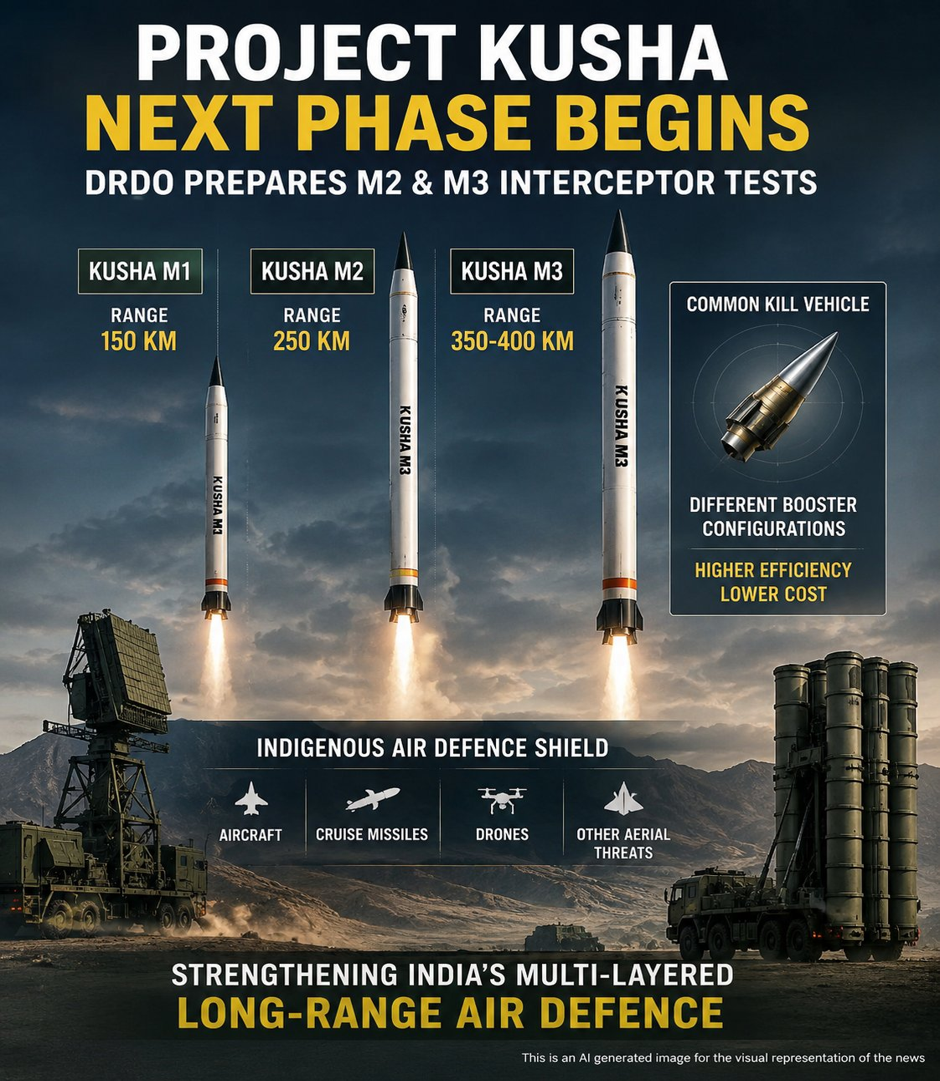
The Kusha programme includes three interceptor missile variants designed to engage threats at different ranges:
- M1: Approximately 150 km interception range
- M2: Approximately 250 km interception range
- M3: Approximately 350 km interception range
Together, these missiles will provide layered protection against multiple aerial threats, allowing the system to intercept hostile targets before they reach critical assets.
Capabilities of Project Kusha
Project Kusha is designed to neutralise a broad range of airborne threats, including:
- Fighter aircraft
- Stealth aircraft
- Cruise missiles
- Unmanned Aerial Vehicles (UAVs)
- Large enemy aircraft
The system integrates advanced radars, command-and-control centres, surveillance sensors, and interceptor missiles, enabling simultaneous tracking and engagement of multiple targets across a large operational area.

Why Project Kusha Is Different from the S-400
Although Project Kusha is often described as India’s indigenous equivalent of the Russian S-400, the two systems are not identical.
The S-400 is capable of engaging both conventional aerial targets and certain categories of ballistic missiles. In contrast, the current version of Project Kusha is primarily designed to counter aircraft, cruise missiles, drones, and similar aerial threats, and is not intended to serve as India’s primary ballistic missile defence system. Ballistic missile interception is instead being addressed through India’s dedicated Ballistic Missile Defence (BMD) programme and the broader Mission Sudarshan Chakra, which aims to build a comprehensive multi-layered national air and missile defence shield.
Role in India’s Air Defence Network
Project Kusha is expected to become a key component of India’s future integrated air defence system. It will complement existing platforms such as the Akash missile system and the imported S-400, creating a layered defence architecture capable of responding to different categories of aerial threats. Such an approach increases survivability by providing overlapping defensive coverage and reducing dependence on any single weapon system.
Strategic Importance
The successful progress of Project Kusha reflects India’s growing capability in indigenous defence technology. Developing a domestic long-range air defence system offers several strategic advantages, including greater control over upgrades, reduced reliance on foreign suppliers, and long-term cost benefits. The project also supports the government’s Aatmanirbhar Bharat initiative by promoting self-reliance in critical defence technologies and strengthening India’s defence industrial base.
Future Outlook
As Project Kusha advances through additional testing and development, it is expected to become one of the pillars of India’s future air defence infrastructure. Working alongside other indigenous missile defence programmes, it will contribute to building a comprehensive security shield capable of protecting the nation from evolving aerial threats. While its present focus is on defeating aircraft, cruise missiles, and drones, it will form an important layer within India’s broader integrated air and missile defence network.
Key Facts for Exams
- Project: Project Kusha
- Developed by: Defence Research and Development Organisation (DRDO)
- Type: Long-Range Surface-to-Air Missile (LR-SAM) System
- Interceptor Variants: M1 (150 km), M2 (250 km), M3 (350 km)
- Designed to Counter: Fighter aircraft, stealth aircraft, cruise missiles, UAVs, and large aerial targets
- Not Primarily Designed For: Ballistic missile interception
- Role: Indigenous layered air defence system supporting India’s broader air defence network
- Significance: Enhances self-reliance, strengthens national air defence, and reduces dependence on imported systems.


