





Colonel Namrata Rathore, VSM, of the Indian Army’s Corps of Engineers, represents a remarkable combination of military leadership, determination and adventure. From growing up near the Indian Military Academy in Dehradun and watching Gentlemen Cadets pass by her school to eventually wearing the uniform herself, her journey is an inspiring example for young Indians aspiring to join the Armed Forces.
One of the defining moments of her military career came in May 2012, when she successfully summited Mount Everest as part of the Indian Army Women Everest Expedition. Then serving as a Captain, Namrata Rathore was among seven women officers who reached the summit of the world’s highest mountain, demonstrating extraordinary physical endurance and, more importantly, mental resilience.
Today, as a Colonel in the Indian Army, she continues to inspire young officers and defence aspirants through her journey, leadership philosophy and message that determination, discipline and self-belief can overcome seemingly impossible challenges.
Early Life and Inspiration to Join the Indian Army
Namrata Rathore was born in September 1986 and hails from Dehradun, Uttarakhand, a city with a deep connection to the Indian Armed Forces.
She grew up with her parents and three sisters and has described her childhood as an amazing experience. However, one aspect of her early years would have a particularly profound influence on the direction of her life.
She studied at Kendriya Vidyalaya located at the Forest Research Institute in Dehradun. The school’s proximity to the prestigious Indian Military Academy exposed her to military life from an early age.
She would regularly see Gentlemen Cadets of the IMA cycling, running and moving around the area during their training. The sight of young men preparing to become officers of the Indian Army left a lasting impression on her.
As a schoolgirl, she would reportedly stop and salute the passing Gentlemen Cadets out of admiration for the uniform and the service they were preparing to render to the country.
Those everyday encounters gradually transformed admiration into ambition.
She wanted to wear the uniform herself.
Commissioned Into the Indian Army in 2007
That childhood dream became a reality on 22 September 2007 when Namrata Rathore was commissioned as an officer into the Indian Army.
The commissioning ceremony was an especially emotional moment for her family as her parents pinned the stars of an Army officer on her shoulders.
For the young girl who had once stood beside the road saluting IMA cadets, she was now beginning her own journey as a commissioned officer.
Colonel Namrata Rathore belongs to the Corps of Engineers, one of the Indian Army’s important combat support arms.
The Corps of Engineers performs crucial roles during both war and peace. Its responsibilities include providing mobility to friendly forces, denying mobility to adversaries, constructing and maintaining operational infrastructure and undertaking engineering tasks in some of the most difficult environments faced by the Army.
Over the course of her career, Colonel Rathore has experienced service in varied and demanding terrains, including the high-altitude regions of Ladakh, the dense forests of the Northeast and the deserts of Rajasthan.
These postings provided challenges very different from the mountains she would eventually conquer, but each contributed to the resilience and leadership qualities that became defining features of her career.
The Road to Mount Everest
The most celebrated chapter of Colonel Namrata Rathore’s early military career began when she became part of the Indian Army Women Everest Expedition in 2012.
Climbing Mount Everest is an enormous undertaking even for experienced mountaineers. At an elevation of approximately 8,848 metres, climbers face freezing temperatures, unpredictable weather, exhaustion, avalanches, crevasses and the severe effects of extremely low oxygen levels.
Above approximately 8,000 metres lies what mountaineers commonly call the “death zone,” where the human body cannot properly acclimatise and begins to deteriorate.
For the Indian Army team, reaching Everest therefore required much more than physical fitness.
The officers underwent months of rigorous preparation and selection designed to test their mountaineering skills, endurance, teamwork and mental strength.
Training included demanding phases in locations such as Manali and the Siachen region, preparing the team for the extreme conditions they would encounter during the expedition.
Indian Army Women Everest Expedition 2012
The 2012 expedition was particularly significant because an Indian Army women’s team was attempting Mount Everest from the traditional South Col route through Nepal.
The expedition was led by then Colonel Ajay Kothiyal and included seven women officers who eventually succeeded in reaching the summit.
The women officers included Major Neha Bhatnagar, Major N. Linyu, Captain Namrata Rathore, Captain Poonam Sangwan, Captain Prachi R. Gole, Captain Deepika Rathore and Captain Smitha L.
The expedition was not simply about reaching the summit. It was also about teamwork, perseverance and the ability to continue functioning under some of the harshest conditions encountered anywhere on Earth.
Weather conditions initially forced the team to turn back during an attempted summit push.
But they did not abandon the mission.
After waiting for another opportunity, the climbers launched their final push towards the summit.
Colonel Namrata Rathore Conquers Mount Everest
On 25 and 26 May 2012, the members of the Indian Army Women Everest Expedition successfully reached the summit of Mount Everest.
Then Captain Namrata Rathore was among the seven women officers who stood on top of the world.
At approximately 8,848 metres above sea level, the achievement represented the culmination of months of preparation, physical hardship and relentless mental determination.
The expedition achieved a remarkable 100 per cent success rate among the women officers, with the team completing its mission without casualties.
For Namrata Rathore, the expedition also reinforced one of the most important lessons of her life: mental strength can become the decisive factor when the body begins to surrender.
During such an extreme climb, physical fitness alone cannot guarantee success. Exhaustion, freezing conditions, reduced oxygen and psychological pressure can force even highly trained climbers to turn around.
Her Everest experience demonstrated the importance of continuing to move towards the objective even when every physical instinct tells the body to stop.
It was a lesson that extended far beyond mountaineering and reflected the qualities expected from a military leader.
Awarded the Vishisht Seva Medal
Colonel Namrata Rathore’s exceptional achievement received national recognition.
For her role in the successful Mount Everest expedition, she was awarded the Vishisht Seva Medal in 2013.
The Vishisht Seva Medal is a distinguished service decoration awarded to members of the Indian Armed Forces for distinguished service of a high order.
Receiving the VSM added another significant milestone to a journey that had begun with a schoolgirl’s fascination with the Indian Army.
Her accomplishments subsequently received recognition through other platforms as well.
She received the Yashaswani Award in 2018, presented by then Defence Minister Nirmala Sitharaman, and the Women Jewel of India Award in 2021.
Beyond Mountaineering
Colonel Rathore’s interests and accomplishments have not been restricted to mountaineering.
She has also represented the Army in competitive sailing and participated in Laser Radial Asian Games trials and national-level competitions in 2014.
Her involvement in different adventure and sporting activities reflects the broader military culture of developing officers who are physically capable, mentally adaptable and willing to continuously test themselves outside their comfort zones.
At the same time, her principal identity has remained that of a professional Army officer responsible for leading troops and fulfilling operational and administrative responsibilities.
Leadership Is About Trust, Not Gender
One of the most important aspects of Colonel Namrata Rathore’s journey is her perspective on leadership.
She has consistently emphasised that leadership in the Army should not be viewed primarily through the lens of gender.
For soldiers, what ultimately matters is whether their officer possesses the competence, confidence and courage required to lead them in difficult circumstances.
Trust has to be earned.
An officer must therefore lead through personal example and demonstrate the same standards of discipline, physical fitness and professional commitment expected from the troops.
This becomes especially important in field areas and operational environments where decisions can have serious consequences.
For Colonel Rathore, leadership also involves taking care of the soldiers under one’s command and remaining conscious of the welfare of their families.
The relationship between officers and troops extends beyond routine administration. Particularly during difficult deployments, mutual trust becomes one of the foundations upon which an effective military unit operates.
Her Message to Women Aspiring to Join the Indian Army
Colonel Namrata Rathore’s career also carries particular significance for young women aspiring to become officers in the Indian Armed Forces.
Women officers have steadily expanded their presence across the Indian Army since their induction began in the early 1990s. Over the years, opportunities for women have grown substantially, including permanent commission in several branches and increasing avenues for command and operational responsibilities.
Colonel Rathore’s journey demonstrates what those opportunities can mean in practice.
She joined the Army, served across challenging terrains, commanded and worked alongside troops, represented the organisation in sporting activities and stood on the summit of the world’s highest mountain.
Her message to young women has remained centred on focus, discipline and refusing to impose artificial limitations on their ambitions.
“There is no limit in the world that can hold you back from achieving your dreams,” she has said, encouraging young aspirants to remain focused, dedicated and disciplined until they achieve their aim.
Inspiring the Next Generation at OTA Gaya
Nearly fourteen years after her historic Everest expedition, Colonel Namrata Rathore continues to pass the lessons of that experience to the next generation of military leaders.
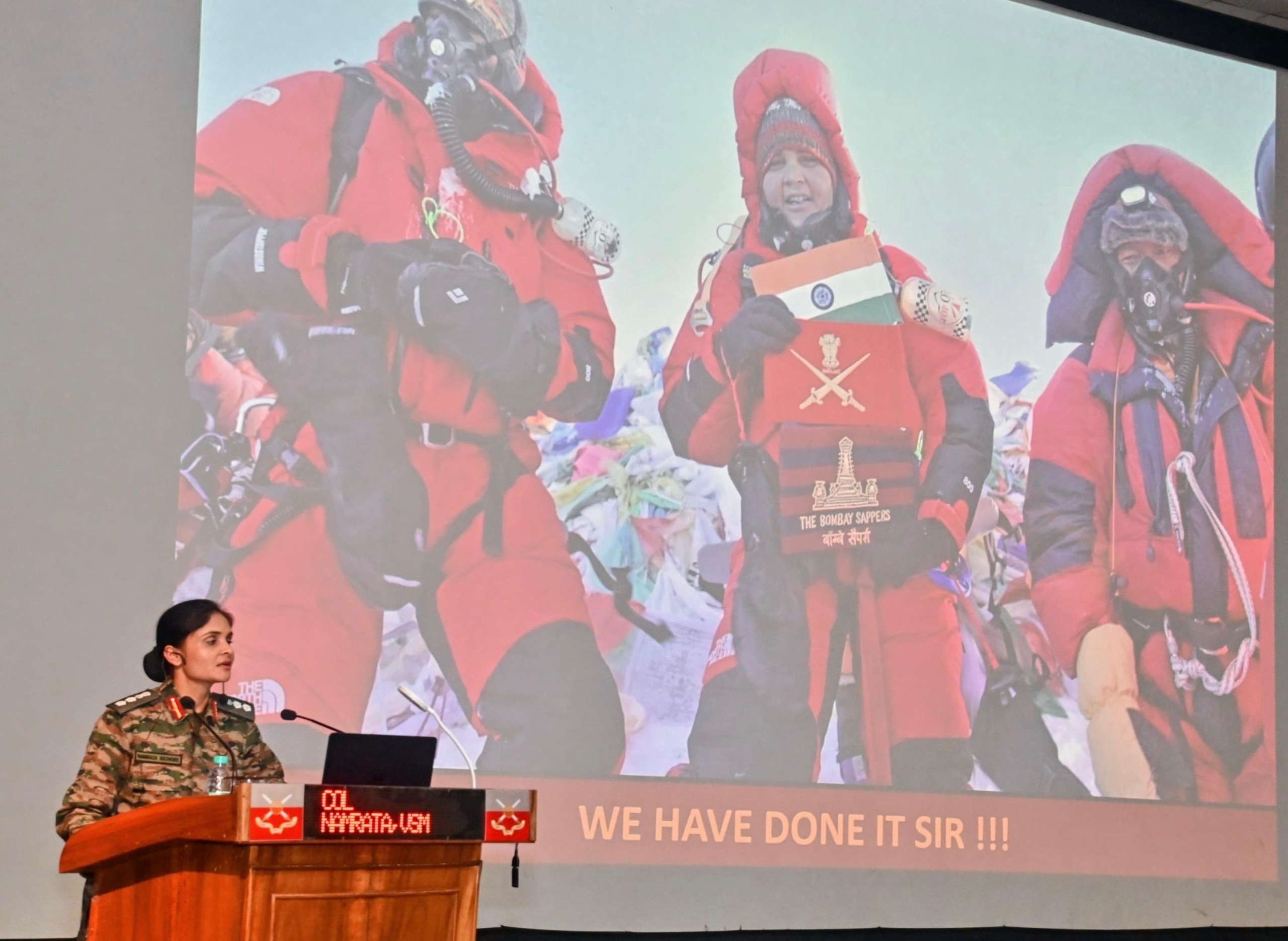
On 12 August 2026, she delivered a motivational guest lecture at the Officers Training Academy, Gaya.
Addressing future officers, Colonel Rathore shared experiences from the 2012 Mount Everest expedition and spoke about leadership, motivation and willpower while operating under extreme conditions.
The interaction provided cadets with lessons extending far beyond mountaineering.
Whether climbing towards the summit of Everest or leading soldiers during military operations, an individual inevitably encounters moments of exhaustion, uncertainty and adversity. It is during those moments that mental resilience, preparation and confidence become crucial.
Her interaction with young military trainees therefore carried a powerful message: officers must develop the ability to remain focused on their mission despite hardship and uncertainty.
Lessons for SSB and Defence Aspirants
Colonel Namrata Rathore’s journey offers several important lessons for NDA, CDS, AFCAT, NCC Special Entry, SSC Tech and other defence aspirants preparing to face the Services Selection Board.
The first is the importance of having a clear goal.
Her ambition to join the Indian Army developed at a young age, but simply wanting to wear the uniform was not enough. That ambition had to be converted into preparation, discipline and sustained effort.
The second lesson is mental resilience.
SSB aspirants often concentrate heavily on physical fitness, academics and practising different testing procedures. While these areas matter, the Armed Forces ultimately look for individuals capable of remaining effective when confronted with pressure, uncertainty and setbacks.
The Everest expedition provides an extreme example of exactly that quality.
Another important lesson is leadership through example.
An effective leader does not simply issue instructions. The leader demonstrates the standards expected from the team and earns the confidence of those around them through consistent actions.
Finally, Colonel Rathore’s journey highlights the importance of perseverance.
The road to any major achievement is rarely straightforward. The Everest team itself had to contend with difficult weather and an unsuccessful initial summit attempt before getting another opportunity.
They continued.
And eventually, they stood on the summit.
From Saluting IMA Cadets to Standing on Top of the World
There is a powerful symmetry to Colonel Namrata Rathore’s story.
As a young student in Dehradun, she would watch Gentlemen Cadets of the Indian Military Academy and salute them as they passed.
Years later, she earned the stars of an Indian Army officer herself.
Then came the deserts, forests and mountains of military service.
And eventually came Everest.
The schoolgirl who once looked at military officers with admiration became an officer capable of inspiring another generation.
Today, Colonel Namrata Rathore, VSM, stands as an example of what determination backed by disciplined action can accomplish.
Her story is not merely about conquering Mount Everest. It is about conquering doubt, physical exhaustion and the limitations individuals sometimes place upon themselves.
For every young defence aspirant dreaming of wearing the uniform, her journey carries a simple but powerful message: set your objective, prepare relentlessly, remain disciplined and keep moving forward when the path becomes difficult.
Sometimes the summit may seem impossibly far away.
But Colonel Namrata Rathore’s journey shows just how far determination can take you.


