




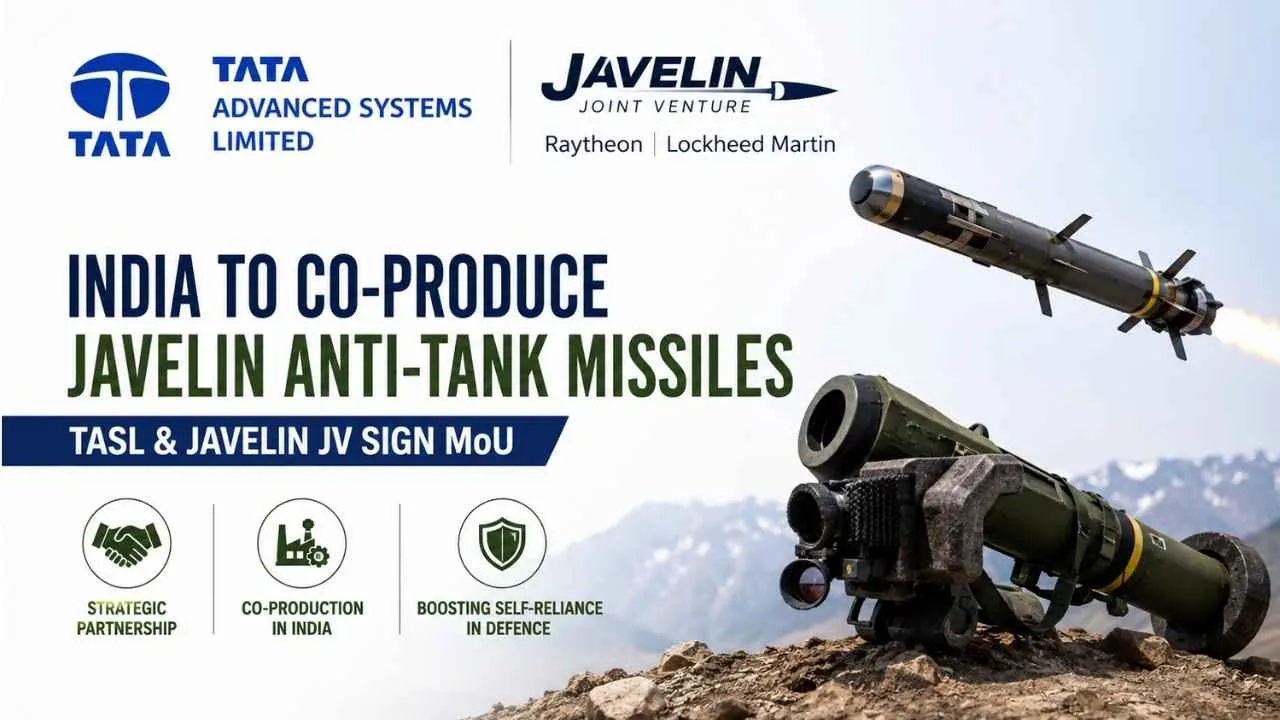
India is set to take an important step towards strengthening its domestic defence manufacturing ecosystem as Tata Advanced Systems Limited (TASL) partners with the US-based Javelin Joint Venture (JJV) to explore local assembly and component production of the Javelin anti-tank missile system.
US Javelin Missiles To Be Made In India With Tata
Under the agreement, the Javelin Joint Venture will work with Tata Advanced Systems to explore establishing a final assembly and integration facility in India for the Javelin All-Up Round (AUR), along with capabilities for producing certain components.
The proposed arrangement is significant because it could gradually expand India’s role in the Javelin supply chain rather than limiting the country to importing completed missile systems.
However, the initial arrangement does not mean that every component will immediately be manufactured in India. According to the report, sub-assembly kits and Guidance Electronic Units (GEUs) will initially be manufactured in the United States and shipped to India for assembly and integration.
Tata Advanced Systems’ Role
Tata Advanced Systems is expected to become an important industrial partner in the proposed localisation of the Javelin system.
The partnership could help India develop expertise in:
- Missile assembly and integration
- Advanced defence manufacturing
- Guidance-related systems integration
- Aerospace and defence component production
- Global defence supply-chain management
The arrangement is also aligned with India’s broader Aatmanirbhar Bharat objective of increasing domestic capabilities in strategically important defence technologies.
According to Tata Advanced Systems’ leadership, the partnership can bring specialised assembly expertise and knowledge transfer into India’s defence industrial ecosystem while improving self-reliance and operational readiness.
What is the Javelin Missile?
The Javelin is a man-portable, fire-and-forget, medium-range anti-tank guided missile system. It was developed by the Javelin Joint Venture involving RTX and Lockheed Martin.
The system entered US military service in 1996 and is designed primarily to engage armoured targets. It is used by the US Army and US Marine Corps and has also been supplied to several international users.
Key Features
Man-portable:
The system can be carried and operated by soldiers, giving infantry units greater flexibility against armoured threats.
Fire-and-forget:
Once the missile has been launched and its target acquired, the operator does not have to continue guiding the missile throughout its flight. This allows personnel to move away from the firing position.
Infrared guidance:
The Javelin uses an infrared guidance system to track its target after launch.
Dual attack modes:
The missile can use a direct-flight mode against certain targets and a top-attack mode, in which it approaches an armoured vehicle from above. The latter exploits the comparatively vulnerable upper surfaces of many tanks.
Why is Local Production Important for India?
The proposed localisation of Javelin production has significance beyond simply acquiring another weapon system.
1. Strengthening Aatmanirbhar Bharat
Local assembly and component manufacturing can contribute to India’s goal of developing a stronger domestic defence manufacturing base.
2. Faster Availability
A domestic assembly capability could potentially help create a more dependable supply chain and improve access to the system for India’s armed forces.
3. Technology and Skill Development
The partnership is expected to provide Indian industry with experience in advanced missile-system assembly and integration.
4. Defence Supply-Chain Development
Greater participation by Indian industry could encourage the development of a broader network of suppliers and technology partners.
5. Indo-US Defence Cooperation
The agreement further deepens defence-industrial cooperation between India and the United States, particularly in advanced weapons and manufacturing.
India’s Javelin Procurement
The development follows India’s decision to acquire the Javelin anti-tank missile system through the US Foreign Military Sales (FMS) process.
The Indian Army signed a Letter of Offer and Acceptance (LOA) for the procurement. The US government described the agreement as an important development in the defence relationship between the two countries.
The Javelin procurement had been under discussion for several years, with the acquisition process dating back to 2010 before finally progressing to the current agreement.
Javelin Joint Venture
The Javelin Joint Venture is operated by RTX and Lockheed Martin. Together, the companies have produced more than 55,000 Javelin missiles and over 12,000 reusable launch units, according to the companies cited by The Indian Express.
The partnership with Tata could therefore connect India’s defence industry with an established global production network.
Strategic Significance
The proposed India-based assembly and production capabilities come at a time when India is increasingly seeking to combine foreign defence technology partnerships with domestic manufacturing.
The Javelin arrangement could provide benefits in three interconnected areas:
Defence capability + Industrial development + Strategic partnership
It also has a wider Indo-Pacific dimension. Localised production in India could contribute to more resilient regional supply chains and potentially support the availability of the system for the US and partner countries in the region.
Conclusion
The Tata Advanced Systems–Javelin Joint Venture agreement represents a significant development in India-US defence-industrial cooperation. While the initial plan involves assembling and integrating US-produced sub-assemblies and guidance electronic units in India, it also opens the possibility of developing broader component-production capabilities within the country.
For India, the partnership could mean greater domestic manufacturing expertise, stronger defence supply chains, skilled employment and improved self-reliance. For the United States and its partners, India could become an important additional manufacturing and supply-chain base for the Javelin system.


