The Indian Air Force (IAF) flies a mix of Russian, French, Anglo-French and Indian-designed fighter aircraft. For candidates preparing for the National Defence Academy (NDA), Combined Defence Services (CDS) examination, Air Force Common Admission Test (AFCAT) and the Services Selection Board (SSB) interview, the combat fleet is a regular topic in current affairs and general knowledge.
As of late 2026, the IAF’s fighter strength stands at 29 squadrons, against a much higher sanctioned figure of 42. That gap widened after the last MiG-21s were retired on 26 September 2025. The current operational fighter types are the Su-30MKI, Rafale, Tejas Mk1, Mirage 2000, MiG-29 and Jaguar. The improved Tejas Mk1A has been ordered in large numbers but, as of November 2026, has not yet been handed over to the IAF.
This article explains ten fighter aircraft used by the Indian Air Force: the six types in service today, the Tejas Mk1A that is next in line for induction, and three historically important types that have already left operational service.
1. Sukhoi Su-30MKI
Origin: Russia (Sukhoi), licence-built in India by Hindustan Aeronautics Limited (HAL)
Role: Heavy air-superiority and multirole fighter
Status (late 2026): Backbone of the IAF fighter fleet; additional aircraft on order from HAL
The Su-30MKI is a twin-engine, two-seat, long-range fighter and the mainstay of the Indian Air Force. The type entered squadron service in 2002. Most of the fleet has been built under licence at HAL’s Nashik facility. It is a heavy, canard-equipped aircraft with thrust-vectoring engines, a long combat radius and the ability to carry a wide mix of air-to-air and air-to-surface weapons, including the air-launched BrahMos supersonic cruise missile.
By numbers, it is by far the IAF’s largest fighter type, with well over 250 aircraft in service. In December 2024 the Ministry of Defence signed a contract with HAL for 12 additional Su-30MKIs, largely to replace aircraft lost to accidents. A mid-life upgrade, often called the Super Sukhoi programme, is intended to modernise the radar and avionics, but it is not yet a completed fleet-wide change.
2. Dassault Rafale
Origin: France (Dassault Aviation)
Role: Twin-engine omnirole fighter
Status (late 2026): In service; 36 aircraft contracted in 2016; 114 more approved in principle
The Rafale is the most modern fighter in IAF service. India signed a contract for 36 aircraft on 23 September 2016, after an earlier competition for a larger medium-fighter order did not reach a final deal. The first Rafales landed at Ambala on 29 July 2020. They equip No. 17 Squadron, the Golden Arrows, at Ambala in Haryana, and No. 101 Squadron, the Falcons, at Hasimara in West Bengal. The fleet includes single-seat Rafale EH and two-seat Rafale DH aircraft.
The Rafale is a twin-engine, canard-delta fighter fitted with the RBE2 AESA radar and the SPECTRA electronic warfare suite. Its Indian weapons package includes the Meteor beyond-visual-range missile, MICA, the SCALP cruise missile and HAMMER precision-guided munitions. In February 2026 the Defence Acquisition Council approved 114 additional Rafales; that follow-on order had not been inducted as of late 2026. The 26 Rafale Marine aircraft for the Indian Navy are a separate programme and should not be confused with the IAF fleet.
3. HAL Tejas Mk1
Origin: India (Aeronautical Development Agency and HAL)
Role: Light multirole fighter
Status (late 2026): In squadron service; original Mk1 order completed
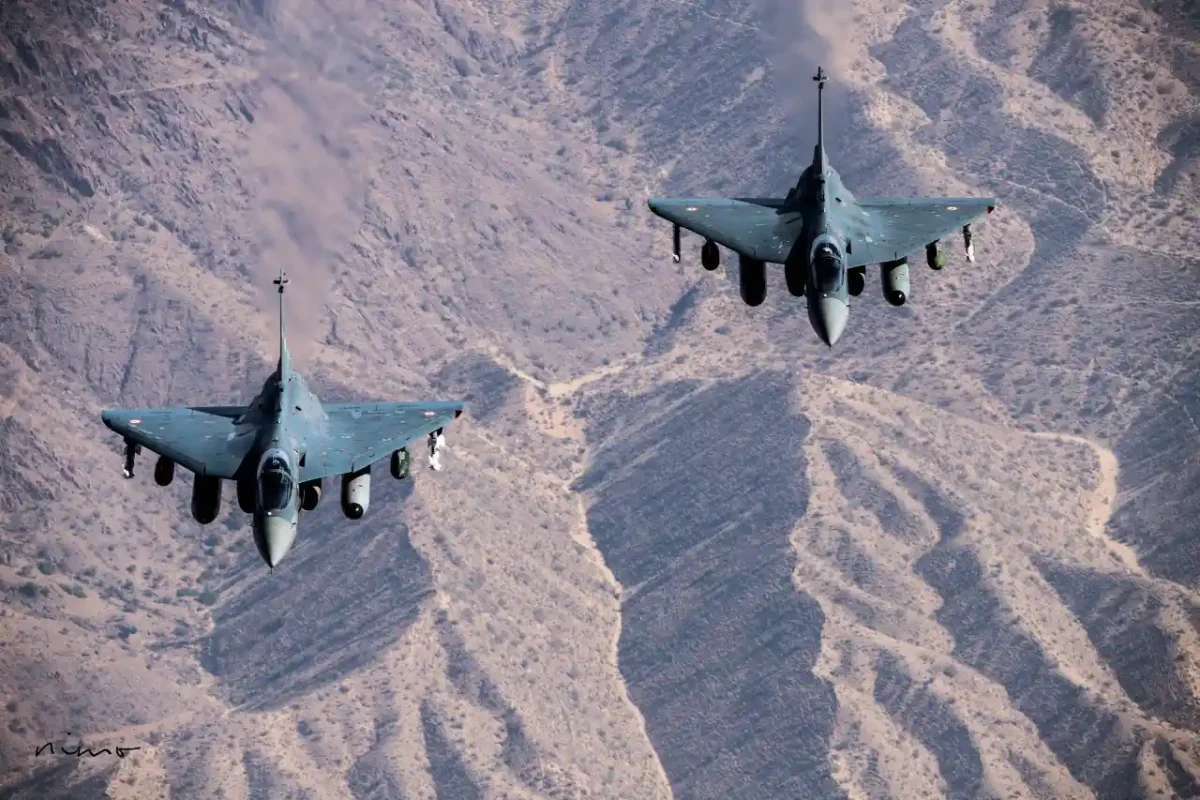
The Tejas is India’s indigenous Light Combat Aircraft, a single-engine, tailless compound-delta fighter designed by the Aeronautical Development Agency and built by HAL. It is powered by the General Electric F404 engine and uses a digital fly-by-wire control system and a high share of composite materials. The Tejas Mk1 entered IAF squadron service in 2016 with No. 45 Squadron, the Flying Daggers, at Sulur in Tamil Nadu. A second unit, No. 18 Squadron, the Flying Bullets, also operates the type.
The original Mk1 contract covered 40 aircraft, including trainers, and HAL completed that order in 2026 when the final twin-seat trainers were handed over. The Mk1 can carry the Astra beyond-visual-range missile and precision-guided air-to-ground weapons, and it is capable of air-to-air refuelling. It is a light fighter in modest numbers, but it is the first Indian-designed combat aircraft in regular IAF front-line service, and the foundation for the Mk1A.
4. HAL Tejas Mk1A
Origin: India (ADA and HAL)
Role: Improved light multirole fighter
Status (late 2026): 180 aircraft on order; not yet delivered to the IAF
The Tejas Mk1A is the improved production standard of the Light Combat Aircraft and is central to the IAF’s plan to recover fighter-squadron strength after the retirement of the MiG-21. It is intended to introduce an AESA radar, a modern electronic warfare suite and improved weapons integration, including the Astra beyond-visual-range missile, compared with the earlier Mk1.
The Ministry of Defence ordered 83 Tejas Mk1A aircraft in February 2021, with deliveries originally due to begin in February 2024. A second contract for 97 more was signed in September 2025, taking the total to 180. As of November 2026, no Mk1A had been formally handed over to the IAF. HAL has built a substantial number of airframes, but deliveries have been held up by late GE F404-IN20 engines and by remaining radar, weapons and software certification. Air Chief Marshal A. P. Singh said in October 2026 that the delay would hurt the IAF. Until the aircraft are accepted, they remain on order, not in operational service.
5. Dassault Mirage 2000 (Vajra)
Origin: France (Dassault Aviation)
Role: Single-engine multirole fighter
Status (late 2026): In service, upgraded to the Mirage 2000I/TI standard
The Mirage 2000, known in IAF service as Vajra, is a single-engine, delta-wing fourth-generation fighter inducted in the mid-1980s. It has long been valued for precision strike as well as air defence. During the Kargil conflict of 1999, IAF Mirage 2000s were used to deliver laser-guided bombs against high-altitude targets. In 2019, upgraded Mirage 2000s were used in the Balakot air strike, carrying Spice 2000 precision-guided munitions.
The fleet has been modernised to the Mirage 2000I and 2000TI (trainer) standard, with updated cockpits, mission computers and radar, and can employ missiles such as MICA. The type is associated with squadrons including No. 1 Squadron (Tigers) and No. 7 Squadron (Battleaxes). Like the MiG-29 and Jaguar, it is an older platform that the IAF plans to replace as newer aircraft arrive, but it remains in the current inventory.
6. Mikoyan MiG-29 UPG (Baaz)
Origin: Soviet Union / Russia (Mikoyan); upgraded in Indian service
Role: Air-superiority fighter, later given a broader multirole capability
Status (late 2026): In service in the upgraded UPG standard
The MiG-29, known in the IAF as Baaz, was inducted in the mid-1980s as a dedicated air-superiority fighter. It is a twin-engine, high-agility aircraft that has since been upgraded to the MiG-29UPG standard, with improved radar, engines, avionics and a distinctive dorsal ‘hump’ that increases internal fuel. The upgrade has also widened the aircraft’s weapons options, including beyond-visual-range air-to-air missiles.
IAF MiG-29 units have included No. 28 Squadron, the First Supersonics, at Adampur. The type should not be confused with the Indian Navy’s carrier-borne MiG-29K, which is a different variant operated from aircraft carriers and is not part of the IAF inventory. The upgraded IAF MiG-29 remains in operational service in late 2026, though it is among the legacy types expected to be withdrawn later as newer aircraft are inducted.
7. SEPECAT Jaguar (Shamsher)
Origin: United Kingdom and France (SEPECAT); many later built or upgraded by HAL
Role: Deep-penetration strike and ground-attack aircraft
Status (late 2026): In service; the IAF is now the principal remaining operator of the type
The Jaguar, known in IAF service as Shamsher, is a twin-engine strike aircraft inducted from 1979. It was designed for low-level, deep-penetration attack rather than as a pure air-superiority fighter, and it has been a mainstay of the IAF’s ground-attack force for more than four decades. Indian Jaguars have been built and extensively upgraded domestically. The principal variants in IAF use are the Jaguar IS for ground attack, the Jaguar IM for maritime strike, and the Jaguar IB trainer.
Successive DARIN avionics upgrades have kept the Jaguar in front-line use with modern displays, navigation and precision-weapon capability. It is nonetheless one of the older types still flying, and it is expected to be phased out later in the decade as replacements arrive. Until then it remains the IAF’s principal conventional deep-strike aircraft.
8. Mikoyan-Gurevich MiG-21 (Retired)
Origin: Soviet Union; later variants built and upgraded in India by HAL
Role: Supersonic interceptor, later a point-defence and multirole fighter
Status: Retired from IAF service on 26 September 2025
The MiG-21 was the Indian Air Force’s first supersonic fighter and, for many years, the backbone of the combat fleet. It was inducted in 1963 with No. 28 Squadron, the First Supersonics, at Chandigarh. Over more than six decades the IAF operated a succession of variants, of which the upgraded MiG-21 Bison was the last in service. HAL’s work on production and upgrades kept later aircraft relevant long after the earliest 1960s jets had been withdrawn.
The MiG-21 fought in the 1965 and 1971 wars, but it also became controversial because of a high accident rate in later years. The last operational unit was No. 23 Squadron, the Panthers. After final flights from Nal in Rajasthan, a formal decommissioning ceremony was held at Chandigarh on 26 September 2025, attended by Raksha Mantri Rajnath Singh. The retirement closed a 62-year chapter and left the IAF with 29 fighter squadrons. The MiG-21 is no longer part of the current inventory.
9. Mikoyan MiG-27 (Bahadur) (Retired)
Origin: Soviet Union; many built under licence by HAL at Nashik
Role: Variable-geometry ground-attack fighter
Status: Retired from IAF service on 27 December 2019
The MiG-27, known in IAF service as Bahadur, was a swing-wing strike aircraft derived from the MiG-23 family and optimised for low-level ground attack. HAL built a large number under licence at Nashik. Compared with the interceptor-oriented MiG-23, the MiG-27 had a sloping nose for better forward view, a stronger undercarriage for rough-field operations, and a navigation-attack system designed for the strike role. A portion of the fleet was later upgraded by HAL to the MiG-27ML UPG standard.
The last IAF unit to fly the type was No. 29 Squadron, the Scorpions. The final sortie and phasing-out ceremony were held at Air Force Station Jodhpur on 27 December 2019. It was also the last variable-geometry combat aircraft in the IAF, the related MiG-23 having already been retired.
10. Mikoyan-Gurevich MiG-25 (Retired)
Origin: Soviet Union
Role: High-altitude reconnaissance and interceptor
Status: Retired from IAF service in May 2006
The MiG-25, known internationally as the Foxbat, was one of the most distinctive aircraft ever used by the Indian Air Force. A small number were inducted in the early 1980s and operated by No. 102 Squadron, the Trisonics. The aircraft was designed to fly at very high altitude and at speeds in the region of Mach 3, which made it a strategic reconnaissance and interceptor platform rather than a typical dogfighter.
Its high-altitude performance made it a frequent question in defence examinations. The IAF retired the MiG-25 in May 2006. It is included here as a historic type, not a current one. The related swing-wing MiG-23 was retired in 2007 (MiG-23MF) and on 6 March 2009 (MiG-23BN).
Conclusion
As of late 2026, the Indian Air Force’s operational fighter force is built around the Su-30MKI, with the Rafale as its most capable modern type, the Tejas Mk1 as the indigenous light fighter already in squadron service, and the Mirage 2000, MiG-29 and Jaguar still flying in upgraded form. The Tejas Mk1A, of which 180 aircraft are on order, is the most important induction still awaited. The MiG-21, retired on 26 September 2025, is no longer in the inventory.
Older types such as the Jaguar, MiG-29 and Mirage 2000 are expected to give way eventually to additional Tejas aircraft, further Rafales if the 114-aircraft approval leads to deliveries, more Su-30MKIs, and later indigenous designs such as the Tejas Mk2 and the Advanced Medium Combat Aircraft (AMCA). Those future types are not yet in operational service. For NDA, CDS, AFCAT and SSB preparation, the safest approach is to know which types are flying now, which are only on order, and which have already been retired.
Frequently Asked Questions
1. How many fighter aircraft types does the IAF currently operate?
As of late 2026, the IAF’s operational fighter types are the Su-30MKI, Rafale, Tejas Mk1, Mirage 2000, MiG-29 and Jaguar. That is six types in service. The Tejas Mk1A is on order but had not been delivered by November 2026. The MiG-21 is retired.
2. Has the IAF retired the MiG-21?
Yes. The last MiG-21s were formally decommissioned at Chandigarh on 26 September 2025, after more than 62 years in IAF service. The final operational unit was No. 23 Squadron, the Panthers. The type is no longer part of the current inventory.
3. What is the difference between Tejas Mk1 and Tejas Mk1A?
The Tejas Mk1 is the earlier standard already in IAF squadron service, mainly at Sulur. The Mk1A is an improved variant with an AESA radar, a modern electronic warfare suite and better weapons integration. India has ordered 180 Mk1A aircraft, but as of November 2026 none had been handed over to the IAF.
4. Which is the most advanced fighter in the IAF today?
The Dassault Rafale is generally regarded as the IAF’s most capable fighter now in service, because of its AESA radar, SPECTRA electronic warfare suite and weapons such as the Meteor and SCALP missiles. The Su-30MKI remains the numerical backbone of the fleet. The Tejas Mk1A is intended to strengthen the indigenous light-fighter force once deliveries begin.
5. Are the Navy’s MiG-29K and Rafale Marine part of the IAF fleet?
No. The MiG-29K and the 26 Rafale Marine aircraft on order are Indian Navy programmes for aircraft-carrier operations. The IAF operates land-based MiG-29UPG and Rafale EH/DH aircraft, which are different variants.
6. How many fighter squadrons does the IAF have in 2026?
The IAF has 29 fighter squadrons as of late 2026, after the MiG-21 retirement, against a sanctioned strength of 42. Filling that gap depends largely on Tejas Mk1A deliveries, additional Su-30MKIs, and any follow-on Rafale induction.