
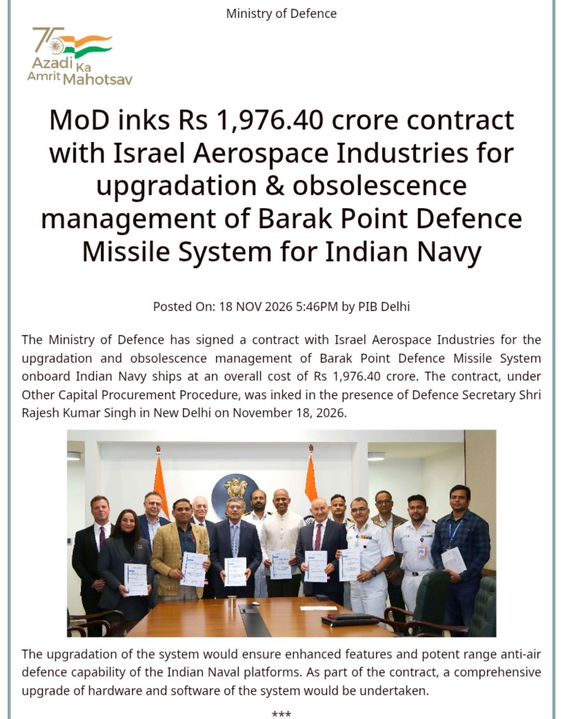
On 18 November 2026, the Ministry of Defence (MoD) signed a contract worth ₹1,976.40 crore with Israel Aerospace Industries (IAI) for the upgradation and obsolescence management of the Barak Point Defence Missile System deployed on Indian Navy warships.
Ministry of Defence Signs ₹1976.40 Crore Contract With Israel For Barak Missile System Upgrade
On 18 November 2026, the Ministry of Defence (MoD) signed a contract worth ₹1,976.40 crore with Israel Aerospace Industries (IAI) for the upgradation and obsolescence management of the Barak Point Defence Missile System deployed on Indian Navy warships.
The agreement, valued at approximately US$211.48 million, covers comprehensive hardware and software upgrades to improve the system’s serviceability and operational readiness. The contract was signed in New Delhi under the Other Capital Procurement Procedure.
What is the Barak Missile System?
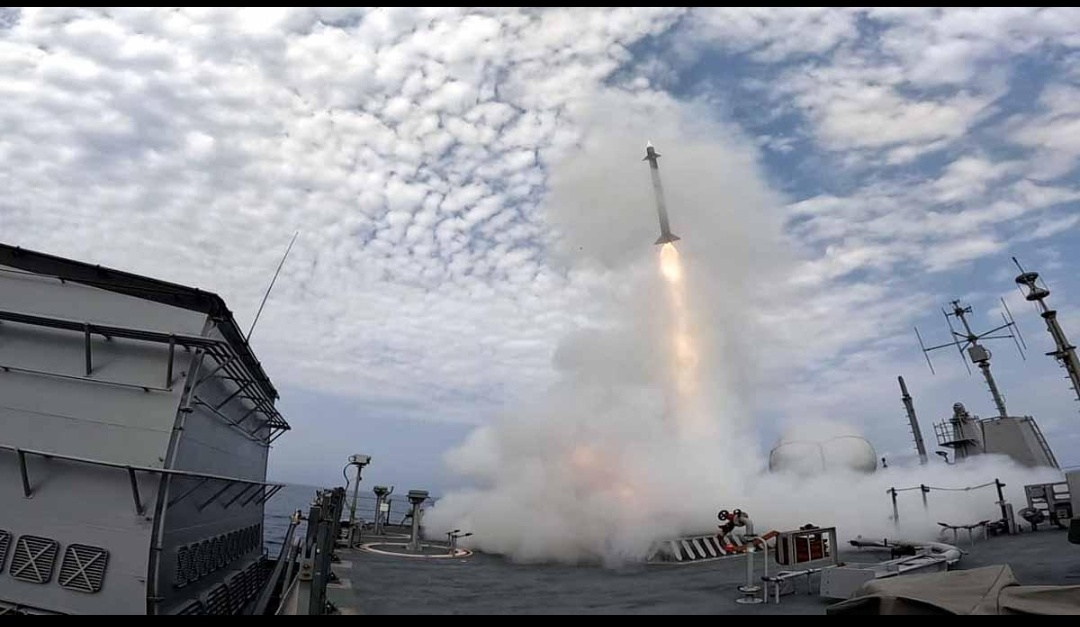
The Barak missile system is a family of surface-to-air missile (SAM) systems developed by Israel. These missiles are designed to intercept aerial threats, including enemy aircraft and incoming missiles.
The Indian Navy operates the Barak Point Defence Missile System to provide close-range protection to its warships against aerial attacks.
A complete naval missile defence system consists of several interconnected components:
- Radar and Sensors: Detect and track incoming aerial threats.
- Combat Management System: Processes information and helps determine the appropriate response.
- Fire-Control System: Supports target engagement and missile-launch decisions.
- Missile Launcher: Launches the interceptor missile.
- Interceptor Missile: Engages and destroys the incoming threat.
The effectiveness of the system depends on the proper functioning and integration of all these components.
What is Point Defence?
Point defence refers to the protection of a specific military asset or installation against incoming threats.
In naval warfare, it provides a protective shield around an individual warship, particularly against threats approaching at close range.
It is different from area defence, which provides protection over a wider geographical zone and can help safeguard multiple ships or strategic assets.
Modern naval forces generally employ a layered air-defence system, combining short-range point-defence weapons with medium- and long-range missile systems.
Difference Between Barak Point Defence, Barak-8 and MR-SAM
Although these systems belong to the broader Barak missile family, they perform different operational roles.
| Missile System | Platform and Role |
|---|---|
| Barak Point Defence | Ship-based, close-range air-defence system |
| Barak-8 / LR-SAM | Naval long-range surface-to-air missile system |
| MR-SAM | Land-based medium-range surface-to-air missile system |
Barak-8 Programme:
India’s Defence Research and Development Organisation (DRDO) and Israel Aerospace Industries (IAI) jointly developed the Barak-8 missile system.
Its two major variants are:
- LR-SAM (Long Range Surface-to-Air Missile): Designed for naval platforms to intercept aerial threats.
- MR-SAM (Medium Range Surface-to-Air Missile): Designed for land-based air-defence applications.
In January 2019, the Indian Navy successfully test-fired the ship-launched LR-SAM from INS Chennai.
Key Details of the November 2026 Defence Contract
| Parameter | Details |
|---|---|
| Contract value | ₹1,976.40 crore |
| Approximate US dollar value | US$211.48 million |
| Signing date | 18 November 2026 |
| Signing location | New Delhi |
| Indian authority | Ministry of Defence |
| Foreign partner | Israel Aerospace Industries (IAI) |
| Missile system | Barak Point Defence Missile System |
| User service | Indian Navy |
| Contract objective | Upgradation and obsolescence management |
| Procurement procedure | Other Capital Procurement Procedure |
What is Obsolescence Management?
Obsolescence management refers to the process of identifying, replacing and upgrading components that have become outdated, unsupported or unavailable.
In advanced military equipment, electronic components, software, sensors and communication systems may become obsolete over time. Their manufacturers may discontinue production or stop providing technical support.
For a naval missile system, this can create difficulties in obtaining spare parts, maintaining software compatibility and ensuring long-term operational availability.
The process of obsolescence management generally involves:
- Replacing outdated electronic and mechanical components.
- Upgrading hardware and software.
- Ensuring compatibility with existing systems.
- Maintaining the availability of spare parts.
- Improving long-term maintenance and operational reliability.
The latest agreement aims to address these issues in the Barak Point Defence Missile System operated by the Indian Navy.
Significance of the Agreement for India
1. Strengthening Indian Navy’s Air Defence
The upgrade will support the continued maintenance and operational readiness of the Barak Point Defence Missile System. It will help sustain the close-range air-defence capabilities of Indian Navy warships.
2. Improving Fleet Readiness
Modernisation of existing missile systems will help extend their serviceability and reduce the risk of operational disruptions caused by outdated components and unavailable spare parts.
3. Strengthening Layered Naval Defence
Point-defence systems play an important role in protecting individual warships against incoming aerial threats. Their integration with other naval air-defence systems contributes to a layered defence architecture.
4. Deepening India–Israel Defence Cooperation
India and Israel have developed a strong defence partnership involving missile technology, surveillance systems, sensors and other military equipment.
The joint development of the LR-SAM and MR-SAM programmes and the latest Barak upgrade agreement reflect different dimensions of this defence cooperation.
5. Supporting Defence Indigenisation
India’s partnership with Israel in missile development has also involved domestic defence industries. Expanding indigenous capabilities in testing, maintenance, component manufacturing and repair can help reduce long-term dependence on overseas suppliers.
Challenges Associated with Missile System Upgradation
Despite its operational importance, modernising an existing missile system involves several challenges:
1. System Integration: New hardware and software must function properly with the existing radar, launchers and combat management systems aboard different warships.
2. Operational Availability: Upgrade activities must be coordinated with naval deployments and scheduled maintenance to minimise ship downtime.
3. Foreign Supplier Dependence: Certain specialised components and proprietary technologies may continue to require technical support from foreign manufacturers.
4. Long-Term Maintenance Costs: Spare parts, technical assistance, training and software updates contribute to the overall lifecycle cost of a missile system.
Way Forward
The Indian Navy can align missile-system upgrades with scheduled ship refits to minimise operational disruptions. Acceptance trials and technical evaluations should ensure that upgraded equipment integrates reliably with existing naval platforms.
India should also continue developing domestic capabilities in missile-system maintenance, testing, repair and component manufacturing. Greater access to technical documentation, spare parts and long-term software support can further improve the sustainability of indigenous naval operations.