


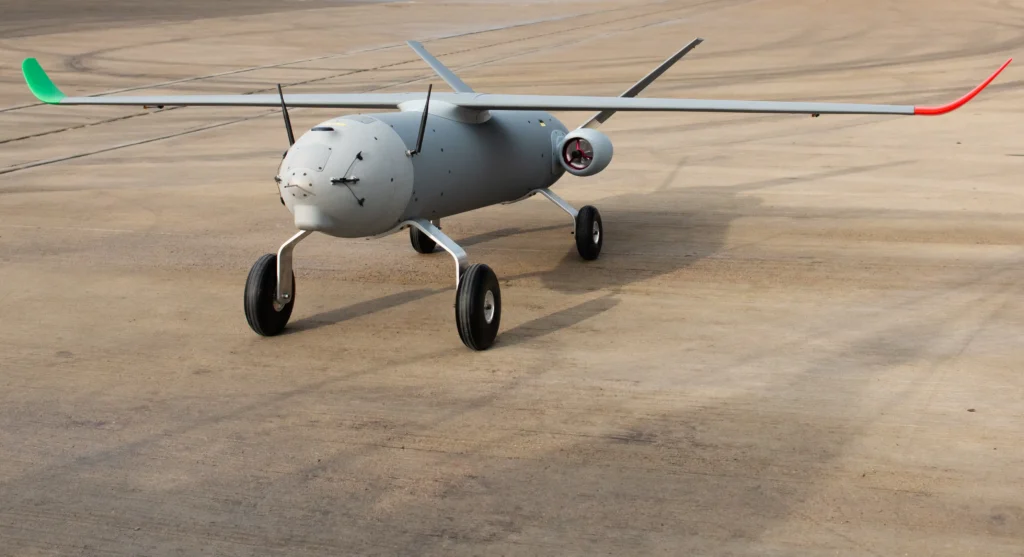
The Indian Air Force is seeking information from Indian companies on 500 low-cost, domestically made expendable surveillance drones intended to detect enemy air defence radars. The proposed systems would add a forward intelligence, surveillance and reconnaissance (ISR) capability near hostile air defence networks.
The IAF’s Request for Information (RFI), the initial stage of the procurement process, sets a response deadline of January 12. The drones are expected to launch from canisters or catapults, without a runway, and operate in contested areas to locate radar emitters in enemy airspace.
After assessing industry responses, the IAF will finalise its requirements and seek Acceptance of Necessity (AoN), the formal approval needed before a tender can be issued. The estimated cost of the 500-drone programme has not been disclosed.
Capabilities and operating requirements
The RFI describes small-form-factor, low-cost platforms able to intercept radar emitters and identify their direction. The drones are also to carry electro-optical and infrared cameras for imagery by day and night, and operate in Global Navigation Satellite System (GNSS)-denied conditions, where satellite navigation signals may be jammed.
The stated requirements include operation at altitudes of up to 25,000 feet, endurance of six hours and a range exceeding 200 km. A two-person crew should be able to launch multiple drones within 10 minutes.
Although classified as expendable, the systems must have a safe recovery mechanism so they can be reused on later missions. The IAF has also asked vendors to provide a roadmap for collaborative swarm operations and human-on-the-loop autonomy, in which drones can carry out missions autonomously while remaining under human supervision.
The IAF is proposing that original equipment manufacturers (OEMs) take responsibility for storing and maintaining the drones. They would be kept under 24/7 CCTV surveillance and delivered to IAF bases when required.
Operational lessons and the need for affordable numbers
The requirement reflects an emphasis on finding and neutralising enemy air defence systems before air campaigns begin. Recent conflicts, including Operation Sindoor and the ongoing wars in Ukraine and West Asia, have highlighted the role of locating radar emitters and using relatively inexpensive unmanned systems in large numbers.
During Operation Sindoor, the IAF reportedly used dummy aircraft designed to resemble fighter jets. Pakistani air defence units activated their radars to engage the simulated targets, exposing their positions; those positions were subsequently targeted by Israeli-made Harop loitering munitions.
The new drones are intended to add a forward layer to the IAF’s surveillance network. Airborne early warning and control (AEW&C) aircraft monitor hostile aircraft and missiles from within friendly airspace, while ISTAR platforms track ground targets from stand-off distances. The smaller proposed drones, by contrast, are intended to operate closer to enemy air defence installations.
Wider surveillance programmes
The proposed acquisition comes amid gaps in India’s airborne surveillance capabilities. The IAF currently relies significantly on Israeli-made Heron and Searcher unmanned aerial vehicles, as well as a limited fleet of six AEW&C aircraft.
During military confrontations with China, the Indian Navy’s P-8I long-range maritime patrol aircraft have also been deployed to monitor activity along the Himalayan frontier. The aircraft are primarily intended for maritime surveillance and anti-submarine warfare.
Several programmes are aimed at expanding India’s airborne surveillance network. The IAF is pursuing six upgraded Netra Mk-1A and six larger Netra Mk-II AEW&C aircraft, but these programmes are expected to take years to deliver operational capability.
India has ordered 31 MQ-9B Predator drones from the United States under a deal worth approximately ₹32,000 crore, signed in October 2024. The first eight aircraft allocated to the IAF are expected to begin arriving only in 2029.
Separately, the Defence Acquisition Council (DAC) has cleared projects for solar-powered pseudo-satellites, including airship-based and fixed-wing platforms designed to remain in the stratosphere for extended periods. Neither programme is close to induction.
The IAF’s Intelligence, Surveillance, Target Acquisition and Reconnaissance (ISTAR) aircraft programme has also faced prolonged delays. A proposed $1-billion deal with US-based Raytheon for two aircraft collapsed in 2017 after disagreements between the IAF and the Defence Research and Development Organisation (DRDO) over technical evaluation responsibilities.
Following Operation Sindoor, the DAC granted initial Acceptance of Necessity for a ₹10,000-crore programme to acquire three ISTAR aircraft equipped with DRDO-developed sensors. The contract has yet to be signed.
A separate tri-service programme for 87 medium-altitude long-endurance (MALE) drones, valued at around ₹30,000 crore, remains under evaluation after attracting approximately 10 bids in June.
The proposed purchase of 500 drones would give the IAF a relatively affordable option for surveillance closer to enemy air defence systems. The plan to use smaller platforms in larger numbers is intended to help identify radar threats while limiting the exposure of high-value surveillance aircraft.




