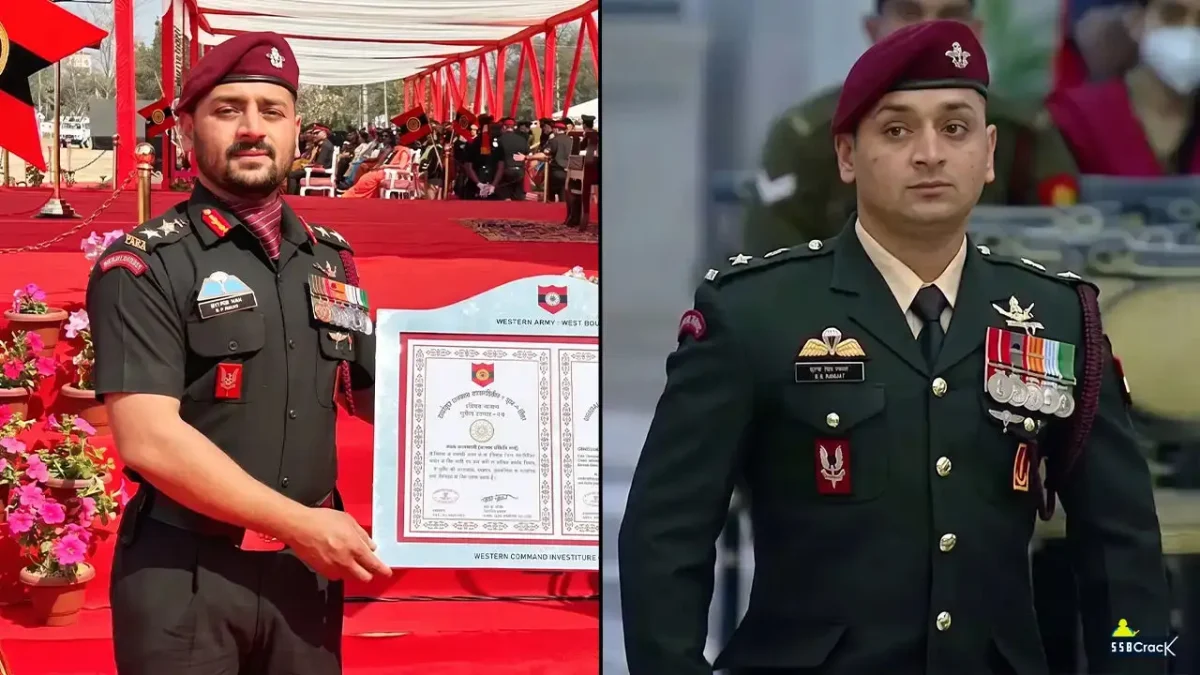
Special Forces officers rarely become household names. Their operations are planned in secrecy, carried out by small teams and, in most cases, never discussed in public. The only time the wider country gets a glimpse of their work is when a gallantry citation is published. One such citation, released on the eve of Independence Day 2020, told the story of Lieutenant Colonel Krishan Singh Rawat of the Parachute Regiment (Special Forces) and a 36-hour ambush along the Line of Control that ended with four terrorists killed.
Now a Colonel, Krishan Singh Rawat, Shaurya Chakra, Sena Medal, belongs to 1 Para (Special Forces), the oldest Special Forces battalion of the Indian Army. His two gallantry awards, a decade apart, trace a career built on patience, close-quarter courage and leadership of small teams. This article looks at what the official record says about him and what defence aspirants can learn from it.
Colonel Krishan Singh Rawat at a Glance
| Detail | Information |
|---|---|
| Rank and name | Colonel Krishan Singh Rawat, SC, SM |
| Personal number | IC-68482Y (as listed in official award notifications) |
| Unit | 1st Battalion, The Parachute Regiment (Special Forces), or 1 Para SF |
| Roots | Bhikiyasain, Uttarakhand; schooled in Delhi (as per published profiles) |
| First gallantry award | Sena Medal (Gallantry), Republic Day 2010, as a Captain |
| Second gallantry award | Shaurya Chakra, announced on Independence Day 2020, as a Lieutenant Colonel |
| Investiture | Shaurya Chakra presented by President Ram Nath Kovind at Rashtrapati Bhavan on 23 November 2021 |
| Defining action | 36-hour ambush near the Line of Control in Jammu and Kashmir; four terrorists killed, one grievously injured |
| Later role | Commanding Officer of 1 Para SF (as per published accounts) |
Roots in the Hills of Uttarakhand
Published profiles of Colonel Rawat say that he hails from Bhikiyasain, a small town in the Almora district hills of Uttarakhand, and that he grew up and studied in Delhi. Uttarakhand has a long tradition of sending its sons into the armed forces, and many families in the hill districts count at least one soldier among them. Profiles also describe a family background connected to the defence establishment in New Delhi, an environment in which the idea of service was familiar from an early age.
Details of his commissioning, such as the academy he passed out from and the year he joined, are not part of the public record. What the record does show is that by 2010 he was already a Captain in 1 Para SF and had been decorated for gallantry.
About 1 Para (Special Forces)
To understand Colonel Rawat’s career, it helps to know the unit he belongs to. 1 Para began life as the 1st Battalion of the Punjab Regiment and was among the three battalions that formed India’s 50th Parachute Brigade after Independence. It fought with distinction in the Jammu and Kashmir operations of 1947–48. In 1978 the battalion was converted, initially as an experiment, into the first Special Forces unit of the Indian Army, and it has been known as 1 Para (SF) ever since.
Officers and soldiers who serve in Para SF battalions volunteer for the role and must clear a demanding probation period before they earn the maroon beret and the Balidan badge. Their training covers airborne operations, mountain and jungle warfare, close-quarter battle and small-team tactics. Published profiles of Colonel Rawat note that photographs show him wearing foreign qualification badges as well, including the US Army Ranger tab, which points to training with partner militaries.
2010: The Sena Medal as a Young Captain
The first public mention of Krishan Singh Rawat came in the list of Republic Day gallantry awards released by the Ministry of Defence in January 2010. In that list, Captain Krishan Singh Rawat of the 1st Battalion, The Parachute Regiment (Special Forces), appears among the recipients of the Sena Medal (Gallantry).
The Sena Medal for gallantry is awarded for individual acts of exceptional devotion to duty or courage that have special significance for the Army. For a Captain, it is a strong early mark of professional standing. The specific operation behind that medal has not been described publicly, which is common for Special Forces actions. Some later profiles describe him as a Major at the time, but the official 2010 list records his rank as Captain.
The 36-Hour Ambush Near the Line of Control
The operation that made Colonel Rawat’s name took place while he was a Lieutenant Colonel and team leader of a mission-oriented team deployed along the Line of Control in Jammu and Kashmir for counter-infiltration and counter-terrorist operations. The official citation, published by the government with the Independence Day 2020 awards, lays out what happened.
Waiting in the Cold
Intelligence was received that terrorists were likely to try either to infiltrate onto the Indian side or to cause casualties to Indian troops. Lieutenant Colonel Rawat led his team out and deployed it along the likely routes of infiltration. The team then stayed in ambush for 36 hours, in inclement weather and in close proximity to the Line of Control, before the group of terrorists was finally spotted.
Thirty-six hours is a long time to stay still, silent and alert in bad weather. Ambushes of this kind test discipline as much as courage. A single careless movement or sound can give away a position, and fatigue can blunt reactions at the moment they matter most.
The Firefight
When the terrorists appeared, a firefight broke out. According to the citation, Lieutenant Colonel Rawat manoeuvred to a flank to locate the specific positions of the terrorists. He then directed a squad commander to crawl forward and bring down accurate fire, which resulted in the elimination of two terrorists.
The remaining terrorists responded with heavy fire. Rather than holding a position that had become exposed, he re-sited his team onto tactically advantageous ground from which it could target the rest of the group.
Closing In
What followed was a period of protracted surveillance, still close to the Line of Control and still under heavy fire, until he identified where the remaining terrorists were. Then, in the words of the citation, “achieving complete surprise and unmindful of personal safety”, he engaged them at extreme close range, killing two terrorists and grievously injuring a third.
The citation concludes that for his resolute and exemplary leadership and conspicuous gallantry during the entire operation, Lieutenant Colonel Krishan Singh Rawat, Sena Medal, was awarded the Shaurya Chakra, India’s third-highest peacetime gallantry award.
Investiture at Rashtrapati Bhavan
The award was announced in August 2020, when the President approved the Independence Day gallantry awards. Lieutenant Colonel Rawat was one of three Army personnel named for the Shaurya Chakra for actions in Jammu and Kashmir that year. Because of the pandemic, the formal investiture came later. On 23 November 2021, at the Defence Investiture Ceremony (Phase 3) at Rashtrapati Bhavan, President Ram Nath Kovind presented him the Shaurya Chakra. Paratrooper Sonam Tshering Tamang of the Parachute Regiment (Special Forces) was decorated with the Shaurya Chakra at the same ceremony.
Command of 1 Para SF
Published accounts describe Colonel Rawat as having gone on to command 1 Para SF, the battalion in which he had served as a young officer. Commanding a Special Forces battalion is one of the most demanding appointments for a Colonel. The Commanding Officer is responsible for training, operations and the welfare of every soldier, and must keep a highly specialised unit ready for missions at short notice.
Command also brings the hardest duties. In August 2024, Lance Naik Praveen Sharma of 1 Para SF, a 26-year-old from Palu village in the Sirmaur district of Himachal Pradesh, was killed in an encounter with terrorists in the forests of Anantnag district in Jammu and Kashmir. Hundreds of people gathered in his village for his last rites. Published accounts state that Colonel Rawat, as Commanding Officer, ensured that the young soldier’s mortal remains were escorted home, in keeping with the Special Forces ethos that no comrade is left behind.
Lessons for Defence Aspirants
Colonel Rawat’s record is short on public detail but rich in lessons for candidates preparing for the NDA, CDS or the SSB interview.
- Consistency over time: His two gallantry awards came about ten years apart, first as a Captain and then as a Lieutenant Colonel. Excellence in the Army is built over years, not in a single moment.
- Patience is a combat skill. The 36-hour ambush shows that endurance and discipline often decide the outcome long before the first shot is fired.
- Adapt when the situation changes. Moving to a flank, re-siting the team and resuming surveillance under fire are examples of the quick, sound decisions that SSB assessors look for in group tasks.
- Lead from the front. The citation records that he personally closed in on the remaining terrorists. Officer-like qualities such as courage and initiative are not abstract terms in the Army.
- Use your team well. Directing a squad commander to bring down accurate fire shows a leader who trusts and employs his men, a quality tested in the Group Testing Officer tasks.
- Care for your soldiers. A Commanding Officer’s responsibility extends to the families of those who fall.
Frequently Asked Questions
Who is Colonel Krishan Singh Rawat?
He is an Indian Army officer of 1 Para (Special Forces) and a recipient of the Sena Medal (Gallantry) and the Shaurya Chakra. Published accounts describe him as a former Commanding Officer of 1 Para SF.
Why was he awarded the Shaurya Chakra?
For leading a Special Forces team in a 36-hour ambush near the Line of Control in Jammu and Kashmir, in which four terrorists were killed, two of them by him personally at extreme close range, and a fifth was grievously injured.
When did he receive the Shaurya Chakra?
The award was announced on the eve of Independence Day 2020 and presented by President Ram Nath Kovind at Rashtrapati Bhavan on 23 November 2021.
When did he receive the Sena Medal?
He was named for the Sena Medal (Gallantry) in the Republic Day 2010 awards list, as a Captain of 1 Para SF.
What is 1 Para SF?
It is the 1st Battalion of the Parachute Regiment and the first unit of the Indian Army converted to the Special Forces role, in 1978. It was originally the 1st Battalion of the Punjab Regiment.
Conclusion
Most of what Colonel Krishan Singh Rawat has done in uniform will probably never be made public. What is on record is enough to show the kind of officer he is: a young Captain decorated for gallantry, a team leader who waited out 36 hours in the cold and then closed with the enemy at arm’s length, and a Commanding Officer who looked after his men to the end. For aspirants dreaming of the maroon beret, his career is a reminder that the Special Forces reward patience, preparation and courage in equal measure.