


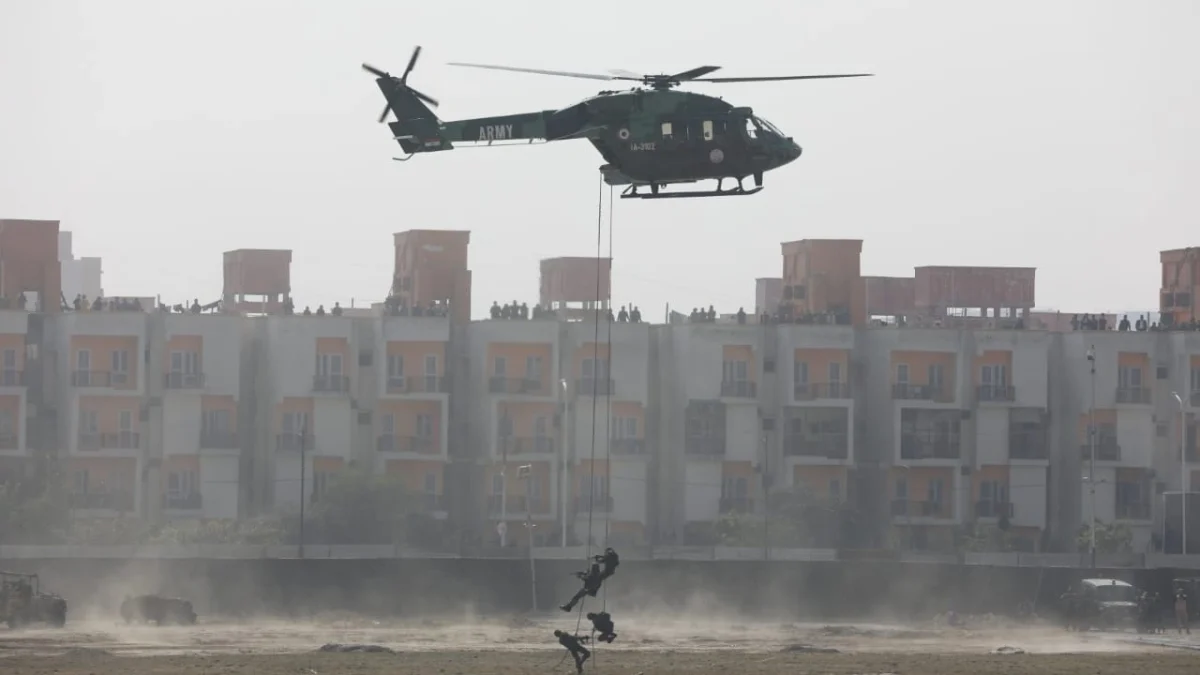
Every officer aspirant knows the names Kargil and Siachen, but how many can explain what actually happened on Tiger Hill, why paratroopers were dropped at Tangail, or how paratroopers reached the Maldives within hours? At the Services Selection Board (SSB), an Interviewing Officer may ask about a famous operation, and in the Group Discussion or a Lecturette you may have to speak on one for three minutes. Knowing the facts, and the lessons behind them, makes a real difference.
Here are 10 of the most dangerous operations conducted by the Indian Army, listed in chronological order rather than as a ranking. Each involved extreme terrain, heavy fire, uncertain intelligence or a race against time. For each you will find the key facts, the story and the lesson that matters for NDA, CDS, TES and SSB preparation.
Casualty figures differ across sources, so only well-documented numbers are given here; disputed figures have been left out.
1. Capture of Haji Pir Pass (1965)
Year: August 1965 (Indo-Pak War of 1965)
Location: Haji Pir Pass, on the old Uri–Poonch road, Jammu and Kashmir
Unit: 1st Battalion, The Parachute Regiment (1 PARA), part of 68 Mountain Brigade
Objective: Capture the pass used as a key infiltration route into the Kashmir Valley
Outcome: Pass captured on 28 August 1965; Major Ranjit Singh Dayal awarded the Maha Vir Chakra
In August 1965, Pakistan pushed armed infiltrators into Jammu and Kashmir, many through the Haji Pir bulge. Capturing the pass would cut this route and link Uri and Poonch by road.
On 27 August, a column of 1 PARA under Major Ranjit Singh Dayal set off from Ledwali Gali to climb more than 1,200 metres by night. Heavy rain, fog and cold slowed the exhausted men, but Major Dayal pushed on.
Next morning, about 700 metres short of the pass, the column came under machine-gun fire. Major Dayal sent two platoons up a spur to attack from the west, and the surprised defenders withdrew. Haji Pir was in Indian hands on 28 August 1965, and 1 PARA beat back a counter-attack the next day.
Lesson for aspirants: Boldness and determination when the men are exhausted are classic officer-like qualities. Haji Pir was later returned under the Tashkent Declaration, a point often raised in interviews.
2. Tangail Airdrop and the Meghna Heli-Bridge (1971)
Year: December 1971 (Bangladesh Liberation War)
Location: Tangail and the Meghna river, then East Pakistan
Units: 2 PARA battalion group at Tangail; 4 Corps under Lt Gen Sagat Singh for the Meghna crossing
Objective: Cut off retreating Pakistani forces and get troops across major rivers to threaten Dhaka
Outcome: Both missions succeeded and sped up the advance that ended with the surrender in Dhaka on 16 December 1971
East Pakistan was a land of wide rivers, and retreating Pakistani troops had destroyed key bridges. Speed was everything, so the Army turned to the air.
From 9 December 1971, 4 Corps began lifting troops across the Meghna in IAF Mi-4 helicopters, each carrying only around 14 soldiers. Flying by day and night, they landed a brigade with artillery on the far bank, an operation known as the Meghna Heli-Bridge.
On 11 December, the 2 PARA battalion group under Lt Col K.S. Pannu was dropped at Tangail to seize the Poongli bridge and block Pakistani troops withdrawing towards Dhaka. The paratroopers took the bridge that evening and beat off counter-attacks until ground forces linked up.
Lesson for aspirants: Army–Air Force jointness and calculated risk can unhinge a larger enemy.
3. Operation Meghdoot: Securing Siachen (1984)
Year: Launched on 13 April 1984
Location: Siachen Glacier and the Saltoro Ridge, Ladakh
Units: Troops of the Kumaon Regiment and Ladakh Scouts, airlifted with the help of IAF helicopters and transport aircraft
Objective: Occupy the key passes on the Saltoro Ridge before they could be seized by the adversary
Outcome: Key passes including Bilafond La and Sia La secured; India has held the heights ever since
With signs that Pakistan was preparing to occupy the Siachen region, India moved first. On 13 April 1984, Indian troops were flown in and began occupying the dominating passes of the Saltoro Ridge.
The environment is as deadly as the enemy. Posts sit at roughly 5,000 to over 6,000 metres, where the air is thin and avalanches, crevasses, frostbite and altitude sickness are constant threats. Siachen is often called the world’s highest battlefield.
In 1987, Naib Subedar Bana Singh of 8 JAK LI led the capture of a Pakistani post on a sheer ice wall, later renamed Bana Top. He was awarded the Param Vir Chakra.
Lesson for aspirants: Meghdoot shows the value of foresight and initiative, and is a favourite topic on high-altitude warfare.
4. Operation Pawan: The IPKF in Sri Lanka (1987)
Year: October 1987 onwards; the IPKF left Sri Lanka in March 1990
Location: Jaffna Peninsula, Sri Lanka
Force: Indian Peace Keeping Force (IPKF)
Objective: Disarm the LTTE and take control of Jaffna under the Indo-Sri Lanka Accord of July 1987
Outcome: Jaffna was secured after weeks of intense fighting; Major Ramaswamy Parameswaran awarded the Param Vir Chakra (posthumous)
The IPKF went to Sri Lanka to keep the peace, but when the LTTE refused to disarm, it had to fight a well-trained insurgent force in crowded towns, coconut groves and mined lanes.
The opening heliborne raid on Jaffna University on the night of 11–12 October 1987, by 10 Para Commandos and 13 Sikh Light Infantry, aimed to capture the LTTE leadership. The LTTE was ready, and the Sikh LI detachment suffered very heavy losses. The raid is still studied for its intelligence lessons.
On 25 November 1987, Major Ramaswamy Parameswaran of 8 MAHAR was ambushed while returning from a search operation. He outflanked and charged the militants; shot in the chest, he snatched a militant’s rifle, shot him and kept directing his men until he died.
Lesson for aspirants: Clear aims, accurate intelligence and knowledge of terrain matter as much as firepower.
5. Operation Cactus: Saving the Maldives (1988)
Year: 3–4 November 1988
Location: Malé and Hulhulé, Republic of Maldives
Units: 50 (Independent) Parachute Brigade, led by 6 PARA, flown in by IAF IL-76 aircraft; the Indian Navy also took part
Objective: Defeat an armed coup attempt and protect the elected government at the Maldives’ request
Outcome: Coup foiled within hours; President Maumoon Abdul Gayoom secured; mercenaries who fled by sea were intercepted by the Navy
On 3 November 1988, armed mercenaries attacked Malé to overthrow the government. The Maldives asked India for help, and by evening paratroopers were in the air.
Two IL-76s from Agra landed at Hulhulé at night with little intelligence about the ground situation. The paratroopers secured the airfield, crossed to Malé and reached President Gayoom in the early hours of 4 November. Mercenaries who fled with hostages on a hijacked ship were intercepted by Indian Navy warships.
Lesson for aspirants: A textbook case of rapid planning and tri-service action, often cited on India’s role in the Indian Ocean Region.
6. Operation Vijay: The Kargil War (1999)
Year: May–July 1999
Location: Kargil, Drass, Batalik, Mushkoh and Turtuk sectors, Ladakh (then part of Jammu and Kashmir)
Objective: Evict Pakistani intruders who had occupied heights along the Line of Control
Outcome: Heights recaptured; victory marked every year on 26 July as Kargil Vijay Diwas; four Param Vir Chakras awarded
In May 1999, the Army found that Pakistani soldiers and irregulars had occupied heights on the Indian side of the LoC, overlooking the Srinagar–Leh highway. The IAF supported the operation under Operation Safed Sagar.
Indian soldiers had to climb near-vertical slopes under direct fire, usually at night. Tololing, Tiger Hill and Point 4875 were captured one by one, with Bofors artillery playing a key role.
The Param Vir Chakra went to Captain Vikram Batra (13 JAK RIF, posthumous), Lieutenant Manoj Kumar Pandey (1/11 GR, posthumous), Grenadier Yogendra Singh Yadav (18 Grenadiers) and Rifleman Sanjay Kumar (13 JAK RIF). More than 500 Indian soldiers made the supreme sacrifice.
Lesson for aspirants: A must-prepare topic that shows the importance of surveillance and junior leadership.
7. Operation Khukri: The Rescue in Sierra Leone (2000)
Year: 15–16 July 2000
Location: Kailahun to Daru, Sierra Leone
Force: Indian contingent of the UN Mission in Sierra Leone (UNAMSIL), including 5/8 Gorkha Rifles, 18 Grenadiers, Mechanised Infantry, Para (SF) and Indian aviation units, with Ghanaian, Nigerian and British support
Objective: Break the siege of two Gorkha companies surrounded by Revolutionary United Front (RUF) rebels
Outcome: All besieged peacekeepers extracted; one Indian soldier killed
In May 2000, the RUF turned on UN peacekeepers. Two companies of 5/8 Gorkha Rifles at Kailahun were surrounded for more than 75 days while talks failed and supplies ran short.
On 15 July 2000, after helicopter and artillery strikes, the Kailahun column broke out while heli-landed troops secured points along nearly 100 km of jungle track. The force fought through ambushes and cratered roads, and helicopters evacuated personnel the next day. Havildar Krishan Kumar of 14 Mechanised Infantry was fatally wounded during the withdrawal.
Lesson for aspirants: Patience in negotiation, then decisive action when talks fail.
8. Cross-Border Strike on the Myanmar Border (2015)
Year: 9 June 2015
Location: Along the India–Myanmar border, opposite Manipur and Nagaland
Unit: Para (Special Forces)
Objective: Strike insurgent groups responsible for the 4 June 2015 ambush on an Army convoy in Manipur’s Chandel district
Outcome: Insurgent camps targeted; the strike team returned to Indian territory
On 4 June 2015, insurgents ambushed a convoy of 6 DOGRA in Chandel district, Manipur, killing 18 soldiers. It was one of the deadliest attacks on the Army in the North East in years.
Within days, Para (SF) teams moved on foot through thick, hilly jungle to strike camps of the groups behind the attack, in areas where the insurgents knew every track.
Lesson for aspirants: Special forces can deliver a quick, measured response to insurgent attacks.
9. The Surgical Strikes Across the LoC (2016)
Year: Night of 28–29 September 2016
Location: Launch pads across the Line of Control, Jammu and Kashmir
Unit: Para (Special Forces)
Objective: Destroy terrorist launch pads where terrorists were waiting to infiltrate into India
Outcome: Strikes carried out and teams returned; the DGMO announced the operation on 29 September 2016
On 18 September 2016, terrorists attacked an Army camp at Uri, killing 19 soldiers. On 29 September, the DGMO announced strikes on terrorist launch pads across the LoC the previous night.
Para (SF) teams crossed one of the most heavily guarded and mined lines in the world in the dark, struck the launch pads and returned before dawn.
Lesson for aspirants: The strikes signalled a shift in India’s response to cross-border terrorism.
10. Operation Sindoor (2025)
Year: 7–10 May 2025
Location: Terrorist infrastructure in Pakistan and Pakistan-occupied Jammu and Kashmir, plus the Line of Control and the western border
Forces: Indian Army, Indian Air Force and Indian Navy
Objective: Strike terrorist camps after the Pahalgam terror attack of 22 April 2025, in which 26 civilians were killed
Outcome: Nine terrorist sites hit in precision strikes on 7 May 2025; Pakistani drone and missile attacks were countered; firing and military action stopped under an understanding reached on 10 May 2025
In the early hours of 7 May 2025, precision strikes hit nine intelligence-verified terrorist sites, including camps linked to Jaish-e-Mohammed and Lashkar-e-Taiba.
The Army planned and executed strikes in the land domain and held the LoC against heavy shelling. When Pakistan answered with waves of drones, Army air defence units, working in an integrated network with the IAF, helped protect bases and cities.
Lesson for aspirants: The best recent example of jointness and layered air defence, and a likely current affairs and GD topic.
Conclusion
From the rain-soaked climb to Haji Pir to Operation Sindoor, these operations show the Indian Army adapting to impossible terrain, taking calculated risks and relying on brave junior leaders. Some, like Pawan, also carry hard lessons, which is why they are studied at the academies.
For an SSB aspirant, the aim is not to memorise every date but to explain what happened, why it mattered and what it teaches about leadership. Pick two or three operations, read the gallantry citations and be ready to discuss them. You can also read about the most elite regiments of the Indian Army and the types of Indian Army units to round off your preparation.
Frequently Asked Questions
1. Which is the highest battlefield where the Indian Army operates?
The Siachen Glacier on the Saltoro Ridge in Ladakh, secured under Operation Meghdoot from 13 April 1984. Some Army posts there are above 6,000 metres.
2. What was the code name of the Indian Army’s operation in the Kargil War?
Operation Vijay. The Indian Air Force’s part of the campaign was called Operation Safed Sagar. Kargil Vijay Diwas is observed on 26 July every year.
3. Which operation saved the government of the Maldives in 1988?
Operation Cactus. Paratroopers of 50 (Independent) Parachute Brigade were flown to Hulhulé on 3 November 1988 and foiled the coup within hours.
4. Who was the only Param Vir Chakra awardee of Operation Pawan?
Major Ramaswamy Parameswaran of 8 MAHAR, awarded posthumously for his action in Sri Lanka on 25 November 1987.
5. When did the Indian Army carry out the surgical strikes across the LoC?
On the night of 28–29 September 2016, after the terror attack on the Army camp at Uri on 18 September 2016. The strikes were carried out by Para (Special Forces) teams.




