




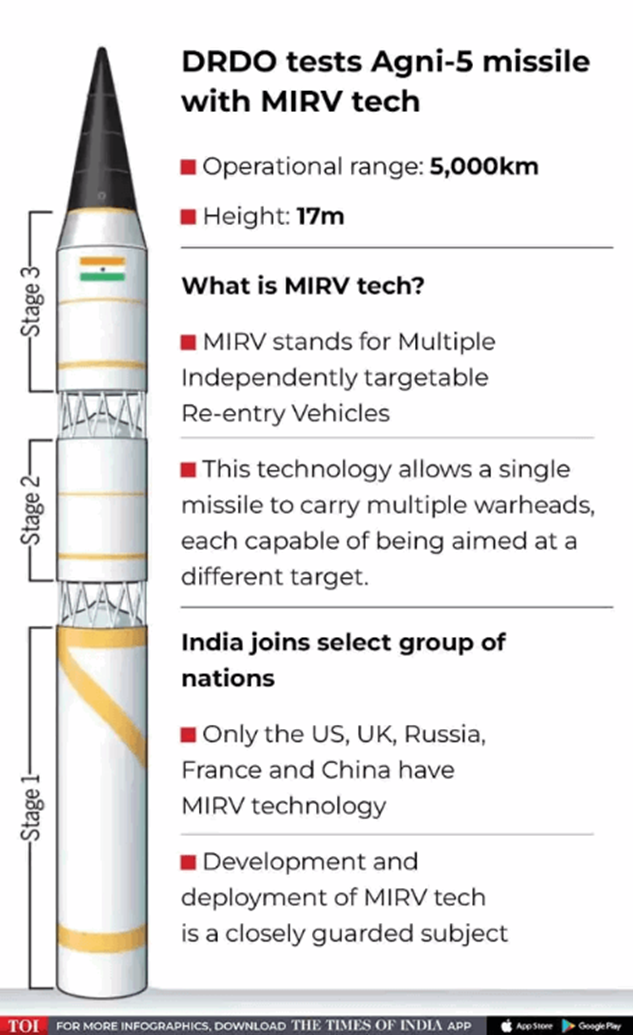
India has achieved several major milestones in the fields of defence technology. India successfully carried out the flight-test of an advanced Agni missile equipped with Multiple Independently Targeted Re-Entry Vehicle (MIRV) technology.
Advanced Agni MIRV Missile Test & Major Progress in Hypersonic Missile Technology
India successfully carried out the flight-test of an advanced Agni missile equipped with Multiple Independently Targeted Re-Entry Vehicle (MIRV) technology from Dr APJ Abdul Kalam Island on May 08, 2026. The missile demonstrated the capability to carry multiple payloads and strike different targets spread across a large area in the Indian Ocean Region.
During the mission, several ground-based and ship-based telemetry stations monitored and tracked the missile’s trajectory from launch to the impact of all payloads. The successful completion of the test confirmed that all mission objectives were achieved accurately.
This achievement marks another important advancement in India’s strategic defence capability, as the MIRV system allows a single missile to engage multiple targets independently. The missile has been developed by Defence Research and Development Organisation with support from Indian industries and was witnessed by senior DRDO scientists and personnel of the Indian Army.
Agni Missile – India’s Strategic Ballistic Missile System
The Agni Missile is a series of long-range ballistic missiles developed by India as part of its strategic defence programme. These missiles are designed and developed by the Defence Research and Development Organisation (DRDO) and form an important part of India’s nuclear deterrence capability.
The Agni missile series is named after “Agni,” the Sanskrit word for fire. These missiles are capable of carrying conventional as well as nuclear warheads and are mainly used for strategic defence purposes.
Key Features of Agni Missile
- Developed under India’s Integrated Guided Missile Development Programme (IGMDP)
- Surface-to-surface ballistic missile
- Can carry nuclear and conventional payloads
- Uses solid-fuel propulsion in most advanced variants
- Equipped with advanced navigation and guidance systems
- Some variants support MIRV (Multiple Independently Targeted Re-Entry Vehicle) technology
Variants of Agni Missile
Agni-I
- Short-range ballistic missile
- Range: Around 700–900 km
- Primarily designed for regional defence requirements
Agni-II
- Medium-range ballistic missile
- Range: Around 2,000 km
- Capable of quick deployment and launch
Agni-III
- Intermediate-range ballistic missile
- Range: More than 3,000 km
- Designed for heavier payload capacity
Agni-IV
- Advanced ballistic missile with improved accuracy
- Range: Around 4,000 km
- Equipped with modern avionics and navigation systems
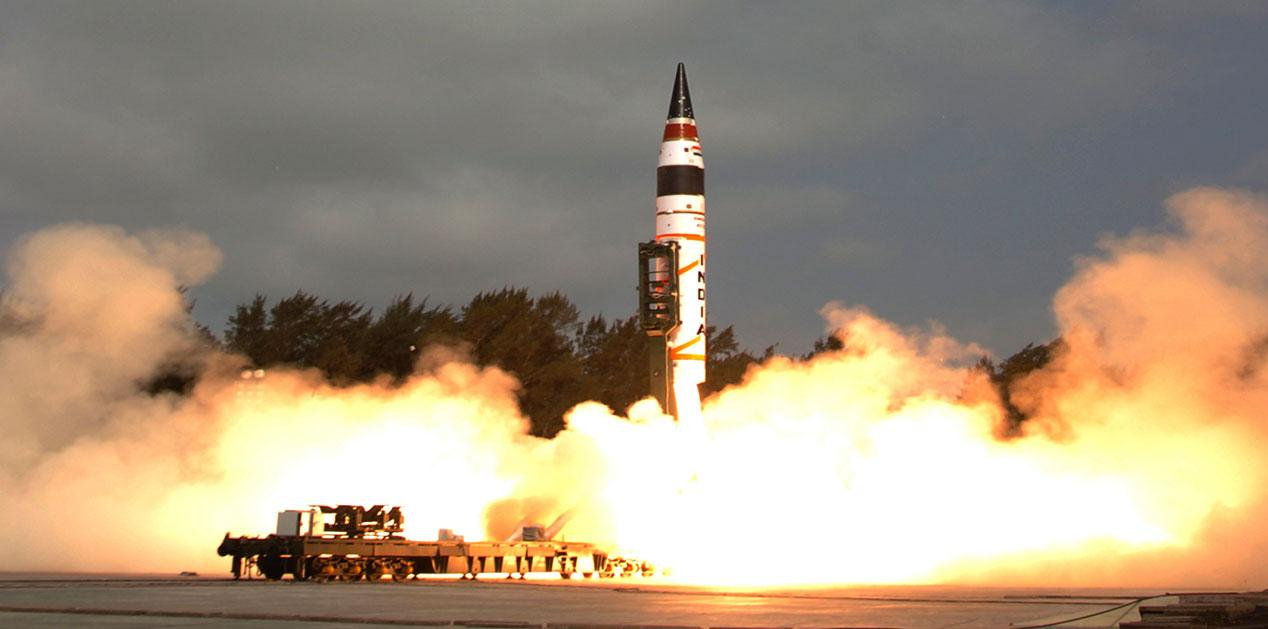
Agni-V
- Long-range intercontinental-class ballistic missile
- Range: More than 5,000 km
- Canister-based launch system for faster mobility and storage
- One of India’s most advanced strategic missiles
Advanced Agni with MIRV
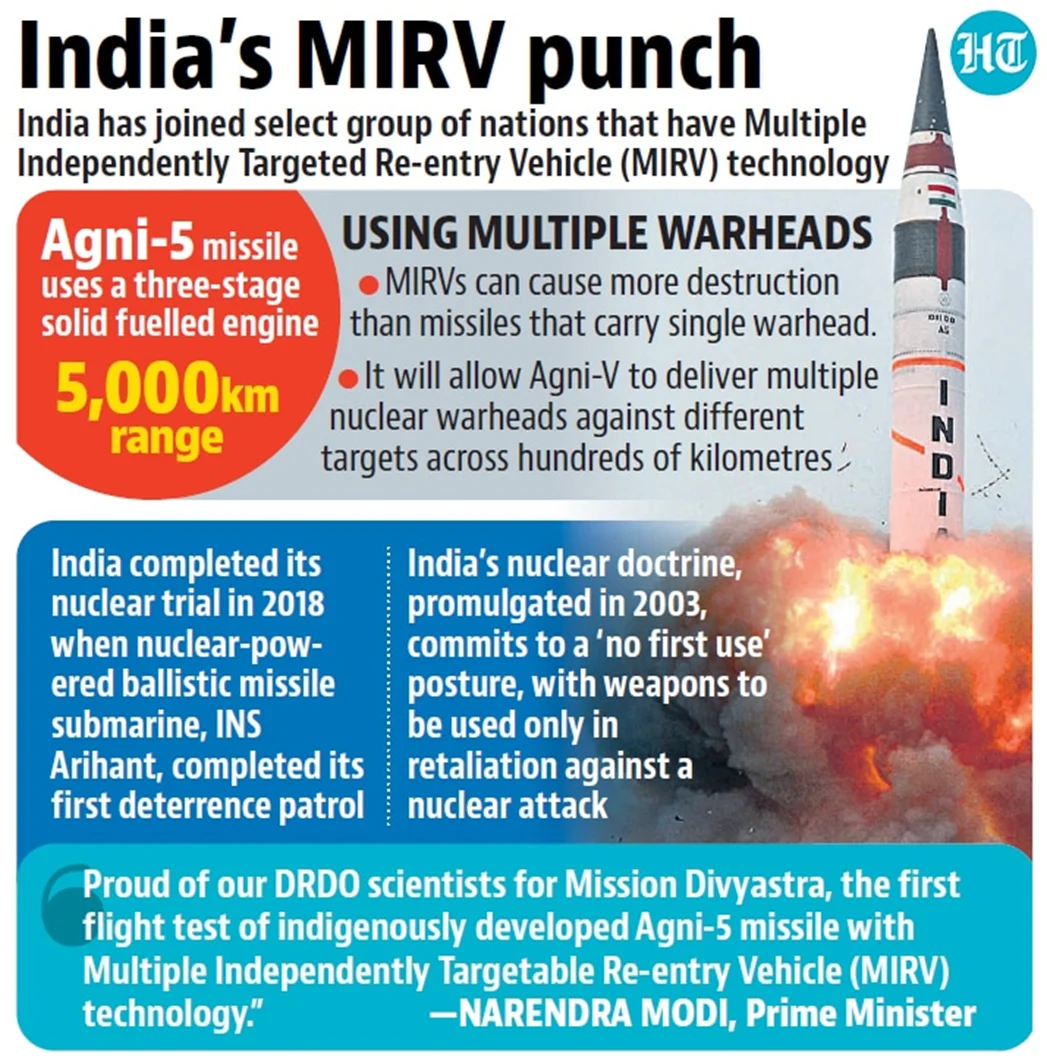
Recently, India successfully tested an advanced Agni missile equipped with MIRV technology. This allows a single missile to carry multiple warheads that can strike different targets independently.
Importance of Agni Missile for India
The Agni missile series strengthens India’s strategic deterrence and national security. It provides the capability to respond effectively to external threats and supports India’s “credible minimum deterrence” policy.
The missile programme also reflects India’s progress in indigenous defence technology and self-reliance under initiatives like Atmanirbhar Bharat.
Interesting Facts
MIRV-equipped missiles can engage multiple targets in one launch.
Agni missiles are developed mainly by DRDO laboratories across India.
Advanced variants use highly accurate guidance systems.
Agni-V is among the longest-range missiles developed by India.
Major Progress in Hypersonic Missile Technology
India also achieved a significant breakthrough in hypersonic missile technology through the efforts of the Defence Research and Development Laboratory under DRDO.
The development involved an advanced supersonic air-breathing engine powered by an indigenously developed liquid hydrocarbon endothermic fuel. Scientists also used high-temperature thermal barrier coatings and modern manufacturing technologies to improve engine performance.
Ground tests conducted at the Supersonic Combustion Test Plant successfully validated the design and efficiency of the active cooled scramjet combustor. This achievement is expected to strengthen India’s future hypersonic weapon capabilities and boost indigenous defence research.
Ramjet vs Scramjet Engine


Ramjet and Scramjet are advanced air-breathing jet engines used mainly in supersonic and hypersonic missiles and aircraft. Both engines do not require rotating compressors like ordinary jet engines and use the vehicle’s high speed to compress incoming air.
Basic Difference
The main difference between a Ramjet and a Scramjet is the speed of airflow inside the combustion chamber.
- In a Ramjet, the airflow slows down to subsonic speed before combustion.
- In a Scramjet, the airflow remains at supersonic speed during combustion.
Ramjet Engine
A Ramjet engine works efficiently at supersonic speeds, generally between Mach 2 and Mach 6.
Working
- Air enters the engine at high speed.
- The airflow slows down inside the inlet.
- Fuel is injected and burned.
- Hot gases exit through the nozzle, producing thrust.
Features
- Simple design
- No moving compressor parts
- Efficient at high supersonic speeds
- Cannot operate at low speeds or from standstill
Uses
- Supersonic missiles
- High-speed aircraft
- Defence applications
Scramjet Engine
Scramjet
A Scramjet (Supersonic Combustion Ramjet) is an advanced version of the Ramjet designed for hypersonic speeds, usually above Mach 5.
Working
- Air enters the engine at extremely high speed.
- Airflow remains supersonic inside the combustion chamber.
- Fuel burns in supersonic airflow.
- Exhaust gases generate massive thrust for hypersonic travel.
Features
- Operates at hypersonic speeds
- Extremely high efficiency at Mach 5+
- Advanced and difficult technology
- Requires very high temperatures and special materials
Uses
- Hypersonic missiles
- Future spaceplanes
- Advanced defence systems
Ramjet vs Scramjet Comparison Table
| Feature | Ramjet | Scramjet |
|---|---|---|
| Full Form | Ram Air Jet | Supersonic Combustion Ramjet |
| Combustion Airflow | Subsonic | Supersonic |
| Speed Range | Mach 2–6 | Mach 5+ |
| Complexity | Less complex | Highly complex |
| Efficiency | Good at supersonic speed | Best at hypersonic speed |
| Applications | Missiles, aircraft | Hypersonic weapons, space research |
Why Scramjet Technology is Important
Scramjet technology is considered a major breakthrough because it enables:
- Hypersonic missile development
- Faster long-distance travel
- Advanced strategic defence systems
- Future reusable space vehicles
Countries like India, United States, China, and Russia are actively researching hypersonic propulsion systems.
Conclusion
Ramjet and Scramjet engines are both powerful air-breathing propulsion systems, but Scramjets represent the next generation of hypersonic technology. While Ramjets are suitable for supersonic speeds, Scramjets are designed for ultra-fast hypersonic travel and advanced missile systems of the future.


