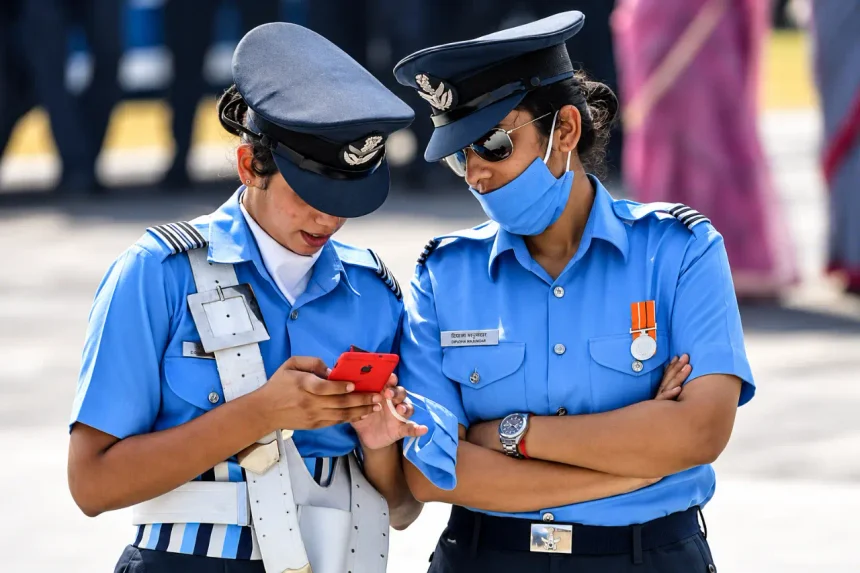
Mobile phones, particularly smartphones, are strictly restricted or prohibited for cadets during training at India’s premier pre-commissioning academies: the National Defence Academy (NDA), Indian Military Academy (IMA), Air Force Academy (AFA) and Indian Naval Academy (INA). The restrictions form part of a deliberate training philosophy that prioritises discipline, security, operational secrecy, concentration and character development over continuous connectivity.
National Defence Academy (NDA), Khadakwasla
Official joining instructions for recent courses list “Mobile Phone and Peripherals” among the forbidden articles that candidates must not bring. Smart watches of any kind are also prohibited. On arrival, any personal mobile phones are deposited. Officers conduct regular checks. Possession of an unauthorised phone is treated as a serious breach of academy rules and typically attracts 21 restrictions. Accumulation of 36 restrictions can result in relegation (failure of a term).
Cadets are not cut off from their families. Telephone booths and WLL/landline connections are available in the squadrons, primarily for use on weekends and holidays. Limited non-camera electronic items (such as certain MP3 players or radios) may be permitted under squadron supervision, but personal smartphones remain banned throughout the three-year training.
Indian Military Academy (IMA), Dehradun
Joining instructions (including those issued for recent Direct Entry courses) explicitly forbid any type of mobile phones, smart watches, laptops, tablets and storage devices. Gentleman Cadets are not permitted to use or possess any type of mobile phone; possession is strictly prohibited.
Communication is facilitated through WLL telephones available in each company, which cadets may use according to timings laid down by the battalions. Internet access is provided under centralised arrangements in company ante-rooms, the IT laboratory and the library, but not in individual rooms. Although a 2011 government statement had permitted mobile phones in rooms (without internet access), subsequent joining instructions have imposed a clear ban. Any limited access that may exist is treated as a privilege rather than a right and is tightly controlled.
Air Force Academy (AFA), Dundigal
Mobile phones are listed among items that are not permissible and must not be brought to the academy. The Indian Air Force has emphasised that unrestricted use of smartphones can compromise aerospace safety, maintenance safety and the secrecy of missions. IAF policy therefore prohibits the carriage and use of smartphones inside technical areas, which include training centres and flying bases.
Authorised communication facilities are provided so that trainees can remain in contact with their families under controlled conditions.
Indian Naval Academy (INA), Ezhimala
Joining instructions require that mobile phones, if carried, be deposited on arrival for safe keeping. Trainees are not permitted to keep mobile phones at the academy. Smart watches and wireless sets are similarly prohibited.
Communication options include STD booths (in the cafeteria and accommodation areas) that may be used on weekends and holidays, landline connections in squadron lines for incoming calls during designated hours, and limited computer/internet facilities available under controlled conditions.
Reasons for the Restrictions
Across all four academies the underlying rationale is consistent:
- Discipline and focus: Training schedules are demanding, combining rigorous physical training, academics, military subjects and leadership development. Smartphones introduce constant distractions through social media, messaging and entertainment.
- Security and operational secrecy: Personal devices can pose risks of data leakage, photography of sensitive areas or compromise of mission-related information, particularly at flying and technical establishments.
- Character and leadership development: The academies aim to cultivate mental toughness, self-discipline and the ability to function without continuous external validation or digital stimulation.
- Safety: In aviation environments, the risks to flight and maintenance safety are considered especially acute.
Unauthorised possession of a phone can lead to confiscation, substantial disciplinary action (including restrictions that may culminate in relegation) and, in serious cases, further administrative consequences.
Communication with Family
Cadets are not isolated. All academies provide authorised telephone facilities—landlines, WLL connections or STD booths—typically usable on weekends, holidays or at stipulated times. Parents can also contact the academy through official channels. On leave and term breaks, cadets normally regain access to their personal devices.
Conclusion
Smartphones and personal mobile phones are not permitted for routine use by cadets during training at NDA, IMA, AFA and INA. The rules are enforced through joining instructions, regular checks and a disciplinary system that treats unauthorised possession seriously. The policy is designed to keep the focus firmly on the mission of producing disciplined, competent and resilient officers.
Selected candidates must carefully follow the latest joining instructions issued by the respective academy, as precise provisions can be updated. Compliance with these regulations is an early and essential demonstration of the self-discipline expected of a future officer of the Indian Armed Forces.