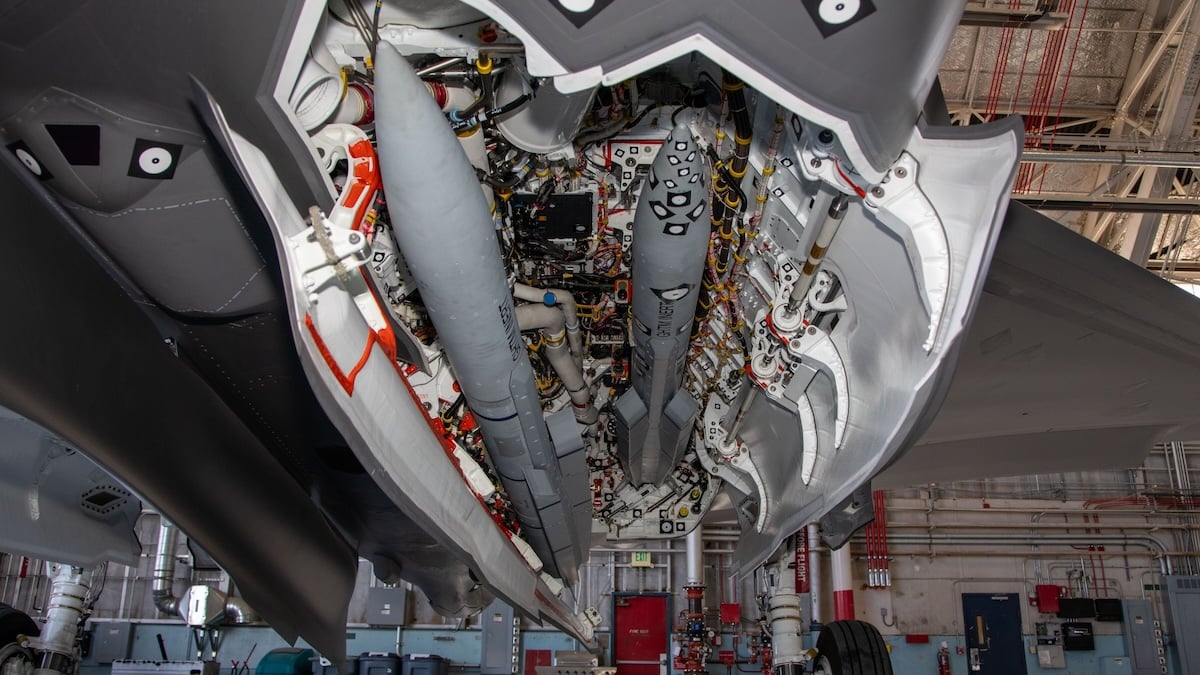
The F-35A Lightning II fighter jet has successfully completed ground-based integration tests with the Meteor beyond-visual-range (BVR) air-to-air missile, inching closer to operational capability. Conducted at Edwards Air Force Base in California, these tests involved collaboration among Lockheed Martin, MBDA, and the F-35 Joint Program Office.
During the trials, engineers performed ground vibration checks and verified the missile’s secure stowage and deployment procedures from the F-35’s internal weapons bay, ensuring that the aircraft’s stealth profile remains intact. The testing included subjecting the missile to various frequencies while monitoring its structural response. Following these tests, one additional ground test is expected before transitioning to airborne evaluations.
The integration of the Meteor missile is actively pursued by Europe’s F-35 operators. Italy is at the forefront of this initiative for the F-35A platform, while the United Kingdom is leading efforts related to the F-35B variant. In a notable development, a Royal Air Force-led campaign in February 2025 carried out the first Meteor flight tests on a US Marine Corps F-35B, with the UK anticipating full operational capability by the early 2030s.
The Meteor missile itself is a product of collaboration among six European nations: France, Germany, Italy, the UK, Spain, and Sweden, with MBDA as the leading manufacturer. It features a solid-fuel variable-flow ducted ramjet propulsion system, allowing it to maintain sustained thrust throughout its flight, distinguishing it from traditional solid-rocket missiles that lose speed after launch.
In terms of guidance, the Meteor utilizes a radar seeker during its terminal phase, backed by inertial navigation and a two-way datalink for mid-course updates and retargeting as necessary. The missile is designed to neutralize a range of threats, including fighter jets, cruise missiles, and drones, using a blast-fragmentation warhead that ensures effective target destruction.
Notably, the Meteor missile is capable of operating in various conditions, including day or night scenarios and during adverse weather or intense electronic warfare environments. It also boasts a significantly larger no-escape zone compared to similar systems available on the market.
Other military operators, including Germany with its Eurofighters, Sweden with its Gripen jets, and South Korea with the KF-21 Boramae combat aircraft, have also integrated the Meteor missile and achieved either operational or advanced testing status. This positions the Meteor as a prominent solution in modern aerial combat scenarios.