





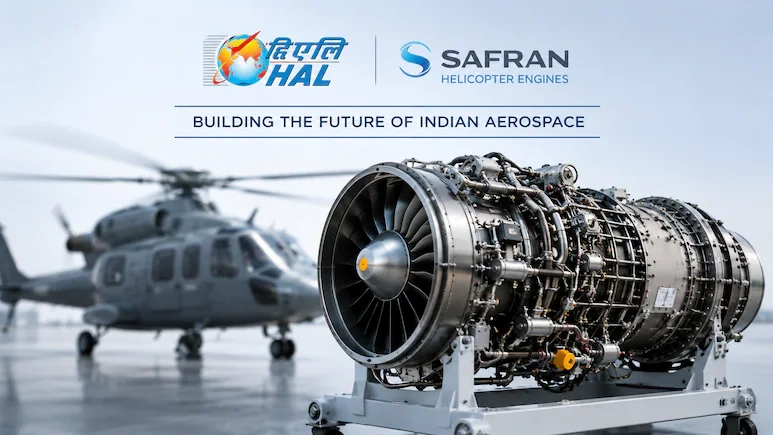
Hindustan Aeronautics Limited (HAL) and Safran Helicopter Engines have signed a final agreement in Bengaluru to jointly develop and manufacture a new high-power turboshaft engine for 13-tonne-class helicopters.
HAL & Safran Sign Aravalli Helicopter Engine Contract
India has taken a major step towards strengthening its aerospace self-reliance with Hindustan Aeronautics Limited (HAL) and France’s Safran Helicopter Engines signing a pact for the development and production of a high-power helicopter engine in India. The collaboration is aimed at creating an indigenous propulsion solution for India’s future 13-tonne-class helicopters.
A Major Step in India’s Aero-Engine Ambitions
The agreement represents an important development in India’s efforts to build domestic capabilities in the highly specialised field of helicopter engine technology.
HAL and Safran have been working together on helicopter-engine programmes for several years. Their cooperation includes an existing joint venture focused on helicopter-engine support and maintenance, while the newer programme takes the partnership towards the design and development of a new-generation high-power engine.
The engine is intended for helicopters in the 13-tonne class, making it particularly significant for India’s future medium-lift military helicopter requirements.
What Is a Turboshaft Engine?
The new powerplant is a turboshaft engine, a type of gas-turbine engine primarily designed to generate rotational shaft power.
Unlike a turbojet, where the main objective is to generate thrust, a turboshaft transfers its power through a shaft and transmission system to drive a helicopter’s rotor.
Simple working:
Air Intake → Compression → Combustion → Turbine → Shaft Power → Rotor
This makes turboshaft engines particularly suitable for helicopters.
Powering India’s Future Helicopters
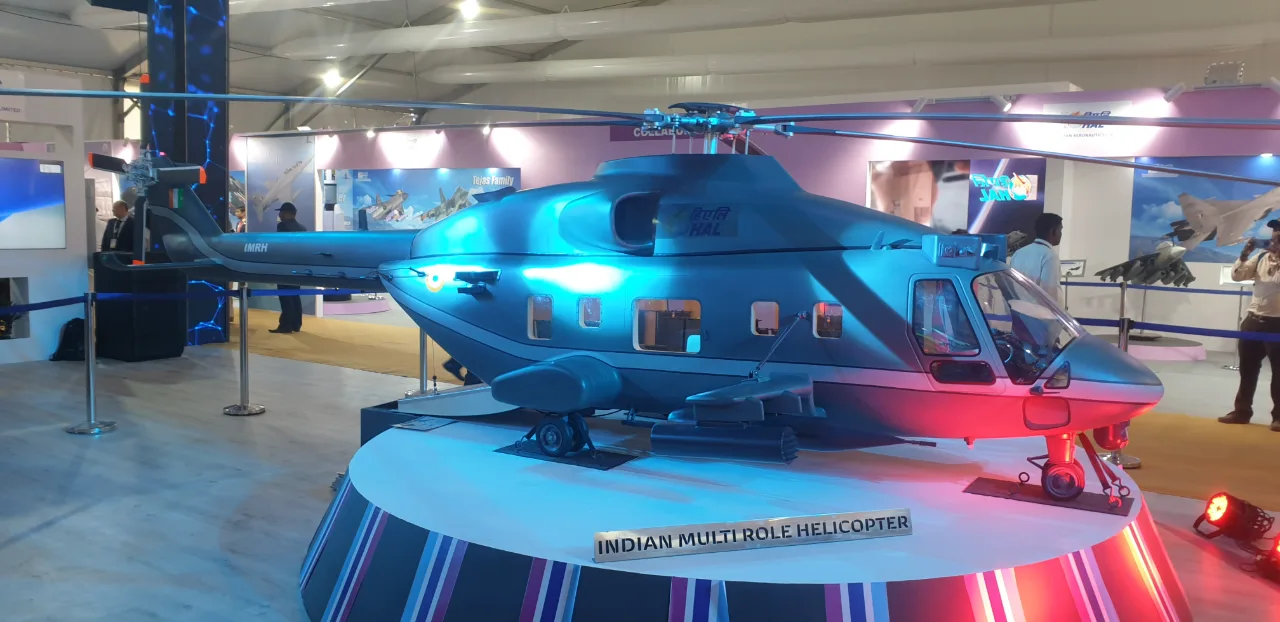
The engine is being developed for HAL’s planned Indian Multi-Role Helicopter (IMRH) programme and its naval version, the Deck-Based Multi-Role Helicopter (DBMRH).
The IMRH is envisaged as a 13-tonne-class helicopter for a range of military missions, while the naval variant is intended for operations from Indian Navy warships.
The availability of a suitable indigenous engine would therefore be an important component of India’s broader effort to reduce dependence on foreign propulsion systems.
Why Is the Engine Important?
Developing a helicopter is considerably more than designing its airframe. The propulsion system is one of the most technically demanding elements and requires expertise in areas such as:
- High-temperature materials
- Turbine technology
- Combustion systems
- Precision manufacturing
- Engine control systems
- Testing and certification
- Maintenance and lifecycle support
HAL’s collaboration with Safran is intended to combine India’s manufacturing and aerospace capabilities with Safran’s established expertise in helicopter propulsion.
Focus on Indigenous Manufacturing
The partnership also aligns with India’s broader Aatmanirbhar Bharat and Make in India objectives.
Greater domestic capability in helicopter engines could help India build expertise across the aerospace supply chain, including component manufacturing, testing, maintenance and overhaul.
HAL has also been developing its own aero-engine research and testing infrastructure. Its Aero Engine Research & Development Centre in Bengaluru is involved in multiple engine programmes, including the Hindustan Turbo Fan Engine and Hindustan Turbo Shaft Engine.
Potential Civil Applications
Although the immediate importance of the programme is linked to India’s military helicopter requirements, the engine technology could potentially have wider applications.
A high-power helicopter platform can find uses in areas such as:
- Offshore operations
- Utility missions
- Search and rescue
- Disaster relief
- Heavy transportation
- VIP transport
This could eventually create opportunities for India’s aerospace industry beyond defence.

Strengthening India-France Defence Cooperation
The HAL-Safran partnership is also part of the expanding India-France strategic and defence relationship.
Both countries have been working to deepen cooperation in aerospace and defence manufacturing, including helicopter engines, aircraft engines and maintenance capabilities. Recent bilateral discussions have highlighted the importance of strengthening defence-aeronautics cooperation under the Make in India framework.
Significance for India
The development of a high-power helicopter engine is strategically important because propulsion technology remains one of the most challenging areas of aerospace engineering.
A successful programme could help India:
- Reduce dependence on imported helicopter engines.
- Build advanced domestic aero-engine expertise.
- Strengthen the Indian aerospace manufacturing ecosystem.
- Support the IMRH and naval helicopter programmes.
- Expand opportunities for Indian suppliers and technology partners.
- Develop indigenous engine maintenance and lifecycle-support capabilities.
Conclusion
The HAL-Safran agreement marks an important chapter in India’s journey towards greater self-reliance in aerospace propulsion. By combining HAL’s Indian aerospace ecosystem with Safran’s specialised helicopter-engine expertise, the partnership aims to create a high-power engine for India’s next-generation 13-tonne-class helicopters.
If successfully developed and manufactured at scale, the programme could strengthen not only India’s helicopter fleet but also the country’s broader capability to design, produce and support sophisticated aero-engines within India.
Exam Quick Facts
| Topic | Key Fact |
|---|---|
| Indian company | HAL |
| Foreign partner | Safran Helicopter Engines, France |
| Engine type | Turboshaft |
| Target helicopter class | 13-tonne class |
| Main programme | Indian Multi-Role Helicopter (IMRH) |
| Naval variant | Deck-Based Multi-Role Helicopter (DBMRH) |
| Main objective | Indigenous helicopter propulsion capability |
| Key theme | Aatmanirbhar Bharat / Make in India |


