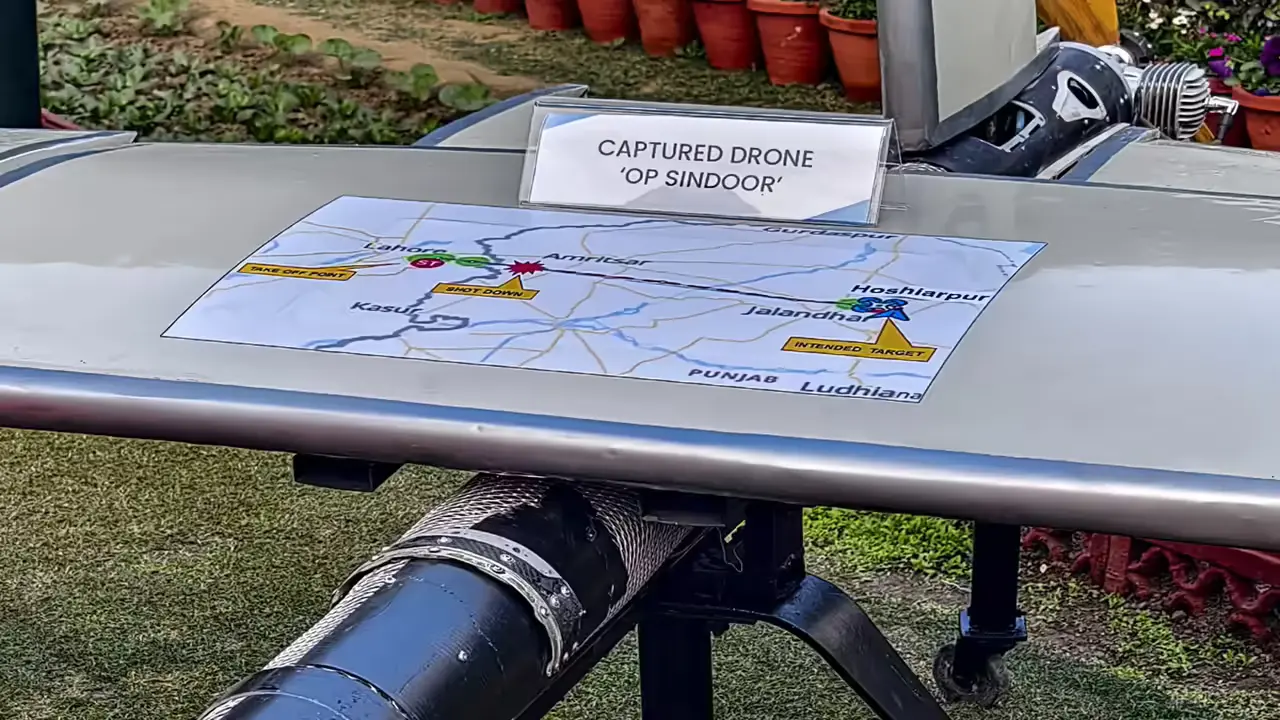
In a significant development, India has disclosed vital information about a weaponised drone operated by Pakistan during Operation Sindoor in May 2025. NDTV gained exclusive access to the remnants of a Turkish-origin kamikaze drone that was brought down by Indian air defence systems and subsequently showcased at the residence of Army Chief General Upendra Dwivedi in New Delhi, coinciding with the Vijay Diwas celebrations.
The drone, identified as a YIHA-III, is a loitering munition that was co-developed by Turkey and Pakistan. Officials disclosed that it was launched from Lahore International Airport and was flying at an altitude of approximately 2,000 meters when Indian forces intercepted and destroyed it on May 10. The intended target of the drone was the Indian Air Force base located in Hoshiarpur, Punjab, but it was neutralised over Amritsar before it could pose any threat to Indian military installations.
Operation Sindoor commenced on May 7, immediately following precision strikes that obliterated several terrorist camps in Pakistan and Pakistan-occupied Kashmir. These actions were in retaliation for the Pahalgam terror attack, which resulted in the deaths of 26 civilians. In response, from May 8 onwards, Pakistan initiated a large-scale drone offensive, deploying hundreds of armed drones targeting nearly 36 towns and cities across Jammu and Kashmir, Rajasthan, and Punjab.
Indian defence officials reported that the YIHA-III drone was equipped with around 10 kilograms of munitions. Designed as a loitering or “suicide” drone, the YIHA-III can hover above a specified area to identify targets before crashing into them with its explosive payload. Fortunately, India’s comprehensive and multi-layered air defence network successfully intercepted most of these drones, averting large-scale damage.
Cyber and technical specialists from the Indian Army meticulously dismantled and examined the drone, focusing on its flight control systems, navigation components, and overall origin. This analysis was crucial in elucidating Pakistan’s operational intentions and its international military partnerships. Moreover, officials indicated that the forensic examination reinforced suspicions of Turkey’s military collaboration with Pakistan.
During the same operational period, there were reports that Pakistan employed Turkish-made Songar armed drones, produced by the Ankara-based defence firm Asisguard. These drones come in various configurations and are capable of carrying a range of armaments, including assault rifles, grenade launchers, and even non-lethal payloads like tear gas.
The display of the intercepted drone emphasizes the evolving dynamics of contemporary warfare and underscores India’s readiness to counter drone and missile threats. Operation Sindoor represents one of the most intense military confrontations between India and Pakistan in recent times, concluding after four days of hostilities when both nations reached a mutual understanding to cease military actions.