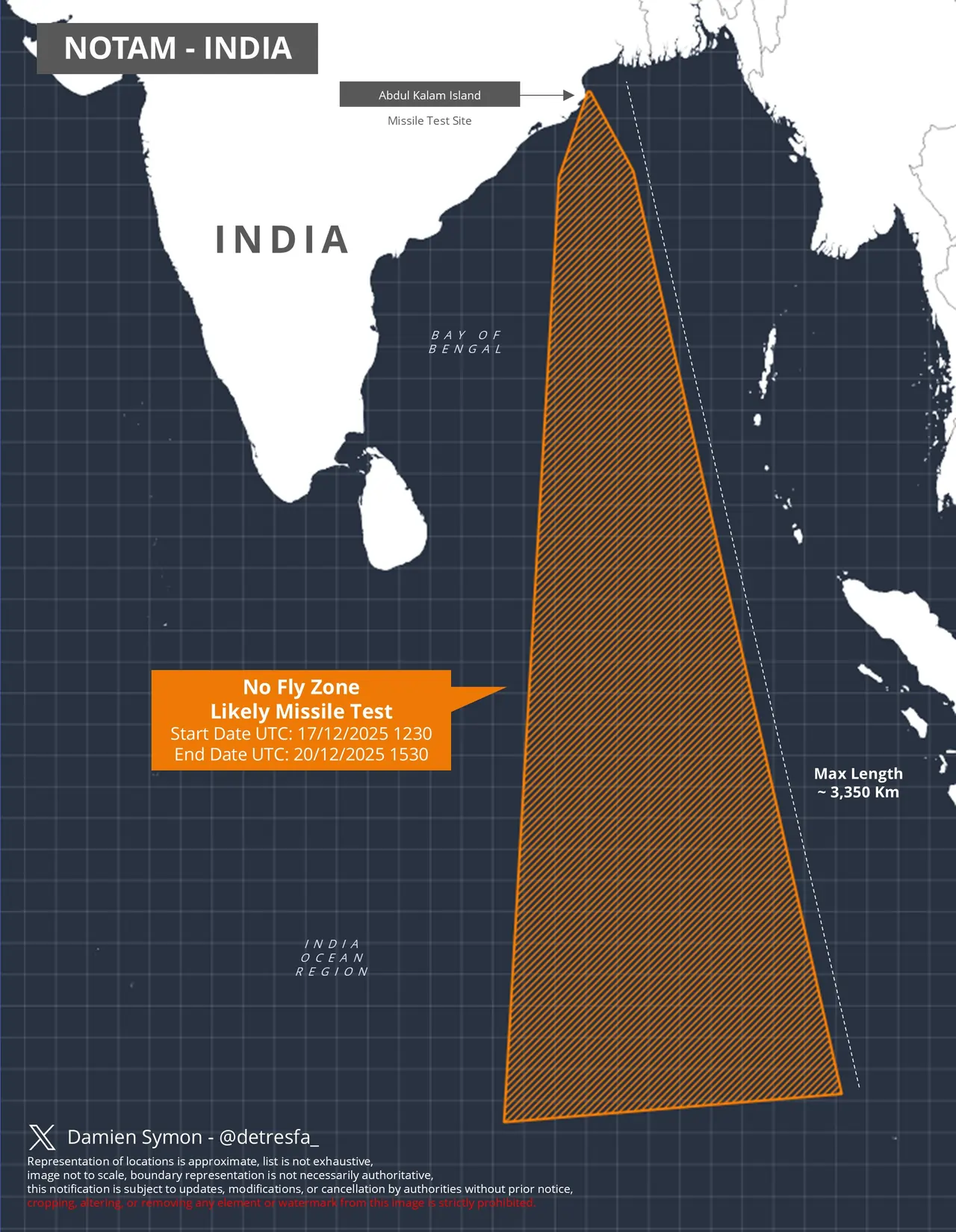
India has announced a critical missile test scheduled to take place in the Bay of Bengal from December 17 to 20, 2025, by issuing a Notice to Airmen (NOTAM). This important development highlights a significant advancement in the country’s strategic missile capabilities, with the establishment of a vast no-fly and no-ship exclusion zone extending up to 3,550 kilometers—one of the largest safety corridors ever designated for an Indian missile trial.
According to defence sources, the NOTAM will be in effect daily from 6:00 am to 6:00 pm IST during the test period. Civilian aviation and maritime operations have been advised to reroute to ensure safety, with the Indian Air Force and the Indian Navy set to jointly enforce the restrictions in light of potential debris risks from missile stages.
The magnitude of the exclusion zone dwarfs the 1,480-kilometer safety area that was declared during a previous missile test in October 2025, indicating that this test may be evaluating a longer-range strategic system.
Analysts speculate that the trial is closely associated with the K-4 submarine-launched ballistic missile (SLBM), a pivotal element of India’s sea-based nuclear deterrent. Developed by the Defence Research and Development Organisation (DRDO), the K-4 is a solid-fuel missile derived from Agni-series technology, designed to overcome the limitations posed by the shorter-range K-15 Sagarika.
The K-4 program was launched post the induction of INS Arihant in 2009, in an effort to ensure that India possesses a reliable second-strike capability in alignment with its policy of credible minimum deterrence.
INS Arihant, which was commissioned in 2016, along with INS Arighat, commissioned in 2024, can each carry four K-4 missiles. Meanwhile, upcoming S4 and S4* submarines are expected to accommodate as many as eight missiles per platform. By mid-2025, the K-4 is anticipated to achieve full operational status aboard Arihant-class SSBNs, following successful user trials with INS Arighat.
The upcoming December test is thought to focus on further validating the K-4’s range, accuracy, and system integration, potentially serving as advanced user or operational trials.
Strategically, the K-4, with an operational range of 3,000 to 3,500 kilometers, allows India to target strategic locations while remaining secure within ocean bastions. This significantly bolsters the nation’s sea-based nuclear capabilities and marks a considerable upgrade from the K-15, which has a 750-kilometer range. It also lays a foundation for future missile systems like the K-5 (5,000 kilometers) and the MIRV-capable K-6 (8,000 kilometers), which are expected to be deployed on next-generation S5-class SSBNs in the 2030s.
The missile’s development aligns with India’s strategic expansion efforts along the eastern seaboard, particularly in Visakhapatnam, which houses essential nuclear submarine and missile infrastructure.
The broadened exclusion zone also reflects the intricacies involved in full-range ballistic missile testing, encompassing various phases such as boost-phase ascent, mid-course flight, and terminal re-entry. The complexities related to solid-fuel stage separations and potential MIRV testing elements necessitate larger safety margins.
Defence officials have noted that previous K-4 trials in late 2024 entailed exclusion zones of about 2,000 kilometers; the current expansion indicates a growing confidence in the system’s maturity as it nears operational readiness.
Should this test be successful, it would further solidify India’s standing within the small group of nations that possess credible sea-based nuclear deterrents, enhancing strategic stability in the Indo-Pacific amidst shifting regional security dynamics.