




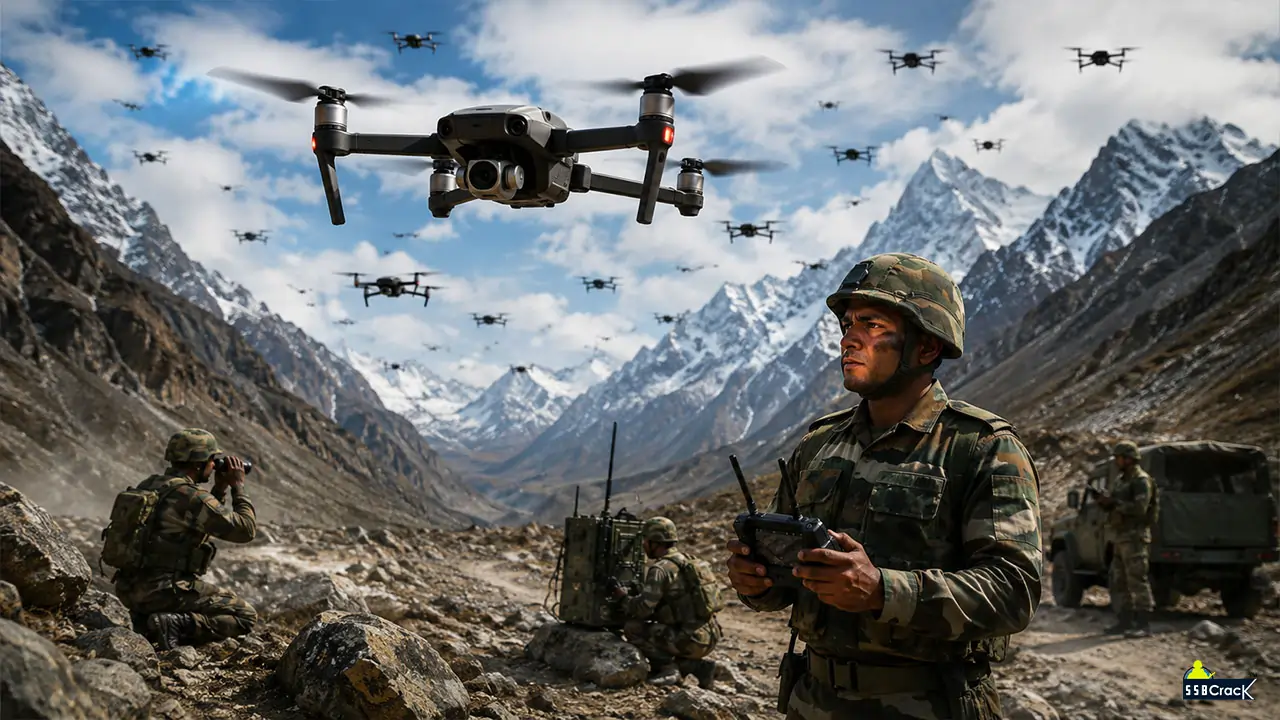
Since 2020, the Indian Army has made significant strides in enhancing its unmanned aerial vehicle (UAV) and loitering munition capabilities as part of its strategic response to evolving operational needs along the Line of Actual Control (LAC) and Line of Control (LoC). This development is informed by the insights gained from events such as the 2020 Galwan standoff and has been validated during operations, notably Operation Sindoor in 2025. The result is a diverse fleet of over 140 UAV platforms across nine categories by March 2026, a remarkable increase from fewer than a dozen UAVs in 2020.
The Indian Army’s advancements focus on persistent intelligence, surveillance, and reconnaissance (ISR) at medium altitudes. This includes a variety of tactical drones, man-portable and vehicle-launched loitering munitions, and cost-effective first-person view (FPV) systems. While exact quantities are often classified, assessments from open sources provide valuable insights into these developments.
In line with the Atmanirbhar Bharat initiative, the Indian Army emphasizes self-reliance through partnerships with private sector firms such as ideaForge, Solar Industries, Tata Advanced Systems, and Adani Defence. This collaborative approach complements the Army’s continued utilization of proven Israeli systems for crucial long-endurance ISR and specialized loitering missions. A pivotal initiative, the Ashney Drone Platoon Programme, aims to equip around 380 infantry battalions with dedicated drone teams, each typically comprising four surveillance drones and six armed or FPV loitering drones, targeting an impressive total of over 100,000 UAVs. This program was accelerated following lessons from Operation Sindoor, showcasing a doctrinal shift toward decentralized drone warfare at the unit level.
### Medium-Altitude Long-Endurance (MALE) UAVs
MALE UAVs are essential for broad-area surveillance, serving as the backbone of strategic ISR along India’s borders. The Heron family, particularly the Mk-I and Mk-II models from Israel Aerospace Industries (IAI), plays a crucial role. The Mk-I delivers long-endurance ISR capabilities with electro-optical/infrared (EO/IR) payloads, while the Mk-II enhances these features with satellite communication links and improved sensors. By 2023, the Indian Army had inducted at least four Mk-II units and maintained more than 30 Mk-I airframes.
Moreover, the Heron TP variant, known for its strike capabilities, has been integrated for extended endurance missions. Other platforms like the Searcher Mk-II support medium-range ISR roles.
Indigenous efforts are embodied in the TAPAS-BH-201 (formerly Rustom-2) and the Archer-NG drones from DRDO. While the TAPAS-BH-201 faced challenges and shifted focus, the Archer-NG is entering user trials and has the potential for armament integration. Additional prototypes remain in testing phases.
### Tactical, Mini, and Micro UAVs for ISR
The tactical and micro UAV category supports close-range reconnaissance and artillery spotting. The ideaForge SWITCH series dominates this segment, having undergone multiple emergency procurements for ISR missions. The Army has also added ultra-light drones such as the Black Hornet for soldier-level reconnaissance, alongside a suite of indigenous mini platforms.
Additionally, developments in swarm and multi-rotor systems are being spearheaded by firms like NewSpace Research & Technologies, alongside in-house Army initiatives aimed at creating autonomous swarm capability for various operational roles.
### Loitering Munitions and Kamikaze Drones
Loitering munitions have shown efficacy during Operation Sindoor and now constitute a key component of India’s precision-strike strategy. Indigenous systems like the Nagastra-1 offer a combat-ready profile with GPS guidance and significant range, while other models like the SkyStriker and ALS-50 are designed for tactical engagements.
In-house FPV kamikaze drones produced by the Army’s Rising Star Drone Battle School showcase technological innovation aimed at anti-tank operations, emphasizing simplicity and real-time FPV capabilities.
### Target Drones and Specialised Systems
The DRDO has developed Lakshya and Abhyas target drones for air-defence training and validation of weapon systems, though emerging logistics and heavy-payload drones are still in early stages of development.
### Summary and Future Outlook
By mid-2026, the Indian Army’s drone capabilities reflect a pragmatic two-tiered strategy emphasizing both high-end ISR and tactical precision strike. Enhancements in indigenous technologies signify a commitment to self-reliance while scrutinizing gaps in MALE-class platforms. The Ashney Drone Platoon Programme represents a transformative shift that could empower ground forces significantly.
Moving forward, the Army is expected to prioritize electronic-warfare resilience, AI-enabled systems, and enhanced drone integration with traditional military units. Continuous advancements will be crucial in maintaining operational superiority in contested environments, ensuring India’s armed forces remain well-equipped for future challenges.


