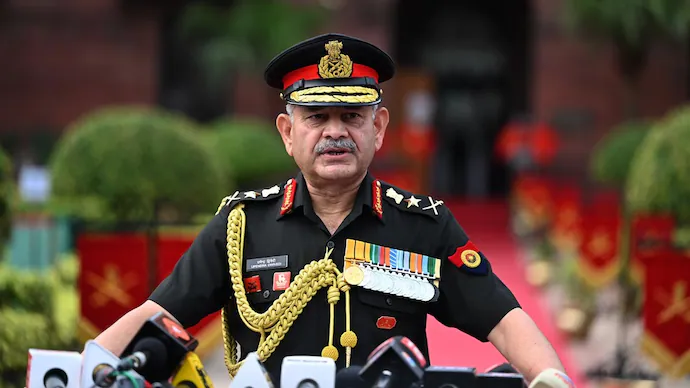
The Indian Army has firmly dismissed China’s renewed assertions regarding the Shaksgam Valley. Chief of the Army Staff General Upendra Dwivedi articulated India’s stance, emphasizing that any activities in the region are not approved by New Delhi, and described Beijing’s position as unacceptable.
During his annual press conference ahead of the 78th Army Day, General Dwivedi reiterated that India regards the China-Pakistan Boundary Agreement of 1963, which resulted in Pakistan’s illegal cession of approximately 5,180 square kilometers of Indian territory in Pakistan-occupied Kashmir to China, as invalid and illegal. He firmly stated, “We do not approve of any activity in Shaksgam Valley,” affirming India’s view that the area is an integral part of the nation. He further noted that India does not recognize any infrastructure projects executed under the China-Pakistan Economic Corridor (CPEC), as these ventures infringe upon Indian territory that is under forcible and illegal occupation.
These responses follow China’s recent assertion claiming Shaksgam Valley as its territory, contending its right to construct infrastructure within the region. In reaction, General Dwivedi firmly maintained that India does not acknowledge any statements from China regarding CPEC or projects conducted in partnership with Pakistan.
The Ministry of External Affairs has consistently reiterated that Shaksgam Valley is Indian territory and has never recognized the contentious 1963 agreement between China and Pakistan.
Turning to the broader situation along the northern borders, General Dwivedi remarked that while the Line of Actual Control (LAC) remains stable, it necessitates persistent vigilance. He highlighted that high-level military and diplomatic dialogues, along with renewed contacts and confidence-building measures, have contributed to a gradual normalization of relations. He mentioned that such initiatives have enabled activities like grazing and welfare camps near the borders, emphasizing India’s balanced and robust deployment along the LAC, which is further supported by ongoing infrastructure development across various government sectors.
In an update on the situation in eastern Ladakh, the Army Chief confirmed that patrolling in Demchok and Depsang has resumed after a hiatus of over four years, thereby restoring conditions to those seen before April 2020.
On the western front, General Dwivedi addressed the drop in terrorist activities, noting that incidents have nearly reached zero following “Operation Sindoor,” a calculated military response to the April 22 Pahalgam terror incident. Nevertheless, he warned that eight terror camps remain operational in Pakistan, housing an estimated 100 to 150 terrorists. He cautioned that any future threats directed towards India would be met with resolute responses, highlighting that Operation Sindoor showcased India’s readiness, precision, and strategic clarity.
General Dwivedi’s statements underscored India’s enduring commitment to territorial sovereignty, the rejection of illegal agreements, and the resolve to maintain peace through preparedness and vigilance along both the northern and western fronts.