In a significant development for India’s defence sector, Nagpur-based Solar Defence and Aerospace Limited (SDAL) has begun delivering its indigenously developed Nagastra-2 anti-tank loitering munition system to the Indian Army. The advanced system is designed to engage armoured targets with precision while maintaining operational effectiveness in electronically contested battlefield environments.
Indian Army Receives First Batch of Indigenous Nagastra 2
In a significant development for India’s defence sector, Nagpur-based Solar Defence and Aerospace Limited (SDAL) has begun delivering its indigenously developed Nagastra-2 anti-tank loitering munition system to the Indian Army. The advanced system is designed to engage armoured targets with precision while maintaining operational effectiveness in electronically contested battlefield environments.
The development strengthens India’s efforts towards defence self-reliance and the indigenous production of advanced military technologies.
What Is Nagastra-2?
Nagastra-2 is an indigenous anti-tank loitering munition designed to locate and engage targets, particularly armoured vehicles. Loitering munitions can remain airborne while searching for a target before being directed to strike it.
The system combines day-and-night surveillance capabilities, an anti-tank warhead and electronic warfare resilience, making it suitable for modern battlefield requirements.
Key Features and Capabilities
1. Advanced Anti-Tank Warhead
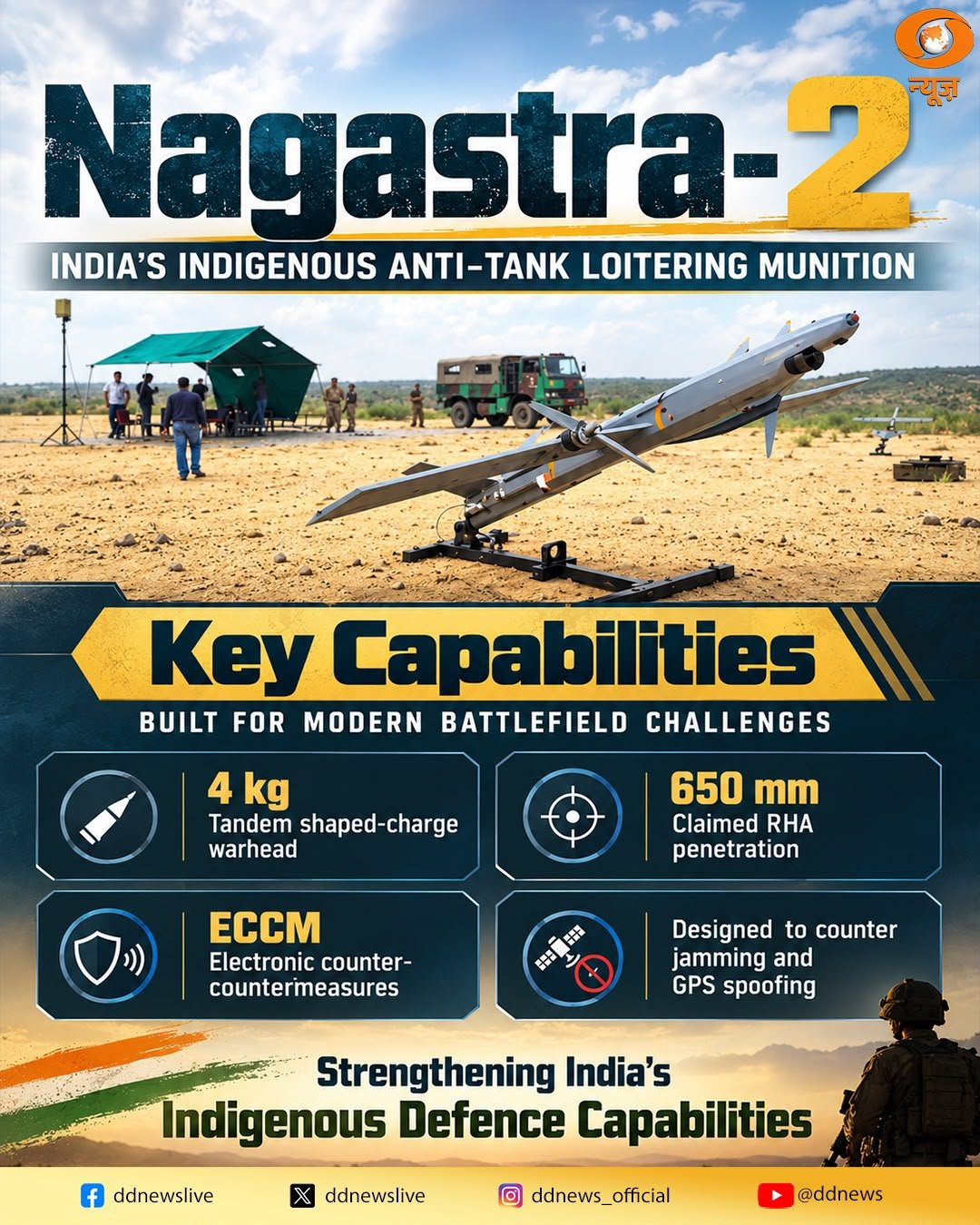
Nagastra-2 is equipped with a 4 kg tandem shaped-charge warhead designed to defeat Explosive Reactive Armour (ERA) and penetrate up to 650 mm of Rolled Homogeneous Armour (RHA). These capabilities enhance its effectiveness against heavily protected armoured targets.
2. Operational Range
The system offers different operational ranges depending on its mode of operation:
- Recover-and-reuse mode: 25 km
- Fire-and-forget mode: 50 km
- Endurance: Up to 60 minutes
The recover-and-reuse mode allows the system to be recovered for another use, while fire-and-forget mode enables it to proceed towards its target after launch without continuous operator control.
3. Day-and-Night Surveillance
Nagastra-2 features electro-optical surveillance cameras for day-and-night operations. These sensors support target detection, tracking and precision engagement in different battlefield conditions.
4. Electronic Warfare Resistance
One of the system’s important technological features is its Electronic Counter-Countermeasures (ECCM) capability. It is designed to improve resilience against electronic warfare threats, including:
- Communication jamming
- GPS jamming
- GPS spoofing
This capability is particularly relevant in modern conflicts, where electronic interference can disrupt navigation and communication systems.

Technical Trials at Mahajan Field Firing Range
According to Solar Defence and Aerospace Limited, Nagastra-2 successfully completed its technical trials at the Mahajan Field Firing Range (MFFR), Rajasthan, in August 2026.
The trials assessed the system’s operational performance and compliance with ECCM requirements. Their successful completion marked an important step towards supplying the system to the Indian Army.
Previous Procurement: Nagastra-1R
In 2025, the Indian Army placed an order with Solar Defence and Aerospace Limited for approximately 450 Nagastra-1R loitering munitions.
The Nagastra-1R system includes reusable launcher equipment, a 360-degree gimbal camera and an optional thermal camera for night operations. It also incorporates encrypted video and telemetry communications and a precision-targeting system with a reported Circular Error Probable (CEP) of two metres.
The system reportedly contains more than 80% indigenous content. Its testing has included locations such as Ladakh and Babina near Jhansi, Uttar Pradesh.
Nagastra-1R and Nagastra-2 represent different systems within India’s expanding indigenous loitering-munition capabilities.
Significance for India’s Defence Sector
The delivery of Nagastra-2 is important for several reasons:
- Defence self-reliance: It supports domestic development and manufacturing of advanced military equipment.
- Enhanced anti-armour capability: Its tandem warhead is designed to engage heavily protected armoured targets.
- Electronic warfare resilience: ECCM features help address communication and navigation interference.
- Operational flexibility: Different operating modes provide options for precision engagement and recovery.
- Growth of private defence manufacturing: The programme highlights the contribution of Indian private-sector companies to military modernisation.