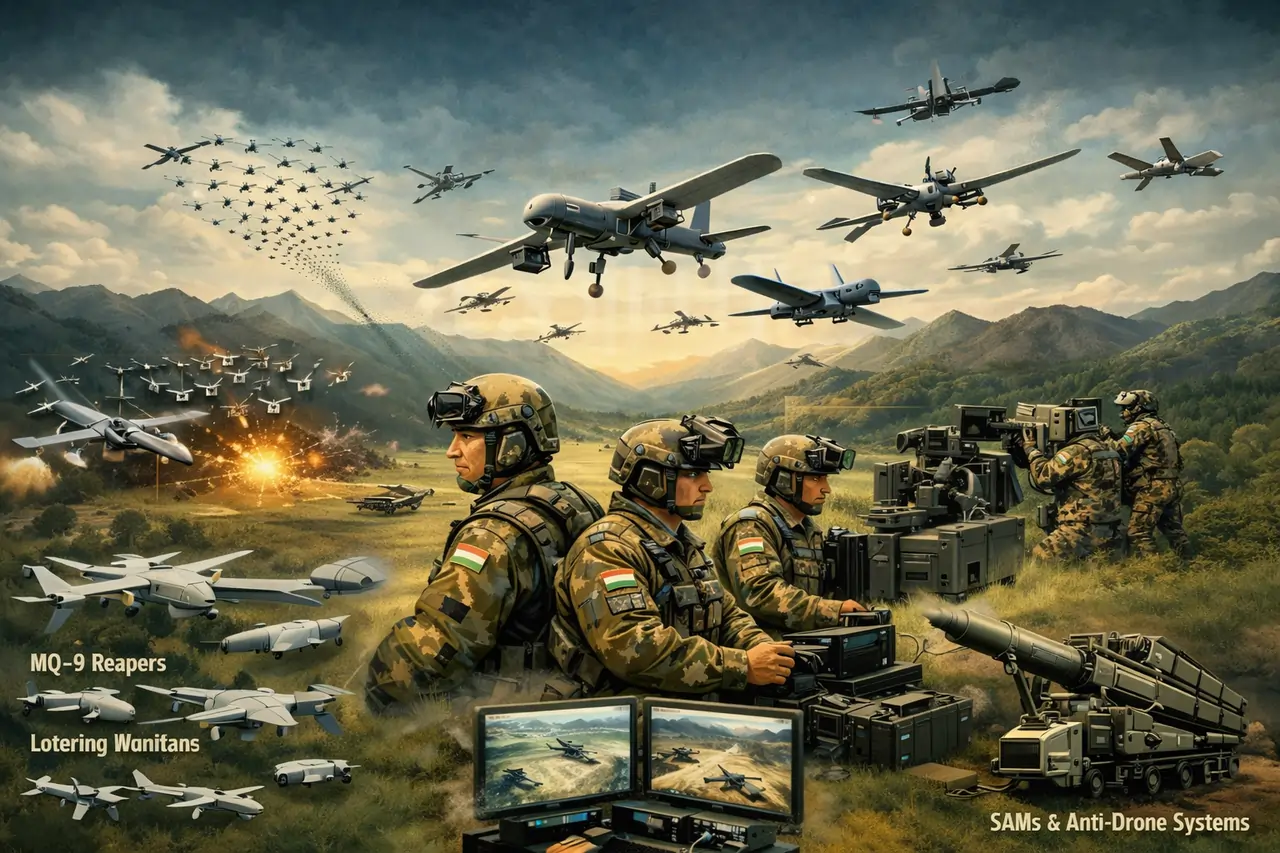
In a groundbreaking shift in military strategy, the Indian Army is set to establish 15 to 20 specialized drone warfare units, designated as Shaktibaan Drone Regiments. This move is one of the most significant advancements in India’s land warfare doctrine, emphasizing the crucial roles of unmanned systems, autonomous platforms, and precision strikes in modern combat.
This initiative is part of a comprehensive vision for force transformation under General Upendra Dwivedi, designed to prepare India for a future battlefield landscape increasingly characterized by drones, loitering munitions, and network-centric warfare strategies.
Understanding Shaktibaan Drone Regiments
The Shaktibaan Regiments will be integrated into the Indian Army’s existing artillery framework, but they will be distinctively centered around unmanned aerial combat systems. Unlike traditional artillery units that focus on traditional weapons like guns or rockets, these regiments will leverage advanced aerial technology.
The regiments are anticipated to deploy a variety of systems, including:
- Swarm drones
- Loitering munitions (also referred to as kamikaze drones)
- Long-range unmanned aerial vehicles (UAVs)
These capabilities allow the Indian Army to conduct strikes on targets situated anywhere from 5 kilometers to nearly 500 kilometers within enemy territory without jeopardizing the safety of pilots or large troop deployments. Initial units of the Shaktibaan Regiments are reportedly in the process of being operationalized, with further rollouts planned in stages.
Significance of the Shaktibaan Regiments
Recent conflicts worldwide have underscored the transformative impact of drones on battlefield dynamics, ranging from reconnaissance to high-precision strikes. The establishment of the Shaktibaan Regiments represents the Indian Army’s proactive approach to adapt to these evolving realities.
These new units are designed to:
- Enhance precision strike capabilities across multiple battlefronts
- Decrease dependence on manned aircraft for high-risk missions
- Facilitate rapid, scalable, and cost-effective deployment of combat resources
- Support multi-domain operations by integrating air, land, cyber, and electronic warfare strategies
By incorporating drones directly into artillery operations, the Army aims to achieve instantaneous surveillance-to-strike capabilities, significantly reducing both decision-making and response times.
Key Technological Innovations in Shaktibaan Regiments
-
Swarm Drone Technology: Operated as coordinated units, swarm drones share data in real-time, enabling operations that can overwhelm enemy air defenses and conduct simultaneous reconnaissance and offensive missions with minimal oversight from operators.
-
Loitering Munitions: Often known as kamikaze drones, these systems combine reconnaissance and attack roles. They can hover over targets for extended periods, confirming them before launching an attack, thus ensuring high precision with reduced collateral damage.
- Long-Range UAVs: These drones will enhance the capabilities of traditional artillery systems like Pinaka and strategic missiles such as BrahMos, providing consistent intelligence, surveillance, and reconnaissance (ISR) while also offering deep strike options that can defuse potential escalations to missile engagements.
Accelerated Procurement and Support for Indigenous Industry
To equip the newly formed Shaktibaan Regiments, the Indian Army plans to initiate fast-track tenders for the acquisition of approximately 850 loitering munitions, including necessary launchers and support equipment. This procurement effort, estimated at ₹2,000 crore, is expected to engage major Indian defense manufacturers like Solar Defence & Aerospace, Adani Defence, and RapheM, with deliveries projected within two years, aligning with India’s self-reliance push (Atmanirbhar Bharat) in defense manufacturing.
Integration into a Comprehensive Drone Warfare Ecosystem
The Shaktibaan Regiments are part of a larger framework that includes training more than 100,000 drone operators and the establishment of Ashmi drone platoons within infantry units, alongside the formation of Bhairav Special Forces focused on drone-centric operations. Together, these initiatives mark a critical transition from conventional platform-centric warfare to technology-driven, unmanned combat methodologies.
Strategic Implications for Future Warfare
The introduction of 15 to 20 Shaktibaan Drone Regiments positions the Indian Army to navigate the future of warfare effectively—where speed, autonomy, precision, and information superiority will overshadow traditional numerical advantages. As India addresses the complex security challenges along its western and northern borders, the Shaktibaan initiative highlights a significant doctrinal evolution, ensuring that the Army remains nimble, lethal, and technologically advanced in an era where the character of combat is rapidly transforming.