




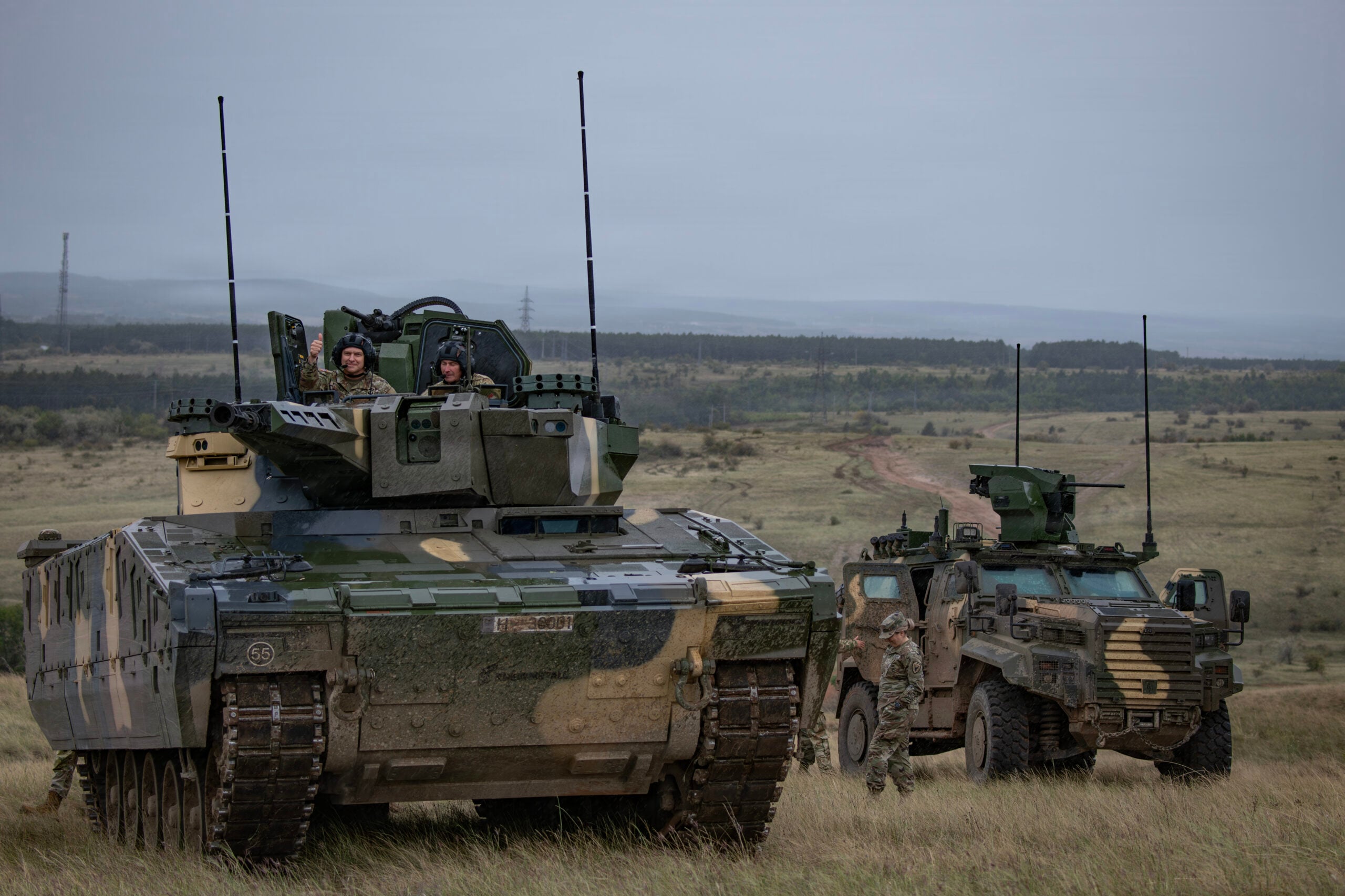
Most infantry fighting vehicles currently in service were developed in earlier decades, with models like the Bradley tracing their roots back to the 1970s and the CV90 entering service in the 1990s. The more recently developed Puma, Germany’s latest IFV, faced delays and budget overruns that extended its development over nearly two decades. In contrast, Rheinmetall’s Lynx was designed to break this trend, emerging as a groundbreaking choice for contemporary armored warfare.
Conceived as a privately funded, clean-sheet design, the Lynx is distinctly positioned for the threats and operational challenges of the 21st century. It emphasizes modular armor, digital connectivity, and drone integration, while also offering a family of variants based on a single hull configuration. This innovative approach has made the Lynx one of the most commercially successful new-generation infantry fighting vehicles, securing contracts in Hungary, Romania, Italy, and Ukraine, even before its initial combat deployment.
The Lynx is designed to fulfill the dual role of armored troop transport and mechanized infantry support, accommodating up to eight troops with a crew of three. Its dimensions include a length of 7.84 meters, a height of 3.3 meters, and a maximum weight of 50 tons, and it can reach speeds of up to 70 kilometers per hour. The vehicle features active protection systems and a choice of armaments, including a 30 mm or 35 mm autocannon, a coaxial machine gun, and optional anti-tank guided missiles.
The vehicle’s modular design allows for rapid adaptation to various missions, with capabilities extending to reconnaissance, command and control, fire support, air defense, medical evacuation, and recovery. Its digital architecture supports future upgrades, integrating sensors and technologies that enhance situational awareness.
Notably, the Lynx has two primary variants: the KF31, designed for lighter tasks, and the more widely adopted KF41, which boasts increased troop and cargo capacity, as well as more advanced technological integrations. Rheinmetall also has plans for a range of mission-specific variants, including heavy fire support, command vehicles, and reconnaissance units, demonstrating the versatility of this platform.
Despite its strengths, the Lynx does face challenges. Its operational track record remains limited compared to established vehicles like the Bradley and CV90. Additionally, the advanced features and capabilities of the Lynx come with higher acquisition costs, which may pose constraints for some defense budgets. Operators must also consider that adding new technologies and equipment could increase the vehicle’s overall weight, potentially affecting its mobility.
On the international stage, the Lynx has made significant inroads, starting with Hungary as its first customer, which ordered over 200 KF41 vehicles as part of a modernization initiative. This also included provisions for local production, establishing Hungary as a key industrial ally. Romania has also embraced the Lynx, bringing the vehicle into its mechanized forces to strengthen NATO’s eastern defenses.
In Italy, the Lynx was selected for the nation’s future infantry fighting vehicle program, while discussions have taken place regarding potential use in Ukraine, indicating a flexible approach to meet varying military requirements across Europe. Despite losing out to Hanwha’s Redback in Australia’s recent Project Land 400 Phase 3 competition, the Lynx continues to evolve, targeting emerging defense challenges with plans for integrated counter-drone capabilities and enhanced networking systems.
With militaries increasingly focused on survivability, digital integration, and modularity, the Lynx is poised to assert itself as a key player in the next generation of infantry fighting vehicles, adapting to meet the dynamic demands of modern combat.


