




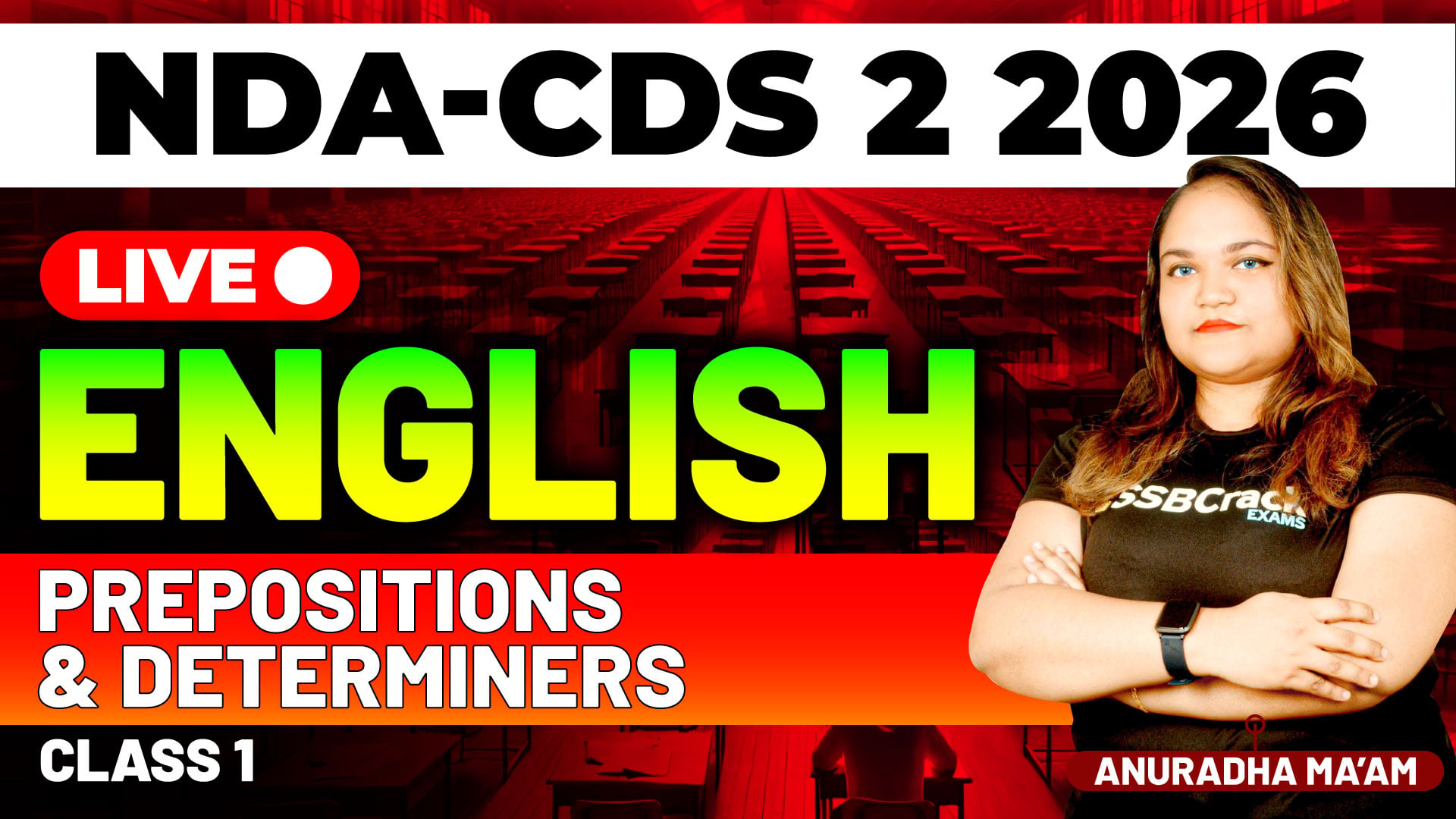
Prepositions and Determiners are among the most fundamental grammar topics in the English section of NDA and CDS examinations. Questions based on these topics are generally asked in the form of Fill in the Blanks, where candidates are required to choose the most appropriate word to complete a sentence meaningfully and grammatically. Since even a minor mistake in the use of a preposition or determiner can change the meaning of a sentence, a thorough understanding of their rules and usage is essential for scoring well in the English section.
The English Prepositions & Determiners Live Class conducted for NDA & CDS 2 2026 aspirants focused on strengthening candidates’ understanding of the grammatical rules governing the use of prepositions and determiners. The session combined conceptual learning with extensive examination-oriented practice questions, enabling candidates to apply grammar rules confidently while solving multiple-choice questions. Through detailed explanations and discussions of commonly tested patterns, candidates learned how to identify the correct option using both grammatical knowledge and contextual understanding.
Importance of Prepositions and Determiners in NDA and CDS Examinations
Questions based on Prepositions and Determiners frequently appear in competitive examinations because they test a candidate’s grammatical accuracy and language proficiency.
These questions help evaluate:
- Knowledge of English grammar
- Vocabulary usage
- Sentence construction skills
- Contextual understanding
- Language accuracy
- Analytical thinking
A strong command of these topics not only improves performance in Fill in the Blanks but also supports other grammar-based sections such as Spotting Errors, Sentence Improvement, Cloze Test, Choosing Correct Sentences, and Comprehension.
Objectives of the Live Class
The primary objective of the session was to help candidates develop a thorough understanding of the rules governing Prepositions and Determiners and apply these concepts effectively while solving examination-oriented questions.
During the class, candidates learned how to:
- Identify the correct preposition according to context.
- Use determiners appropriately before nouns.
- Recognize commonly tested grammatical patterns.
- Eliminate incorrect options logically.
- Apply grammar rules accurately in Fill in the Blanks questions.
- Improve both speed and accuracy in solving MCQs.
The session emphasized conceptual clarity alongside regular practice.
Understanding Prepositions
The class began with a detailed discussion of prepositions.
A preposition is a word that shows the relationship between a noun or pronoun and another word in the sentence. It often indicates time, place, direction, manner, cause, possession, or movement.
Examples include:
- In
- On
- At
- By
- For
- With
- Between
- Among
- Into
- Through
- During
- Since
Candidates learned that selecting the correct preposition depends on understanding both grammar and context.
Types of Prepositions Discussed
The session covered the major categories of prepositions commonly tested in defence examinations.
Prepositions of Time
Candidates revised the correct use of:
- At
- On
- In
- Since
- For
- During
- Until
- By
Special emphasis was placed on understanding the differences between these commonly confused prepositions.
Prepositions of Place
The class discussed the correct use of:
- In
- On
- At
- Above
- Below
- Under
- Over
- Between
- Among
- Behind
- Beside
Candidates practiced selecting the most appropriate preposition based on the location described in the sentence.
Prepositions of Movement
The session also included commonly tested prepositions expressing movement.
Examples included:
- Into
- Onto
- Across
- Through
- Towards
- Along
- Up
- Down
Understanding movement-related expressions helped candidates solve contextual Fill in the Blanks questions more accurately.
Understanding Determiners
The second part of the class focused on Determiners.
Determiners are words placed before nouns to specify or limit their meaning. They indicate quantity, possession, number, definiteness, or indefiniteness.
Common determiners discussed included:
- A
- An
- The
- This
- That
- These
- Those
- Some
- Any
- Much
- Many
- Few
- Little
- Each
- Every
- Either
- Neither
Candidates learned how determiners influence the meaning and grammatical correctness of a sentence.
Types of Determiners Covered During the Session
Several important categories of determiners were discussed.
Articles
The class revised the correct use of:
- A
- An
- The
Candidates practiced identifying situations where articles should be used or omitted.
Demonstrative Determiners
Candidates revised:
- This
- That
- These
- Those
Special attention was given to singular-plural agreement and reference to nearby or distant objects.
Quantifiers
The session covered important quantifiers such as:
- Some
- Any
- Much
- Many
- Few
- Little
- Several
- Enough
Candidates learned to select quantifiers based on countable and uncountable nouns.
Distributive Determiners
The class also discussed:
- Each
- Every
- Either
- Neither
Practice questions demonstrated their correct grammatical usage in sentences.
Fill in the Blanks Practice
The major focus of the live class was solving examination-oriented Fill in the Blanks questions.
Candidates were provided with sentences containing missing prepositions or determiners and were required to choose the most appropriate option from four alternatives.
Each question required candidates to:
- Read the complete sentence carefully.
- Understand the context.
- Recall the relevant grammar rule.
- Eliminate grammatically incorrect options.
- Select the most appropriate answer.
Detailed explanations followed every question to reinforce conceptual understanding.
Commonly Confused Prepositions Practiced
Several pairs of commonly confused prepositions were discussed during the session.
These included:
- In and Into
- On and Upon
- Between and Among
- Since and For
- By and Until
- Beside and Besides
- Above and Over
- Below and Under
Candidates practiced identifying the correct usage based on sentence context.
Commonly Tested Determiner Rules
The session also emphasized important determiner rules frequently asked in examinations.
Topics included:
- A versus An
- Much versus Many
- Few versus A Few
- Little versus A Little
- Some versus Any
- Each versus Every
- Either versus Neither
Practice questions highlighted subtle differences in meaning and usage.
Common Errors Discussed During the Session
Several mistakes frequently made by aspirants were highlighted.
These included:
- Choosing prepositions based on literal translation rather than English usage.
- Confusing similar determiners.
- Ignoring noun countability.
- Overlooking sentence context.
- Selecting grammatically correct but contextually inappropriate options.
Candidates learned how careful reading and rule-based analysis can prevent these mistakes.
Examination-Oriented Strategies
The class introduced practical strategies for solving Prepositions and Determiners questions efficiently.
Read the Entire Sentence
Candidates were advised to understand the complete meaning before selecting an option.
Identify Grammar Clues
Nearby words often indicate which preposition or determiner is required.
Focus on Context
Many questions cannot be solved through memorization alone and require contextual understanding.
Eliminate Incorrect Options
Removing clearly unsuitable choices improves the chances of selecting the correct answer.
Revise Common Usage Patterns
Frequent revision of standard English expressions increases accuracy in examinations.
Importance of Regular Practice
The session emphasized that mastery of Prepositions and Determiners develops through continuous exposure to varied sentence patterns.
Regular practice helps candidates:
- Improve grammatical accuracy.
- Build vocabulary.
- Strengthen contextual understanding.
- Increase examination speed.
- Develop confidence in solving Fill in the Blanks questions.
Practice remains the most effective method for mastering these topics.
Benefits of Learning Prepositions and Determiners
A thorough understanding of these grammar topics offers several advantages.
It helps candidates:
- Improve overall English grammar.
- Strengthen sentence construction skills.
- Enhance reading comprehension.
- Develop better writing abilities.
- Perform well in grammar-based examination questions.
These concepts also improve communication skills beyond competitive examinations.
Preparation Tips for NDA & CDS 2 2026 Aspirants
To perform well in Prepositions and Determiners questions, candidates should:
- Revise grammar rules regularly.
- Learn commonly used prepositional phrases.
- Practice Fill in the Blanks questions daily.
- Read quality English newspapers and articles.
- Solve previous years’ examination papers.
- Maintain notes on commonly confused words.
- Review mistakes made during practice sessions.
A consistent and disciplined approach significantly improves performance.
Key Learning Outcomes from the Live Class
By the end of the session, candidates had developed a stronger understanding of:
- Rules governing prepositions.
- Correct use of determiners.
- Contextual grammar application.
- Common examination patterns.
- Fill in the Blanks solving techniques.
- Elimination strategies for MCQs.
These skills are essential for scoring well in grammar-based sections of NDA and CDS examinations.
Conclusion
The English Prepositions & Determiners Live Class for NDA & CDS 2 2026 aspirants provided comprehensive coverage of one of the most important grammar topics in the English syllabus. Through detailed explanations of grammatical rules and extensive practice of examination-oriented Fill in the Blanks questions, candidates strengthened their understanding of prepositions, determiners, and their contextual usage.
The session reinforced the importance of combining grammatical knowledge with careful reading and logical analysis while attempting multiple-choice questions. With regular revision, consistent practice, and familiarity with standard usage patterns, aspirants can significantly improve their accuracy and confidence in Prepositions and Determiners and strengthen their overall preparation for NDA and CDS examinations.


