




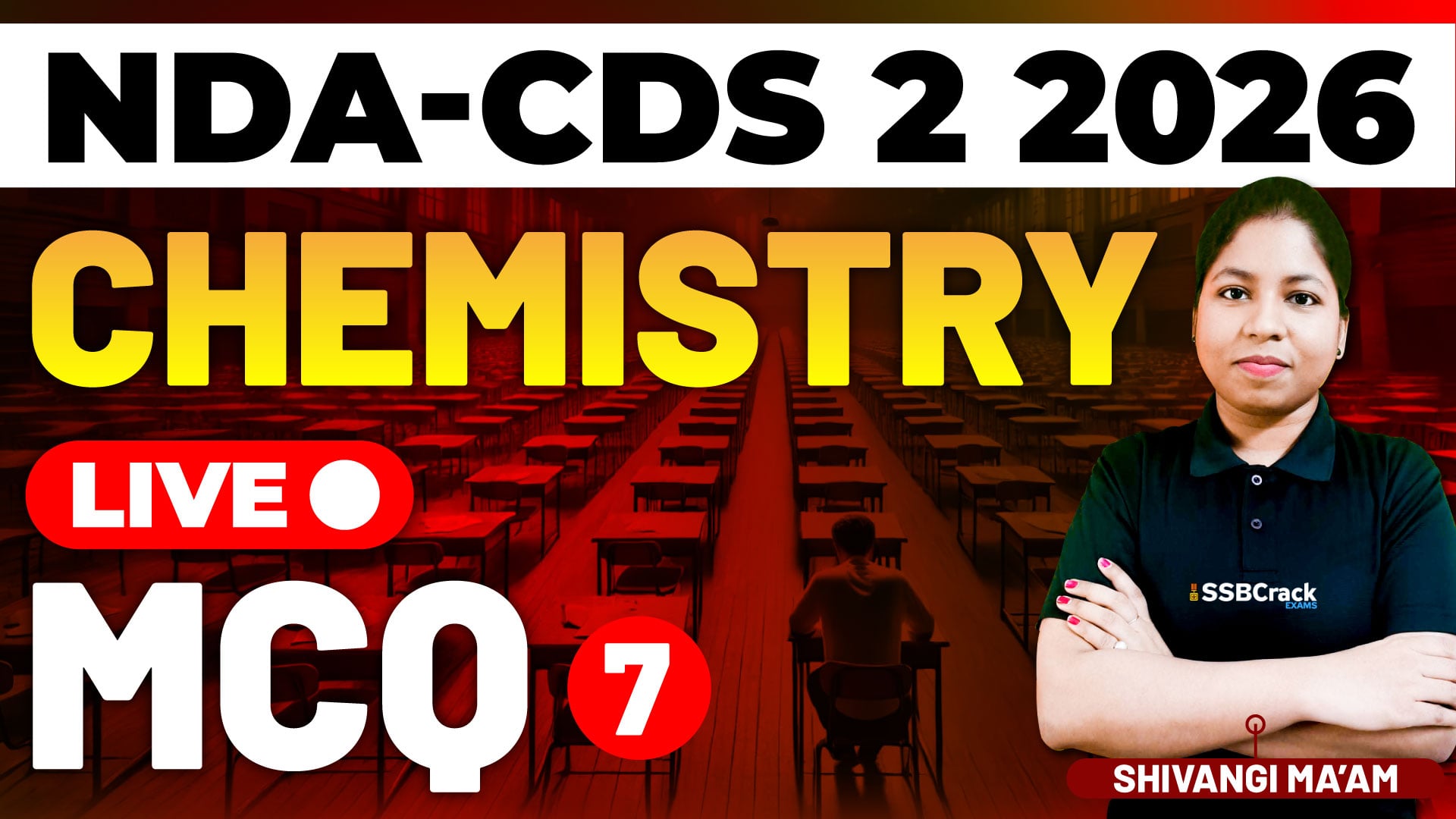
Today’s live session was strategically designed to strengthen the foundation of two of the most important chapters in the NDA/CDS Chemistry syllabus—Atomic Structure and Mole Concept. Since these topics consistently contribute questions in the examination, the class focused primarily on solving Previous Year Questions (PYQs) to help students understand the pattern, difficulty level, and frequently tested concepts. The objective was not only to revise the theory but also to develop the analytical approach required to solve examination-oriented questions accurately and within the stipulated time.
During the session, we began with a quick conceptual revision of Atomic Structure, covering fundamental ideas such as the structure of the atom, subatomic particles, atomic models, electronic configuration, quantum numbers, and the relationship between atomic number and mass number. These concepts were then reinforced through carefully selected PYQs, where students learned to identify recurring question patterns and eliminate incorrect options using conceptual understanding instead of guesswork. Special emphasis was placed on avoiding common mistakes that candidates often make in the examination.
The second part of the class focused on the Mole Concept, one of the highest-scoring and calculation-based topics in Chemistry. Students revised the concepts of mole, Avogadro’s number, molar mass, molecular mass, empirical and molecular formulas, percentage composition, and stoichiometric calculations. Numerous PYQs were discussed step-by-step, highlighting shortcut techniques, unit conversions, and time-saving methods that are particularly useful in competitive examinations like NDA and CDS. The emphasis remained on improving calculation speed without compromising accuracy.
Throughout the class, students were encouraged to analyze every question logically rather than memorizing answers. The PYQs served as a tool to identify important concepts, understand the examiner’s approach, and build confidence for solving similar questions in the upcoming examination. Regular interaction and doubt-solving ensured that every concept was thoroughly understood before moving to the next problem.
In conclusion, today’s session provided a strong conceptual revision along with extensive practice of previous year questions from Atomic Structure and Mole Concept. Students are advised to revise the class notes, reattempt all the discussed PYQs independently, and practice additional numerical questions to further strengthen their preparation. Consistent revision and regular PYQ practice will significantly improve both conceptual clarity and examination performance, giving aspirants a competitive edge in the NDA/CDS 2 2026 Chemistry paper.


