




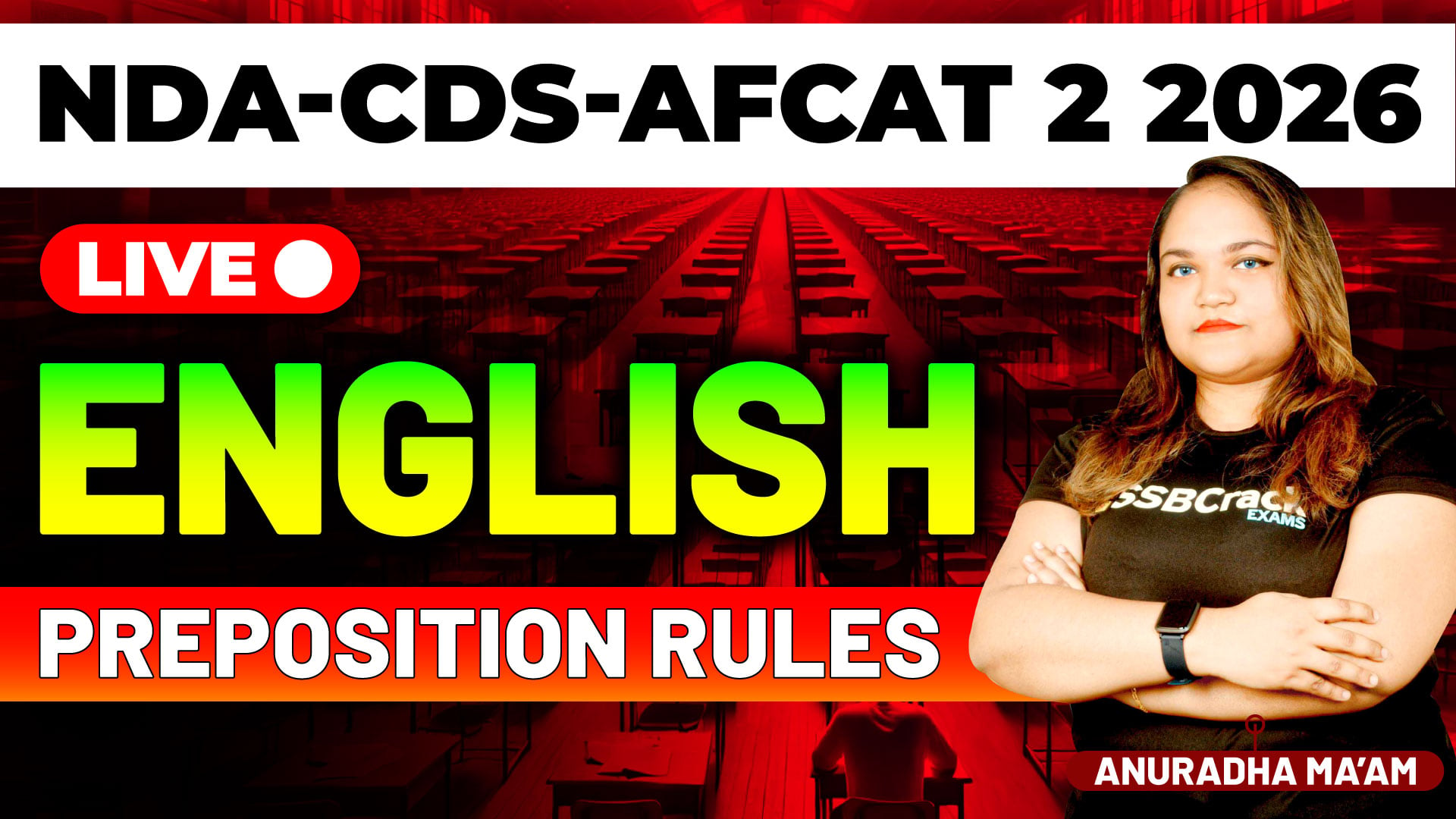
Prepositions are among the most frequently tested topics in the English sections of NDA, CDS, and AFCAT examinations. Questions based on prepositions regularly appear in Spotting Errors, Sentence Improvement, Fill in the Blanks, Cloze Test, Completion of Sentences, and other grammar-based topics. Since prepositions establish relationships between words in a sentence, their correct usage is essential for grammatical accuracy and effective communication.
In the English Live Class conducted for NDA, CDS & AFCAT 2 2026 aspirants, a detailed discussion was held on the concept of prepositions, important usage rules, common exam-oriented prepositional combinations, and the techniques required to solve multiple-choice questions accurately. The session emphasized both conceptual understanding and practical application, enabling candidates to improve their performance in grammar-based questions frequently asked in defence examinations.
What Is a Preposition?
A preposition is a word that shows the relationship of a noun or pronoun with another word in the sentence. It may indicate place, time, direction, cause, manner, possession, or association.
Examples:
- The book is on the table.
- The cadets arrived at the academy.
- The meeting will begin at 9 a.m.
- The aircraft flew over the mountains.
In each sentence, the preposition establishes a specific relationship between two elements.
Why Are Prepositions Important in Defence Exams?
Questions involving prepositions are common because they test a candidate’s practical command of English rather than mere theoretical knowledge. Examiners often assess whether candidates can identify the correct preposition according to context and established usage.
Prepositions play an important role in:
- Spotting Errors
- Sentence Improvement
- Fill in the Blanks
- Cloze Test
- Completion of Sentences
- Reading Comprehension
- Choosing Correct Sentence
- Phrasal Verb Questions
A strong understanding of prepositions significantly improves accuracy in grammar-based sections.
Types of Prepositions Covered in the Live Class
1. Prepositions of Time
Used to indicate time relationships.
Examples:
At
Used for a specific time.
- The parade starts at 6 a.m.
- The meeting begins at noon.
On
Used for days and dates.
- The examination is on Sunday.
- Independence Day is celebrated on 15 August.
In
Used for months, years, seasons, and longer periods.
- The course begins in July.
- He was born in 2005.
These distinctions are frequently tested in Fill in the Blanks and Spotting Errors.
2. Prepositions of Place
Used to indicate location.
At
Used for a specific point or location.
- She is at the station.
In
Used for enclosed spaces.
- The cadets are in the classroom.
On
Used for surfaces.
- The files are on the desk.
Candidates often confuse these three prepositions, making them a popular examination topic.
3. Prepositions of Movement
Used to indicate direction or movement.
Examples:
- into
- onto
- towards
- through
- across
Example:
- The soldiers marched towards the border.
- The aircraft flew across the valley.
Important Preposition Rules Discussed in the Live Class
Rule 1: Correct Use of “Between” and “Among”
Between
Used for two persons or things.
- The agreement was signed between India and Nepal.
Among
Used for more than two persons or things.
- The prizes were distributed among the participants.
Incorrect usage of these prepositions is frequently tested.
Rule 2: Correct Use of “Since” and “For”
Since
Used to indicate a specific point in time.
- He has been preparing since January.
For
Used to indicate a period of time.
- He has been preparing for six months.
This rule commonly appears in Fill in the Blanks and Sentence Improvement questions.
Rule 3: Correct Use of “By” and “With”
By
Indicates the doer of an action.
- The report was prepared by the officer.
With
Indicates an instrument or means.
- He wrote the letter with a pen.
Candidates often confuse these two prepositions in Active-Passive Voice questions.
Rule 4: Correct Use of “Into” and “In”
Into
Indicates movement.
- The cadet entered into the room.
In
Indicates position.
- The cadet is in the room.
Understanding this distinction helps avoid common grammatical mistakes.
Rule 5: Correct Use of “Beside” and “Besides”
Beside
Means next to.
- The vehicle was parked beside the building.
Besides
Means in addition to.
- Besides English, she studies Mathematics.
These words are frequently included in objective-type questions.
Common Prepositional Combinations Important for Defence Exams
Many English questions test fixed prepositional combinations.
Examples:
- Good at
- Interested in
- Depend on
- Fond of
- Capable of
- Proud of
- Responsible for
- Agree with
- Believe in
- Comply with
Example:
He is good ___ Mathematics.
Correct answer:
at
Memorizing such combinations is extremely important for examination success.
Importance of Prepositions in Spotting Errors
Preposition-related mistakes are among the most common errors tested in NDA, CDS, and AFCAT examinations.
Example:
Incorrect:
She is good in Mathematics.
Correct:
She is good at Mathematics.
Example:
Incorrect:
He discussed about the issue.
Correct:
He discussed the issue.
Candidates who understand standard prepositional usage can identify such errors immediately.
Importance of Prepositions in Sentence Improvement
Sentence Improvement questions frequently require replacing an incorrect preposition with the correct one.
Example:
Incorrect:
The officer is responsible of the operation.
Improved:
The officer is responsible for the operation.
Knowledge of fixed combinations helps candidates choose the correct answer confidently.
Importance of Prepositions in Fill in the Blanks
Fill in the Blanks is one of the most common formats in defence examinations.
Example:
The cadets were waiting ___ the instructor.
Options:
(a) at
(b) for
(c) on
(d) with
Correct answer:
for
Candidates must rely on grammar and contextual understanding rather than guesswork.
Importance of Prepositions in Cloze Test
Many blanks in Cloze Test passages require appropriate prepositions.
Candidates must understand:
- Contextual meaning
- Word-preposition combinations
- Sentence relationships
Strong prepositional knowledge improves both speed and accuracy in passage-based questions.
Importance in Completion of Sentences
Sentence Completion questions often require candidates to select the correct preposition to complete a meaningful sentence.
Example:
The officer succeeded ___ completing the task.
Correct answer:
in
Understanding standard usage patterns is essential for solving such questions.
Importance in Reading Comprehension
A strong command of prepositions helps candidates understand subtle meanings and relationships within passages.
This improves:
- Contextual understanding
- Interpretation skills
- Accuracy in answering inference-based questions
Common Mistakes Made by Aspirants
During MCQ practice sessions, several recurring mistakes were observed:
- Confusing at, in, and on
- Incorrect use of since and for
- Mixing up between and among
- Wrong fixed prepositional combinations
- Using unnecessary prepositions after certain verbs
- Confusing beside and besides
Regular practice helps eliminate these common errors.
Effective Preparation Strategy
To master prepositions for NDA, CDS, and AFCAT examinations, aspirants should:
- Learn major preposition rules systematically
- Memorize common word-preposition combinations
- Practice Fill in the Blanks regularly
- Solve Spotting Errors and Sentence Improvement questions
- Attempt previous years’ papers
- Revise frequently tested combinations daily
- Maintain a notebook of important prepositional expressions
Consistent revision and application-based learning are essential for long-term retention.
Conclusion
Prepositions are one of the most important and frequently tested grammar topics in the English sections of NDA, CDS, and AFCAT examinations. In the English Live Class conducted for NDA, CDS & AFCAT 2 2026 aspirants, detailed discussion of prepositional rules and usage patterns helped candidates strengthen their grammatical foundation and improve their ability to solve Spotting Errors, Sentence Improvement, Fill in the Blanks, Cloze Test, Completion of Sentences, and other grammar-based questions.
A strong understanding of prepositions not only improves examination performance but also enhances overall language accuracy and communication skills. With conceptual clarity, regular revision, and continuous MCQ practice, aspirants can confidently tackle preposition-based questions and maximize their scores in the English section of the upcoming defence examinations.


