





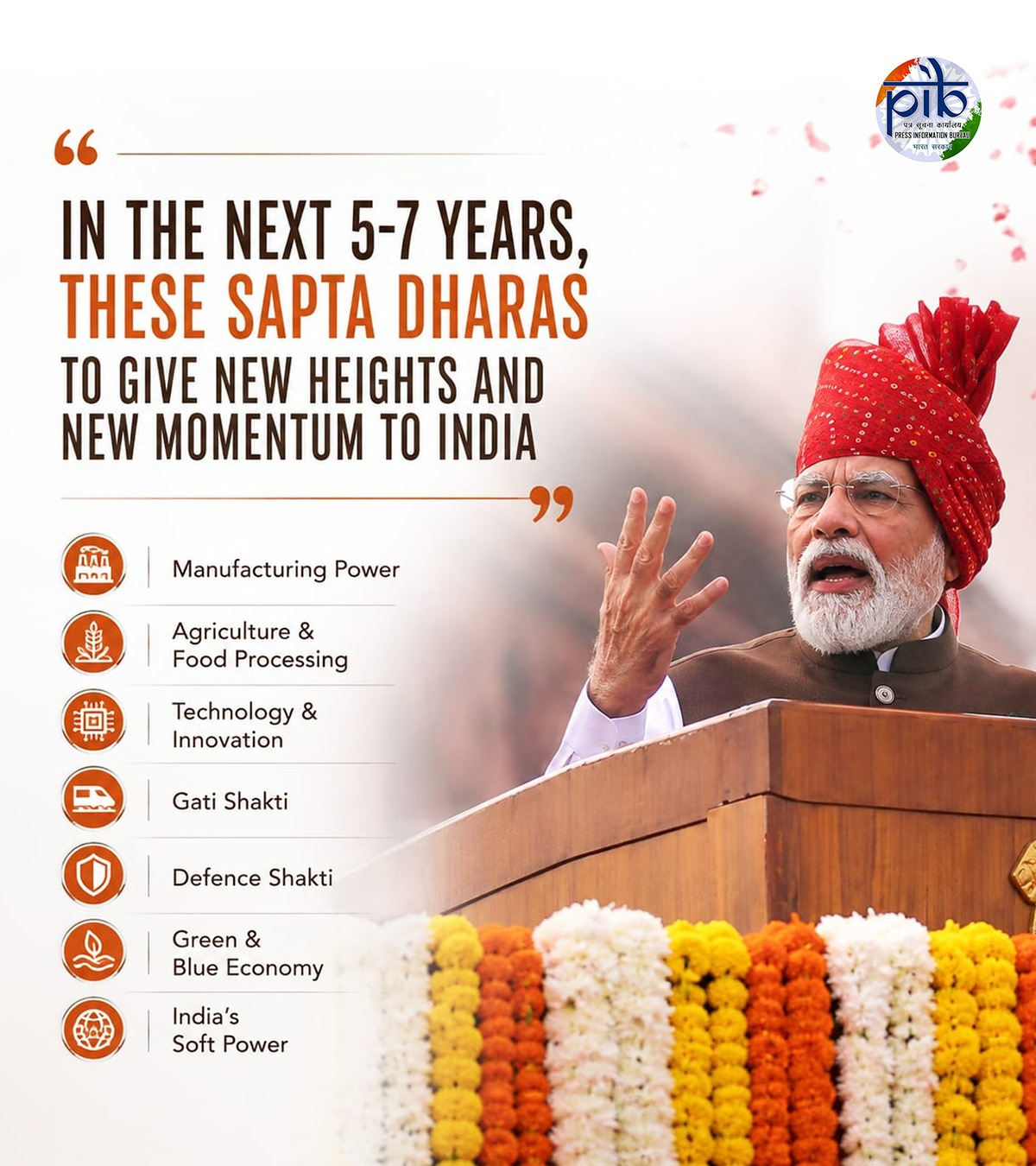
On India’s 80th Independence Day, 15 August 2026, Prime Minister Narendra Modi presented “Sapta Dhara” — the Seven Streams of Strength — as a broad roadmap for taking India towards the goal of Viksit Bharat by 2047. The framework focuses on seven major areas that are expected to drive economic growth, technological progress, national security and India’s global influence.
PM Modi’s ‘SAPTA DHARA’ Vision For Viksit Bharat 2047
On India’s 80th Independence Day, 15 August 2026, Prime Minister Narendra Modi presented “Sapta Dhara” — the Seven Streams of Strength — as a broad roadmap for taking India towards the goal of Viksit Bharat by 2047. The framework focuses on seven major areas that are expected to drive economic growth, technological progress, national security and India’s global influence.
The term Sapta Dhara draws upon the idea of seven streams and carries a cultural association with the sacred seven rivers of Hindu tradition. In the development context, however, it represents seven strategic streams of national strength.
The Seven Streams of Sapta Dhara
1. Manufacturing Power
The first pillar focuses on strengthening India’s manufacturing sector, increasing domestic production and improving India’s competitiveness in global markets.
The emphasis is on creating a stronger industrial base and promoting self-reliance, while enabling Indian companies to become globally competitive.
2. Agriculture and Food Processing
The second stream focuses on agriculture, farmers and food processing.
The objective is not only to increase agricultural production but also to create greater value from farm products through processing, storage and modern supply chains. This can help increase farmers’ income and strengthen India’s position in global food markets.
3. Technology and Innovation
Technology and innovation form the third pillar.
The vision places importance on emerging technologies such as artificial intelligence, semiconductors, data centres and quantum technology. India aims to develop stronger technological capabilities and become a major global player in advanced technologies.
4. Gati Shakti
The fourth stream is Gati Shakti, which focuses on improving infrastructure, connectivity and logistics.
Better roads, railways, ports, airports and integrated logistics networks can reduce transportation costs, improve supply chains and accelerate economic activity.
5. Defence Power
The fifth pillar is Raksha Shakti or Defence Power.
The focus is on building a more self-reliant defence industry, reducing dependence on imports and developing advanced military technologies within India. The Independence Day address also highlighted areas such as drones, counter-drone systems and hypersonic technology.
This pillar is closely connected with the broader Aatmanirbhar Bharat approach in defence manufacturing.
6. Green and Blue Economy
The sixth stream combines the green economy and blue economy.
The green economy focuses on areas such as renewable energy, environmental sustainability and clean technologies. The blue economy focuses on India’s maritime resources, fisheries, oceans and related technologies.
Together, these sectors are expected to contribute to sustainable economic growth while protecting natural resources.
7. Soft Power
The seventh stream is India’s soft power.
India’s cultural heritage, Yoga, Ayurveda, education, cinema, arts and traditions can strengthen the country’s global influence. Digital content and India’s cultural presence can also help expand India’s reach internationally.
Why Is Sapta Dhara Important?
Sapta Dhara presents development as a multi-sectoral approach rather than focusing on a single economic indicator. Manufacturing and agriculture are linked with technology, infrastructure, defence, sustainability and cultural influence.
The framework is ultimately connected to the larger objective of making India a developed nation by 2047, the centenary year of India’s independence.
Youth have also been placed at the centre of this development vision, with the idea that India’s young population will play a major role in technology, entrepreneurship, innovation and nation-building.
Exam-Oriented Facts
| Question | Answer |
|---|---|
| What is Sapta Dhara? | Seven Streams of Strength |
| Announced by | Prime Minister Narendra Modi |
| Occasion | Independence Day 2026 |
| Goal | Viksit Bharat by 2047 |
| Number of pillars | 7 |
| 1st pillar | Manufacturing Power |
| 2nd pillar | Agriculture & Food Processing |
| 3rd pillar | Technology & Innovation |
| 4th pillar | Gati Shakti |
| 5th pillar | Defence Power |
| 6th pillar | Green & Blue Economy |
| 7th pillar | Soft Power |
One-Line Revision Trick
Manufacturing → Agriculture → Technology → Gati Shakti → Defence → Green/Blue → Soft Power
Sapta Dhara = 7 Streams → Viksit Bharat 2047.


