




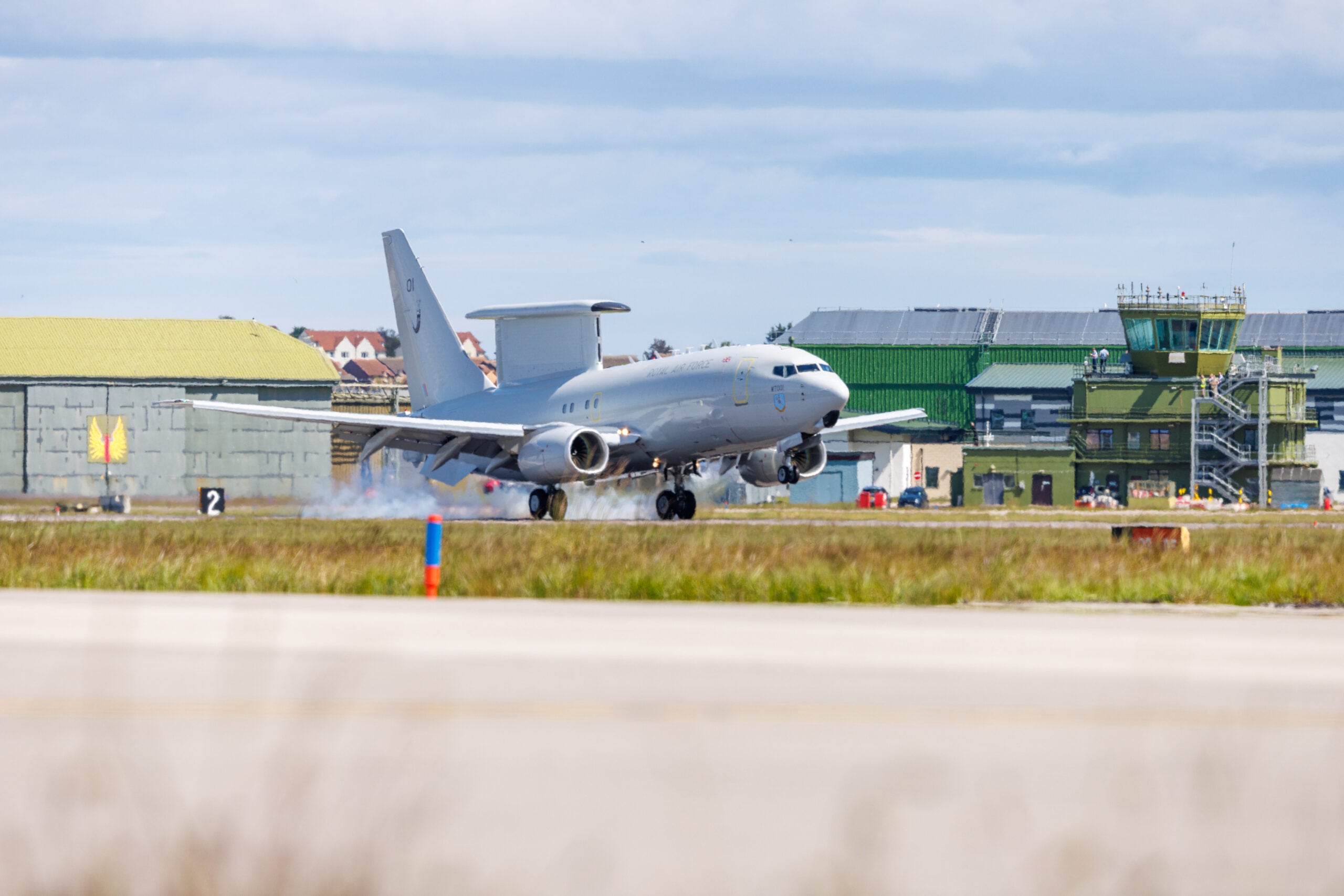
The Royal Air Force (RAF) has officially received its first E-7 Wedgetail airborne early warning (AEW) aircraft, marking a significant advancement in the UK’s commitment to modernizing its airborne surveillance capabilities. The aircraft, designated WT001, was delivered by Boeing to RAF Lossiemouth after undergoing modifications at STS Aviation Services in Birmingham.
This delivery comes at a crucial time for the UK’s airborne surveillance program, which has faced delays and setbacks. The Wedgetail is poised to succeed the retired fleet of E-3D Sentry aircraft. Once fully operational, it will enhance long-range airborne surveillance, provide battle management, and offer vital command-and-control functions to support joint military operations.
Group Captain Sarah Brewin, the Station Commander at RAF Lossiemouth, emphasized the importance of the aircraft’s arrival, calling it “a significant step” towards achieving the RAF’s next-generation airborne surveillance capability. The E-7 Wedgetail is expected to undergo further testing and evaluation before being formally integrated into No. 8 Squadron.
Initially, the United Kingdom planned to acquire five Wedgetail aircraft. However, this order was reduced to three in 2021 due to broader defense budget constraints. The program has experienced delays related to aircraft modifications and certification processes.
The Wedgetail’s introduction fits into a broader strategy aimed at enhancing the UK’s surveillance capabilities. Recently, the Royal Navy commenced the integration of ANAFI Parrot quadcopters into its operations near Gibraltar. These lightweight drones, equipped with electro-optical sensors, are designed to improve maritime surveillance, intelligence gathering, and force protection by providing high-resolution imagery for real-time situational awareness.
In December 2025, the UK Ministry of Defence’s innovation arm initiated a £1 million competition to accelerate the development of autonomous sensor systems that can identify and counter deception in intelligence-gathering operations. This effort reflects a trend toward more sophisticated and technologically advanced methods of surveillance within the UK military.
Additionally, in November 2025, the British Army’s artillery units received their first ground-based surveillance radar systems from Elbit Systems UK. These systems are intended to enhance battlefield awareness and improve troop survivability by providing both surveillance capabilities and corrections based on the fall of shot.
The steps being taken to bolster the UK’s surveillance and military capabilities indicate a commitment to maintaining a robust defense posture in an increasingly complex global security environment.


