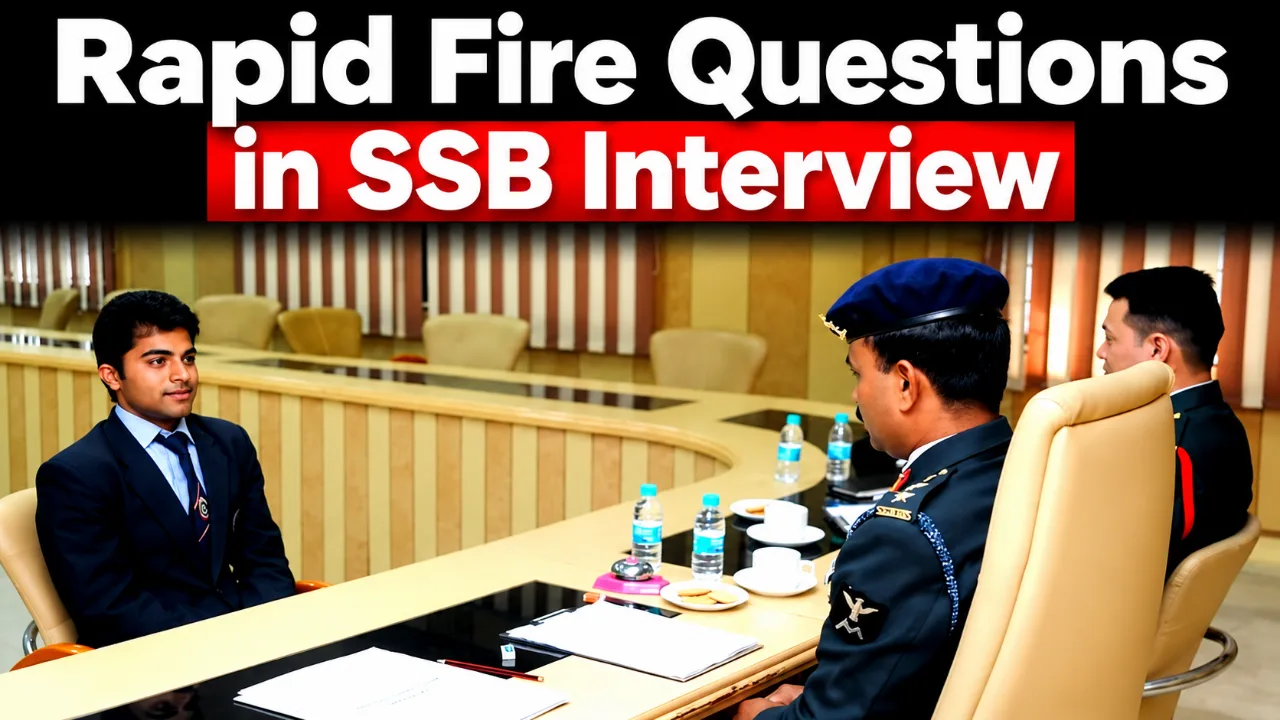
The SSB Interview Rapid Fire Questions are among the most challenging parts of the Services Selection Board (SSB) Personal Interview. During this interaction, the Interviewing Officer (IO) may ask a series of questions in quick succession, expecting candidates to remember the important points and respond clearly.
For many NDA, CDS, AFCAT and other defence aspirants, the challenge is not answering individual questions but remembering multiple questions asked together.
Imagine the Interviewing Officer asking:
“Tell me about your education from Class 10 onwards, your academic performance, favourite subjects, teachers you liked, your best friends, sports participation, extracurricular activities and your major achievements.”
Instead of answering just one question, you must organise your thoughts and address several topics naturally.
In this guide, we cover 20 commonly asked SSB Interview Rapid Fire Questions with sample answers, techniques for remembering long questions, mistakes to avoid and practical exercises to improve your interview performance.
For a deeper understanding of how the Interviewing Officer groups personal interview questions, read our guide on the 6 CIQs asked in the SSB Interview.
What Are Rapid Fire Questions in SSB Interview?
Rapid-fire questions are a series of connected questions asked together by the Interviewing Officer during the SSB Personal Interview.
These questions generally revolve around the candidate’s Personal Information Questionnaire (PIQ), educational background, family, friends, hobbies, achievements, responsibilities, personality and motivation to join the Armed Forces.
The Interviewing Officer may use these questions to understand how a candidate recalls information, communicates experiences, handles multiple topics and maintains clarity during a conversation.
There is no compulsory fixed number of rapid-fire questions. Some IOs may ask five or six connected questions, while others may cover more topics in a longer sequence.
Similarly, the order of questions can vary depending on the candidate’s background and the direction of the interview.
The objective is not to test memory alone. The IO is also interested in understanding your personality through the experiences and decisions you describe.
20 Most Common Rapid Fire Questions Asked in SSB Interview
Here are 20 important question areas every SSB aspirant should prepare before attending the Personal Interview.
1. Tell Me Something About Your Hometown
The Interviewing Officer may ask you to describe the city, town or village you come from.
You should know its location, geographical importance, historical background, major industries, educational institutions and important places.
Possible follow-up questions:
- What is your hometown famous for?
- What are the major problems faced by people in your area?
- What improvements would you like to see in your city?
- Which famous personalities belong to your district?
- What would you show someone visiting your hometown for the first time?
How to answer: Begin with the location and important characteristics of your hometown. Then discuss one or two meaningful aspects, such as its economy, culture or geographical importance.
Avoid memorising a lengthy description. Focus on facts you genuinely understand.
2. Tell Me About Your Family Members
Questions about family background are common because the IO wants to understand your upbringing and family environment.
Possible questions:
- How many members are there in your family?
- What are their occupations?
- What is your father’s profession?
- What does your mother do?
- What are your siblings studying or pursuing professionally?
- What responsibilities do you perform at home?
Example answer:
“Sir, there are five members in my family: my parents, my younger brother, my grandmother and me. My father works in a private company, and my mother manages our household. My younger brother is studying in Class 11. I help him with mathematics and assist my family with household purchases.”
The example demonstrates how to organise the information. Your response must reflect your real family circumstances.
3. How Is Your Relationship With Your Family and Neighbours?
The Interviewing Officer may ask about the activities you undertake with your family, how you resolve disagreements and how you interact with your neighbours.
Important areas to prepare:
- Family activities and celebrations.
- Responsibilities shared among family members.
- How you support your parents or siblings.
- Your relationship with neighbours.
- Your contribution to community activities.
Answering tip: Use specific examples of cooperation, responsibility and everyday interaction.
There is no need to portray your family as perfect. If differences of opinion arise, explain how you handle them respectfully.
4. Tell Me About Your Educational Qualifications
Your academic record forms an important part of your PIQ and may lead to multiple follow-up questions.
Prepare your marks from Class 10, Class 12, graduation and any additional qualifications.
Possible questions:
- Which schools and colleges did you attend?
- What percentages or grades did you achieve?
- Why did you choose your academic stream?
- Which subjects interested you most?
- What academic projects have you completed?
Preparation tip: Create a simple academic timeline with the name of each institution, years attended, marks obtained and important achievements.
The IO may ask about any detail you have included in your PIQ, so accuracy is important.
5. Who Is Your Favourite Teacher and Why?
This question can reveal how you observe and appreciate people who have influenced your development.
Rather than naming a teacher without explanation, describe specific qualities you admire.
Example answer:
“My mathematics teacher in Class 12 was one of my favourites because he encouraged us to understand the logic behind problems rather than memorise formulas. His teaching helped me become more confident in solving difficult questions.”
If asked about a teacher you did not get along with, be respectful and factual.
You do not need to claim that every teacher was your favourite. Explain genuine differences without insulting anyone.
6. Tell Me About Your Best Friends
The IO may ask about your closest friends, how you met them and the qualities you appreciate in them.
Possible follow-up questions:
- Who are your three closest friends?
- What are their strengths?
- What are their weaknesses?
- What activities do you enjoy together?
- Have you ever disagreed with a close friend?
- How did you resolve the disagreement?
How to answer: Choose friends you genuinely know well and describe meaningful qualities supported by experience.
For example, you may admire one friend’s punctuality and another friend’s ability to remain calm during difficult situations.
It is perfectly reasonable to recognise that even your closest friends have areas they can improve.
7. Why Did Your Academic Marks Improve or Decline?
Many candidates have fluctuations in their academic performance between school and college.
The Interviewing Officer may ask why your marks increased or decreased during a particular period.
Example answer:
“My marks declined during Class 11 because I initially struggled with the transition to a more demanding science syllabus. I later improved my study schedule, started revising regularly and performed better in Class 12.”
Important: Avoid generic excuses or blaming teachers for your performance.
Take responsibility where appropriate and explain what you learned from the experience.
8. What Are Your Sports Achievements?
Sports-related questions help the IO understand your participation in physical activities, teamwork, competitiveness and experiences handling success or defeat.
Prepare these details:
- Sports you play.
- Frequency of participation.
- Position or role in a team.
- School, college or district-level participation.
- Achievements, if any.
- Important lessons learned.
Not every candidate will have medals or certificates.
If you play football or cricket recreationally, discuss your actual experience without exaggerating your achievements.
You should also understand the basic rules of any sport you mention.
9. What Extracurricular Activities Have You Participated In?
Extracurricular activities may include debates, cultural programmes, NCC, NSS, volunteering, event organisation, technical clubs or other initiatives.
Possible questions:
- Which activities did you participate in?
- Why did you choose them?
- What responsibilities were assigned to you?
- Did you face any difficulties?
- What did you learn?
Example answer:
“During college, I volunteered for our annual cultural festival. I helped coordinate participants and managed the registration desk. We faced scheduling difficulties, so our team revised the registration process to reduce delays.”
Focus on your actual contribution rather than taking credit for the achievements of an entire team.
10. Describe a Memorable Experience From School or College
The IO may ask about a situation that had a meaningful impact on your development.
It could involve a competition, a difficult academic project, helping someone, resolving a disagreement or learning from a mistake.
A useful way to organise your answer is:
Situation → Your responsibility → Your actions → Outcome → Learning
For example, if you organised a college event, describe your responsibilities, the problems that occurred, the decisions you made and the lessons you learned.
The experience need not be extraordinary. Genuine experiences are more valuable than exaggerated stories.
11. What Are Your Hobbies and Interests?
Hobbies are an important interview topic because they provide insight into how candidates spend their free time.
Common hobbies include reading, running, cycling, photography, gardening, trekking, playing musical instruments and sports.
Possible follow-up questions:
- How long have you pursued this hobby?
- How frequently do you practise it?
- What skills have you developed?
- Who inspired you?
- What have you learned recently?
If you mention reading books, you should be able to discuss books you have actually read.
If you mention running, you may be asked about your training routine and personal progress.
Do not include hobbies in your PIQ merely because they sound impressive.
12. Describe Your Daily Routine
The Interviewing Officer may ask you to explain how you spend a typical day, from waking up until going to bed.
Your response can include studies, work, exercise, household responsibilities, leisure activities and rest.
Example answer:
“I usually wake up at 6 AM and go for a morning run. After breakfast, I attend college classes and complete my assignments. In the evening, I spend time preparing for competitive examinations and help my younger brother with his studies. I generally finish my activities and prepare for the following day before going to bed.”
Your actual routine does not need to resemble this example.
The most important thing is to provide an accurate description of your habits.
13. How Do You Spend Your Pocket Money or Earnings?
Questions about money management can help the IO understand your financial awareness and everyday decision-making.
You may be asked:
- How much pocket money do you receive?
- What are your major expenses?
- Do you save money?
- Have you earned money through part-time work?
- How do you decide whether a purchase is necessary?
Answering tip: Be prepared to explain your approximate monthly expenses and how you manage them.
For candidates who are financially independent, questions may involve salary, savings, family contributions and personal financial responsibilities.
14. What Responsibilities Do You Handle at Home or College?
Candidates often describe themselves as responsible without providing examples.
The IO may ask about real responsibilities you have undertaken.
These might include organising household purchases, helping younger siblings, coordinating college projects, managing a sports team or supporting community activities.
Example answer:
“I am responsible for paying some of our household utility bills online and helping my parents with important digital services. In college, I also coordinate the assignment submissions for my project group.”
Small responsibilities performed consistently can be meaningful.
Avoid inventing leadership positions or responsibilities you have never held.
15. What Are Your Strengths and Weaknesses?
This is among the most common questions asked during SSB Personal Interviews.
You should be able to discuss your strengths using examples and identify genuine areas where you need improvement.
Example strength:
“I am dependable when given a responsibility. During our college project, I coordinated the team’s weekly progress and ensured that we completed our assignments before the deadline.”
Example weakness:
“I previously hesitated to speak during large group discussions. To improve, I started participating more actively in classroom presentations and student activities.”
Do not present unrealistic answers such as having no weaknesses.
You can also explore our guide to preparing tricky questions for the SSB Personal Interview to understand how to discuss personal challenges without becoming defensive.
16. What Was Your Biggest Failure and What Did You Learn?
The IO may ask about setbacks in academics, sports, relationships or personal goals.
The purpose of preparing this question is to reflect on how you respond when things do not go according to plan.
A useful response should cover:
- What happened?
- What was your role?
- What mistakes did you make?
- What did you do afterwards?
- What have you changed?
Do not simply say that failure made you stronger. Explain the specific actions you took to improve.
17. Why Do You Want to Join the Indian Armed Forces?
This is a fundamental question for candidates aspiring to become commissioned officers.
Your answer should demonstrate genuine motivation and a realistic understanding of military service.
Example answer:
“I want to join the Indian Armed Forces because I am interested in a career involving leadership, discipline, teamwork and responsibility. My experiences in sports and college activities have helped me discover that I enjoy working with teams and handling challenging situations. I understand that military life involves demanding conditions and personal sacrifices, and I want to prepare myself for those responsibilities.”
Avoid copying this response.
Your motivation should come from your own interests and experiences.
For more examples of personal interview topics, explore the SSB Interview Questions With Answers guide.
18. What Do You Know About the Indian Army, Navy or Air Force?
The IO may ask service-related questions based on the Armed Forces branch you wish to join.
Important areas:
- Basic responsibilities of the Army, Navy and Air Force.
- Officer training academies.
- Rank structure.
- Major operational roles.
- Relevant defence developments.
- Recent military exercises and equipment.
You should be prepared to explain why a particular service interests you.
Avoid relying entirely on memorised facts. Understand the basic responsibilities and challenges associated with your preferred career.
19. What Will You Do If You Are Not Recommended?
This question examines how you approach uncertainty and career planning.
A reasonable response should show that you have considered your options and remain committed to personal development.
Example answer:
“If I am not recommended, I will reflect on my performance, continue improving my preparation and pursue my academic or professional goals. If I remain eligible, I will prepare for another attempt while also working towards a meaningful alternative career.”
For repeaters, the IO may additionally ask what changed between attempts.
Reading genuine candidates’ experiences can help you understand the variety of interviews. For example, this SSB recommendation experience after a third attempt describes several questions encountered by the candidate.
20. Why Should You Be Selected as an Officer?
This question encourages you to reflect on your suitability for a career in the Armed Forces.
Rather than claiming that you possess every Officer Like Quality, discuss your actual experiences, strengths and willingness to learn.
Example answer:
“I believe my experiences have helped me develop a sense of responsibility, teamwork and perseverance. I have taken responsibility during college activities, learned from setbacks and worked towards improving my communication and physical fitness. I understand that I still have areas to develop, and I am willing to learn and accept the demands of officer training.”
The answer should be confident without appearing arrogant or suggesting that selection is guaranteed.
How Does the Interviewing Officer Ask Rapid Fire Questions?
The 20 topics above may be asked individually, but a rapid-fire sequence typically combines multiple questions into one extended prompt.
For example:
“Tell me about your Class 10 and Class 12 results, the subjects you liked, your favourite teachers, your three best friends, the sports you played, the competitions you participated in and your achievements.”
A candidate who has prepared the individual topics still needs to remember the order of the question.
This is where structured listening becomes useful.
Best Technique to Answer SSB Interview Rapid Fire Questions
Step 1: Listen Without Interrupting
Allow the Interviewing Officer to complete the question.
Do not start speaking before the IO has finished.
Step 2: Identify the Main Keywords
Instead of memorising every sentence, remember the broad topics.
For the example above, the sequence is:
Academics → Subjects → Teachers → Friends → Sports → Achievements
This simple mental outline makes it easier to organise the answer.
Step 3: Answer One Topic at a Time
Begin with academics and continue through the remaining topics.
Use natural transitions between sections.
Avoid unnecessarily long explanations that make you lose track of the original question.
Step 4: Keep Answers Concise but Complete
A common mistake is answering one part of a rapid-fire question in excessive detail while neglecting the others.
Give a relevant response to each topic and allow the IO to ask for additional details if required.
Step 5: Politely Request Clarification When Needed
If you forget part of the question, do not panic.
You can say:
“Sir, I have covered my academics, friends and sports. Could you please repeat the remaining part of the question?”
There is no requirement to pretend you remember a question you have forgotten.
Step 6: Avoid Memorised Scripts
Practise remembering topics and explaining your experiences rather than memorising complete responses.
The Interviewing Officer may change the order or ask unexpected follow-up questions.
For additional techniques, read our Golden Tips for SSB Personal Interview.
Example of a Complete SSB Rapid Fire Question With an Answer
Interviewing Officer:
“Tell me about your education from Class 10 onwards, your percentages in Class 10 and Class 12, your favourite subjects, teachers, closest friends, sports participation and major achievements.”
Example candidate response:
“Sir, I completed Class 10 with 84% and Class 12 with 78% in the science stream. Mathematics and physics were my favourite subjects because I enjoyed problem-solving and understanding practical concepts.
“My favourite teacher was my mathematics teacher, who encouraged us to solve problems independently and helped me develop confidence in difficult subjects.
“My two closest friends are Rahul and Aman. Rahul is disciplined and punctual, while Aman is supportive and good at organising group activities. We have been friends since school and regularly play cricket together.
“Regarding sports, I participated in school-level cricket and represented my house in inter-house competitions. I also took part in debate competitions and helped organise our annual school function.”
The answer follows the broad sequence of the questions without adding unrelated information.
This is an illustrative example, not a script for memorisation.
The Interviewing Officer may then ask follow-up questions about academic performance, friendships, sports rules or specific responsibilities.
Common Mistakes While Answering SSB Rapid Fire Questions
Trying to Memorise Every Question Word for Word
Candidates sometimes focus so heavily on remembering exact wording that they lose track of the overall meaning.
Remember the topics instead of individual sentences.
Giving Rehearsed Answers
An answer that sounds impressive on paper may appear artificial when delivered without genuine personal experience.
Prepare your facts, not a fictional personality.
Exaggerating Achievements
Do not claim medals, leadership responsibilities or sports participation that you cannot explain honestly.
Contradicting Your PIQ Form
Important details about education, family and achievements should remain consistent with the information you have provided.
Becoming Nervous After Forgetting a Question
Forgetting one part of a long question does not automatically mean that you have performed poorly.
Remain calm and ask for clarification when necessary.
Criticising Friends, Teachers or Family Members
When discussing disagreements or negative qualities, remain respectful and focus on actual experiences.
Giving Long and Unstructured Responses
Long answers can make it difficult to address all the questions in a rapid-fire sequence.
Organise your response and stay on topic.
7-Day SSB Interview Rapid Fire Practice Plan
Candidates can improve their listening and response organisation through short daily practice sessions.
| Day | Practice activity |
|---|---|
| Day 1 | Prepare academic details, favourite subjects and teachers |
| Day 2 | Practise questions about family, friends and responsibilities |
| Day 3 | Prepare hobbies, daily routine, sports and achievements |
| Day 4 | Review strengths, weaknesses, failures and lessons learned |
| Day 5 | Practise questions about defence awareness and career motivation |
| Day 6 | Attempt five mock rapid-fire sequences with a friend |
| Day 7 | Record a mock personal interview and review your answers |
During mock interviews, ask your partner to combine five to eight questions into a single prompt.
After answering, review whether you covered the main topics, maintained clarity and gave truthful responses.
You can improve further by following our step-by-step SSB Personal Interview self-correction framework.
Difference Between Rapid Fire Questions and the 6 CIQs
Rapid-fire questioning describes the method of asking multiple connected questions together.
The six CIQs are a commonly used SSB preparation framework that organises personal interview topics into major categories.
| Rapid Fire Questions | 6 CIQs |
|---|---|
| A method of asking several questions together | A framework for organising interview topics |
| Can cover one or more personal topics | Commonly grouped into six broad areas |
| Number and order vary | Six categories are used for preparation |
| Focuses on responding to a grouped prompt | Helps candidates prepare across major areas of personal life |
Both are useful for preparation, but neither should be treated as a compulsory official question sequence.
For detailed examples from every category, study the 6 CIQs Decoded: SSB Interview Questions and Preparation Guide.
How to Prepare for SSB Personal Interview at Home
You do not necessarily need a formal classroom environment to practise rapid-fire questions.
Start by preparing your PIQ details, reviewing your personal experiences and practising grouped questions with a friend or family member.
Record yourself answering questions and observe your speaking pace, clarity, body language and tendency to repeat information.
You should also prepare for unexpected follow-up questions rather than focusing exclusively on the examples listed in this article.
Candidates looking for a broader understanding of the interview process can read How to Answer 10 Rapid Fire SSB Interview Questions.
For comprehensive book-based preparation, Let’s Crack SSB Interview covers the SSB selection process and preparation for different testing stages.
The Personal Interview is only one part of the overall SSB assessment. Candidates should also understand the psychology tests and GTO tasks.
For additional practice in TAT, WAT, SRT and Self-Description, the SSB Interview Psychological Tests Workbook offers structured practice material.
Frequently Asked Questions About SSB Interview Rapid Fire Questions
1. How many rapid fire questions are asked in the SSB Interview?
There is no fixed number. The Interviewing Officer may combine several questions into one sequence, and the length of the question depends on the candidate and the interview discussion.
2. Are rapid fire questions compulsory in SSB?
Grouped questions are commonly discussed in SSB interview preparation, but there is no guarantee that every candidate will receive the same type, number or sequence of questions.
3. How can I remember rapid fire questions in SSB?
Remember the main keywords and their sequence. Practise identifying broad topics such as education, family, friends, sports and achievements rather than memorising every word.
4. What should I do if I forget a rapid fire question?
Answer the parts you remember and politely request clarification about the remaining question. Avoid inventing an answer.
5. Should I answer rapid fire questions in the same order?
Following the original sequence is generally helpful because it keeps your answer organised. However, clarity and completeness are more important than mechanically following an exact sequence.
6. Are SSB rapid fire questions based on the PIQ form?
Many personal interview questions relate to information provided in the PIQ. However, the IO may also ask about current affairs, personal experiences, defence awareness and other relevant topics.
7. Can the IO ask questions beyond the 20 listed here?
Yes. These are common preparation topics, not an exhaustive or official question bank. The IO may ask different questions based on your background and responses.
8. How should freshers prepare for rapid fire questions?
Freshers should begin by understanding their PIQ, reflecting on personal experiences, preparing academic details and practising grouped questions without memorising scripts.
9. What additional questions can repeaters expect?
Repeaters may be asked about previous SSB attempts, their assessment of earlier performance, improvements made since the last attempt and future preparation plans.
10. What is the best way to practise rapid fire questions?
Practise with a partner who asks several connected questions in one sequence. Record your responses, check whether you covered all topics and gradually increase the difficulty.
Final Tips for SSB Interview Rapid Fire Questions
Rapid-fire questions are an opportunity to explain your life experiences, responsibilities, achievements, interests and motivation clearly.
The best preparation is not memorising hundreds of answers but understanding your own background and learning to communicate it naturally.
Listen carefully, remember the main topics, answer in a logical sequence and remain honest throughout the interaction.
If you forget a question, remain composed and request clarification rather than allowing one missed point to affect the rest of your interview.
Remember that the SSB Personal Interview is a broader assessment of your personality and suitability for officer training. Your ability to recall questions is only one part of the interaction.
Prepare your experiences, practise your communication and stay true to your personality.
For more structured guidance covering the Personal Interview, Psychology Tests and GTO tasks, explore SSB Interview preparation books and the SSB Interview preparation section on SSBCrackExams.