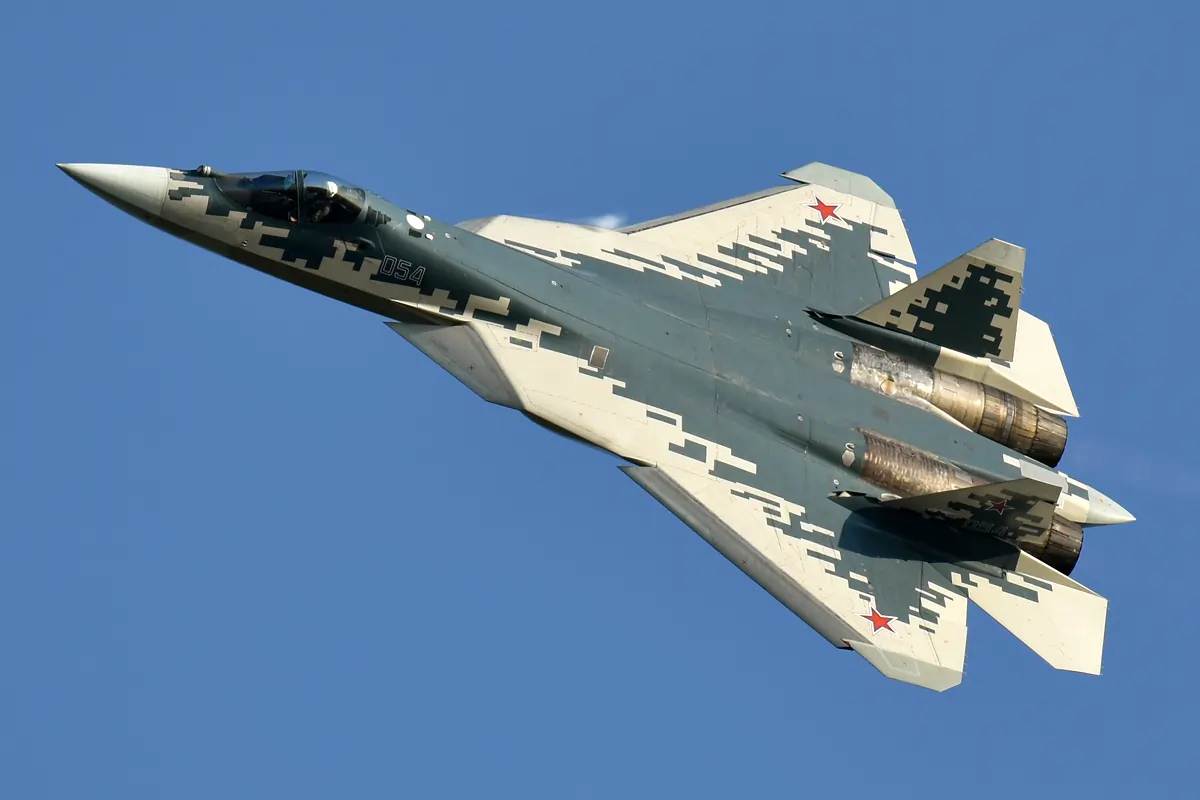
In a significant move aimed at bolstering defence cooperation, Russia has extended an offer to India for its advanced twin-seat Su-57M1E fifth-generation stealth fighter jet. This proposal, presented with full technology transfer and access to the aircraft’s source code, is designed to address the Indian Air Force’s future combat aircraft needs and enhance bilateral relations.
The discussions regarding this substantial offer took place during high-level meetings between Indian and Russian officials at the Wings India 2026 aviation exhibition. Alongside the jet offer, Russia has proposed reviving the Fifth Generation Fighter Aircraft (FGFA) programme, from which India had withdrawn in 2018.
United Aircraft Corporation (UAC) of Russia has indicated that India would have considerable industrial involvement in the project, enabling domestic production of essential aircraft components. The offer comes with a suite of advanced technologies, which includes next-generation engines like the Izdeliye 30 and AL-51F1, Active Electronically Scanned Array (AESA) radar, sophisticated optical sensors, and artificial intelligence-powered combat automation. Notably, the offer also includes access to the source code, facilitating the integration of Indian weaponry, such as the BrahMos and Astra missiles.
The twin-seat configuration of the Su-57M1E is particularly noteworthy, allowing for modern manned-unmanned teaming (MUM-T) operations. This configuration lets a second crew member manage a network of combat drones, freeing the pilot to concentrate on aerial combat.
The timing of this offer is strategic, occurring as the Indian Air Force seeks to maintain its technological superiority in light of China’s active fleet of fifth-generation fighters, including the J-20 and J-35. While India is in discussions to finalize a deal with France for 114 Rafale fighter jets to meet its current operational demands, its indigenous Advanced Medium Combat Aircraft (AMCA) programme is not expected to begin production until the mid-2030s. This timeline raises concerns about a potential capability gap.
To address this interim period, defence sources suggest that India may consider acquiring around two squadrons, or approximately 40 units, of the Su-57M1E. Such a move could serve as a strategic bridge to enhance the country’s air combat capabilities while the AMCA project continues its development.
Should the proposal proceed, it stands to significantly influence the air power dynamics in South Asia, drawing close attention from regional observers who are keenly monitoring India’s advances in its fifth-generation fighter acquisition strategies.