




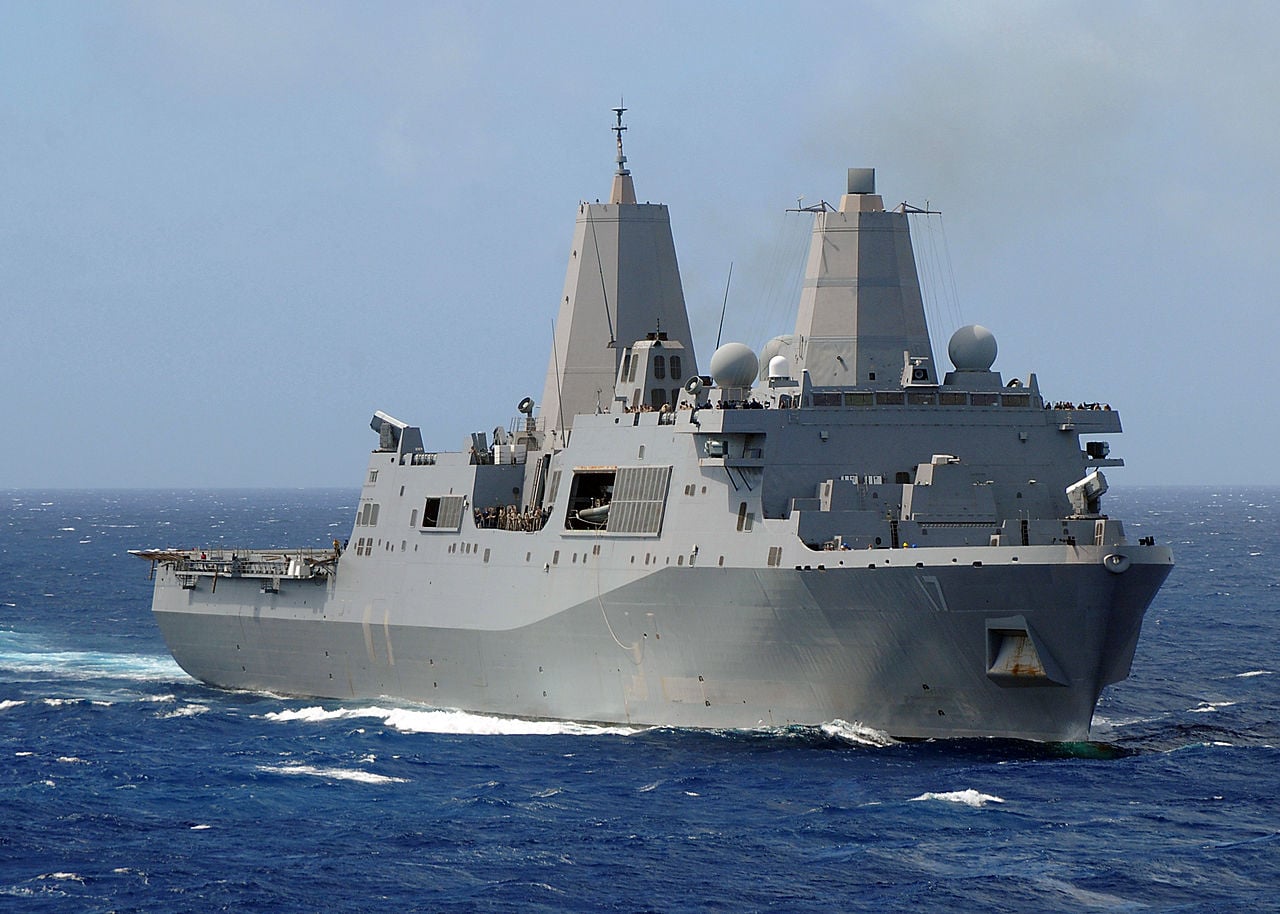
A San Antonio-class amphibious transport dock may appear to be just another gray vessel from a distance, but beneath its stealthy exterior lies a highly versatile platform crucial to modern expeditionary warfare. Designed to facilitate the movement of U.S. Marines, aircraft, landing craft, and command elements, this class of ships is paramount to the U.S. Navy’s efforts to project power from sea to shore.
At its core, the San Antonio-class supports a variety of missions—including expeditionary warfare, humanitarian assistance, and joint operations—all under one operational umbrella. This ship acts as a seaborne staging hub, capable of delivering Marines, vehicles, supplies, and equipment directly into contested environments without relying on established port facilities. Furthermore, it serves as a command-and-control center that can coordinate joint and allied forces using advanced communication systems.
The ship is well-equipped for humanitarian missions as well, with the ability to deliver essential aid, restore access to affected coastal areas, and facilitate evacuation efforts even in the absence of functioning infrastructure ashore. Its operational capabilities are enhanced by a flight deck and hangar that support helicopter and tiltrotor operations for rapid troop movement.
In terms of specifications, the San Antonio-class amphibious transport dock is approximately 684 feet long and has a displacement of around 24,900 long tons at full load. Propelled by four marine Diesel engines, it can reach speeds of 22 knots. The crew size varies, typically ranging from 631 to 699, depending on the specific variant.
The program originated as a replacement for older classes of amphibious ships, such as the Austin and Newport. Huntington Ingalls Industries led the development of this class, with construction primarily taking place in Pascagoula, Mississippi. The lead ship, USS San Antonio (LPD-17), was commissioned in 2006, representing a significant evolution in amphibious ship design.
Over time, two different operational variants have emerged: Flight I, covering ships from LPD-17 to LPD-28, which includes incremental upgrades for baseline design; and Flight II, starting with LPD-30, which optimizes cost while maintaining essential capabilities.
The deployment process for the San Antonio-class allows for seamless operational transitions. After transit to an operational area, the ship positions itself out of direct threat range. Then, landing craft are deployed from the well deck, and aircraft are launched from the flight deck to establish a foothold ashore. The vessel continues to support operations through logistics, medical assistance, and command functionalities.
The San Antonio-class boasts several key features, including the ability to launch and recover various landing craft from its well deck and accommodate both tiltrotor and rotary-wing aircraft. Its stealth design presents a reduced radar profile compared to older vessels, and it is integrated with advanced command, control, communications, computers, intelligence, surveillance, and reconnaissance (C4ISR) systems.
While this class of ships offers remarkable multirole flexibility and improved survivability due to enhanced armor and redundancy, it does have limitations. The advanced systems increase procurement and maintenance costs, and the vessel relies on escort ships for protection in high-threat environments. Additionally, the complexity of the systems necessitates significant logistics and maintenance requirements.
Globally, San Antonio-class ships have been deployed in a variety of combat and non-combat scenarios, including significant operations during the Iraq War and the war in Afghanistan. They have also been instrumental in disaster relief efforts, providing essential support following hurricanes and other crises around the world.
Looking to the future, the San Antonio-class is expected to maintain a central role in U.S. amphibious strategy. The emergence of the Flight II variant indicates a focus on affordability while preserving operational capabilities, ensuring the class remains relevant as older ships are decommissioned. In the coming years, advancements in unmanned systems, expanded aviation capabilities, and concepts of network-centric warfare will likely shape the next evolution of these vessels. As naval amphibious doctrine continues to adapt to modern challenges, the San Antonio-class will play a vital role in bridging the gap between sea control and power projection on land.


