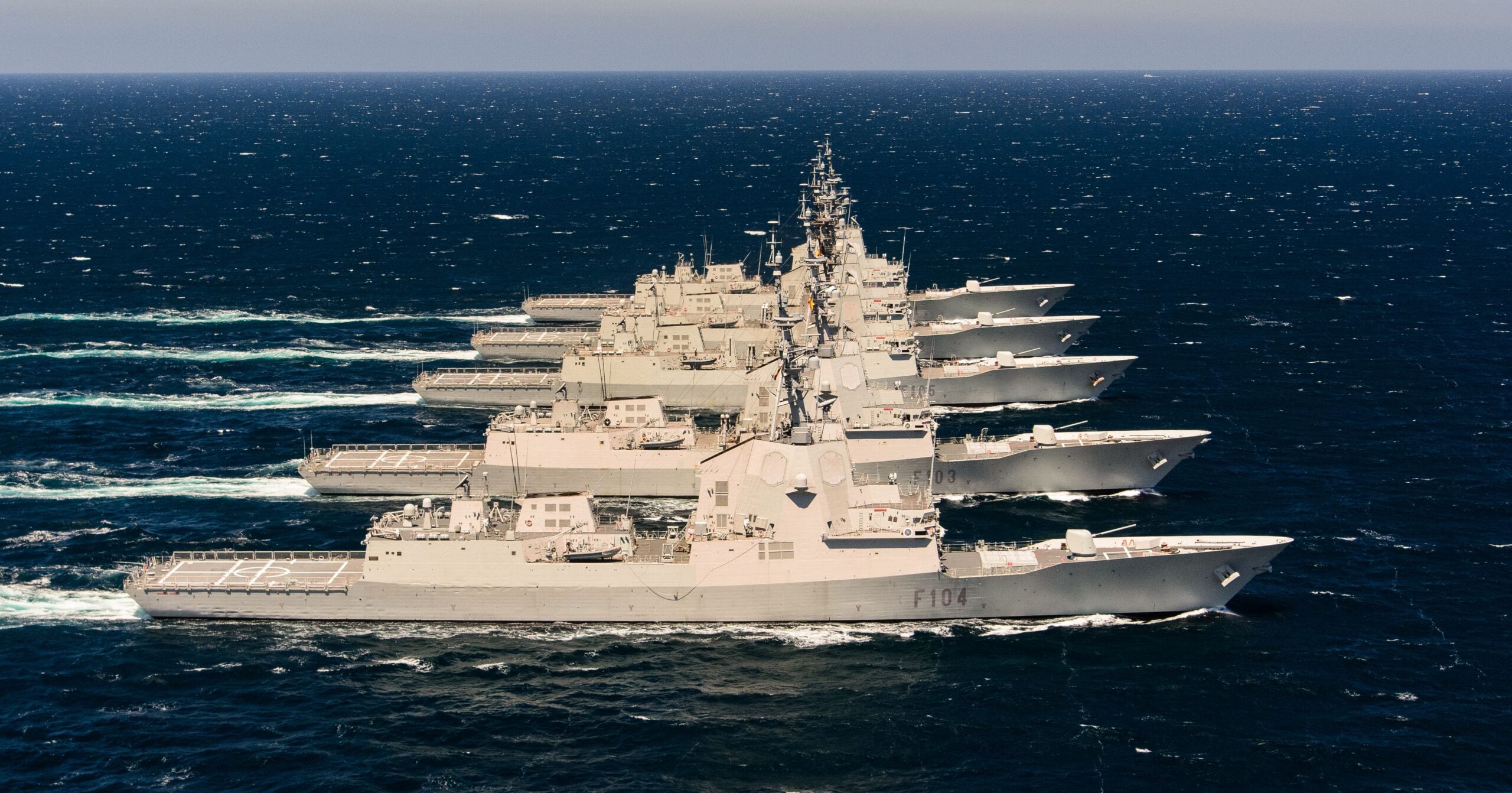
Spain’s Council of Ministers has greenlit a significant modernization program for the navy’s fleet of F100 frigates, a move anticipated to bolster the country’s maritime defense capabilities in the years to come. The contract, worth an estimated 3.2 billion euros (approximately $3.71 billion), is set to be executed by Spanish shipbuilder Navantia over the next 120 months.
The F100 frigates, known as the Álvaro de Bazán-class, were originally constructed by Navantia and delivered between 2002 and 2012. This upgrade initiative aims to extend the operational lifespan of these vessels until 2045, ensuring they remain a vital component of Spain’s naval forces.
Key objectives of the modernization program include addressing identified technological obsolescence, standardizing upgraded systems across the class, enhancing overall efficiency and operability, and ensuring adherence to contemporary environmental regulations. The initiative not only promises to improve the performance of the ships but is also projected to have a notable economic impact, contributing approximately 215 million euros ($250 million) to Spain’s annual GDP. Additionally, it is expected to create around 3,500 jobs, encompassing direct, indirect, and induced employment opportunities.
Navantia President Ricardo Domínguez emphasized the company’s commitment to collaborating closely with the Spanish Navy throughout the modernization process. He recognized the F100 frigates as internationally acclaimed multipurpose vessels and underscored the importance of maintaining their technological edge. Furthermore, Domínguez noted that alongside the construction of the F110 frigates, this initiative will significantly enhance Spain’s maritime defense capabilities.
Designed as versatile escort ships, the F100 frigates are equipped for a range of missions, including anti-air, anti-surface, and anti-submarine operations, particularly in roles focused on force protection and naval power projection. They measure an impressive 146.7 meters (481 feet) in length, have an 18.6-meter (61-foot) beam, and a draft of 4.75 meters (15.58 feet), displacing 5,900 tons in standard condition and 6,594 tons when fully loaded.
Powered by a combination of two LM2500 gas turbines and two Caterpillar 3600 diesel engines, the F100 frigates can achieve speeds of up to 28 knots (52 kilometers/32 miles per hour) and maintain a range of 4,500 nautical miles (8,334 kilometers/5,178 miles) at a steady pace of 18 knots (33 kilometers/21 miles per hour). The crew capacity is designed for 201 personnel.
Notably, the F100s were the first European warships to incorporate Lockheed Martin’s Aegis combat system, featuring the advanced AN/SPY-1D radar system capable of detecting multiple threats simultaneously. Additionally, they are outfitted with a MK 41 Vertical Launch System, enabling a wide array of missile deployments for various operational scenarios.
In a significant update during the midlife enhancement, the existing Boeing Harpoon anti-ship missile launchers will be replaced with Naval Strike Missiles, further advancing the frigates’ operational capabilities. This comprehensive modernization effort positions the F100s to remain an integral part of Spain’s naval strategy into the coming decades.