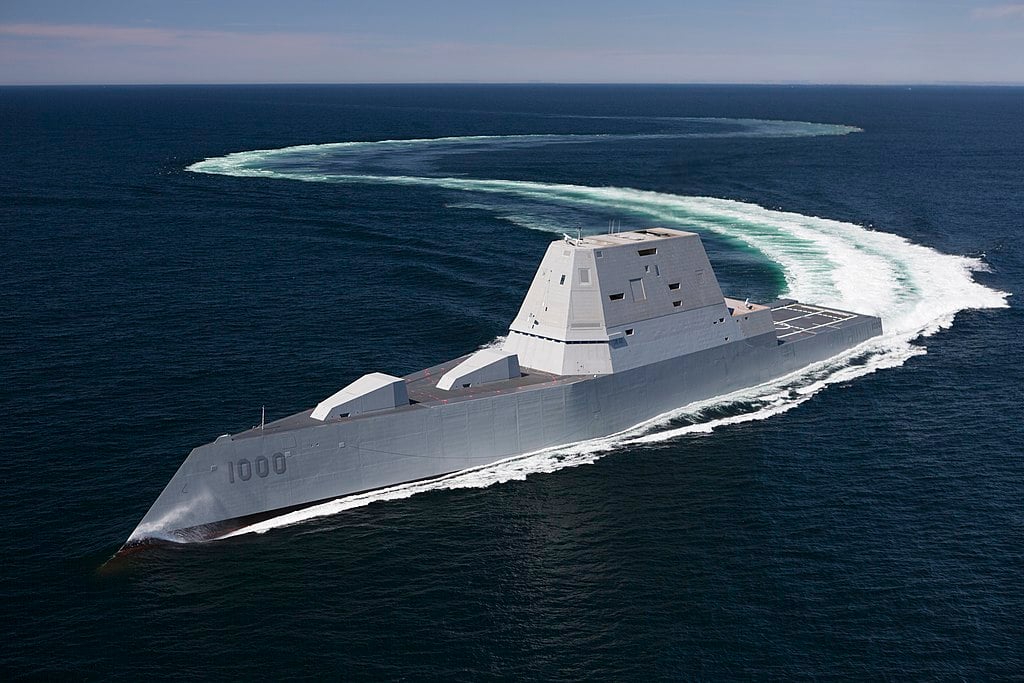
When the US Navy unveiled the Zumwalt-class destroyer, also referred to as the DDG-1000, its striking, futuristic design evoked comparisons to something out of a science fiction movie rather than a traditional warship. However, beneath its sleek exterior lies a vessel that represents one of the most advanced surface combatants ever constructed.
The Zumwalt-class was purpose-built with a unique wave-piercing hull and an integrated power system, seamlessly blending stealth capabilities with significant firepower. Commissioned in 2016, this stealth destroyer minimizes radar visibility and incorporates powerful sensors, along with the capacity to accommodate next-generation weaponry to ensure naval superiority.
The Zumwalt-class features a remarkable tumblehome hull design, which slopes inward to substantially reduce radar cross-section, allowing the massive 600-foot (182-meter) destroyer to appear on radar as a considerably smaller vessel. Its state-of-the-art integrated power system generates an impressive 78 megawatts of electricity, far surpassing the output of other destroyers. This power allows the operation of advanced radar, electronic systems, and potentially future weapons like railguns or high-energy lasers.
Initially equipped with two Advanced Gun Systems (AGS) meant to fire Long Range Land Attack Projectiles at distances exceeding 60 miles (96 kilometers), the Zumwalt-class faced challenges when the costly ammunition—estimated at over $800,000 per round—was ultimately canceled. Consequently, the US Navy has redirected these ships to carry conventional and hypersonic missiles, including the Conventional Prompt Strike system.
Despite its advanced features, the Zumwalt-class destroyer is noted for being one of the most expensive naval programs in American history. What was once envisioned as a fleet of over 30 ships has been significantly scaled back due to escalating costs. Each Zumwalt-class ship is estimated to cost between $7.5 billion and $8 billion, which includes both research and development. In contrast, the cost of a modern Arleigh Burke-class destroyer is around $2 billion. With only three ships ultimately built—USS Zumwalt (DDG-1000), USS Michael Monsoor (DDG-1001), and USS Lyndon B. Johnson (DDG-1002)—the program has become a cautionary tale of ambitious innovation and burgeoning budgets.
Critics have pointed out that a considerable investment was made in ships whose primary weapon systems became obsolete due to the cancellation of their intended specialized ammunition. Nonetheless, supporters argue that the Zumwalt serves as a valuable testbed for emerging technologies, paving the way for integrated power systems and next-generation weapons.
Since its commissioning, the Zumwalt-class has undergone substantial reorientation. The US Navy has shifted its focus from the original AGS setup to exploiting the ship’s advanced integrated power system and stealth design for future weaponry. Current plans involve equipping the destroyers with hypersonic missiles, potentially elevating them among the world’s most formidable surface combatants.
However, several limitations overshadow these advances. The extraordinary costs associated with development and procurement placed each ship at over $7 billion, making them the priciest destroyers ever built. Moreover, the cancellation of the AGS’s ammunition eliminated the ship’s original land-attack capabilities. The reduction in fleet size from the planned 32 ships to just three, coupled with the challenges of maintaining complex and cutting-edge systems, poses further hurdles.
Despite these setbacks, the Zumwalt program has impacted the US Navy and global naval strategies in various ways. It has acted as a technology pathfinder, facilitating the testing of integrated electric propulsion, automation systems to reduce crew size, and advanced radar systems. These advancements will inform the design of the Navy’s forthcoming destroyer initiative, dubbed DDG(X).
Furthermore, the Zumwalt-class’s transformation into platforms for hypersonic missiles aligns with the Navy’s strategic emphasis on deterring peer competitors such as China and Russia. The program stands as a symbol of both the risks and innovations inherent in defense procurement, illustrating the balance needed between pioneering designs and fiscal prudence. While its bold design has drawn international attention, many other navies have opted for more gradual upgrades rather than adopting a similar leap-ahead approach. The lessons learned from the Zumwalt project will likely shape future US naval procurement strategies, emphasizing the importance of balancing innovation with affordability and scalability.