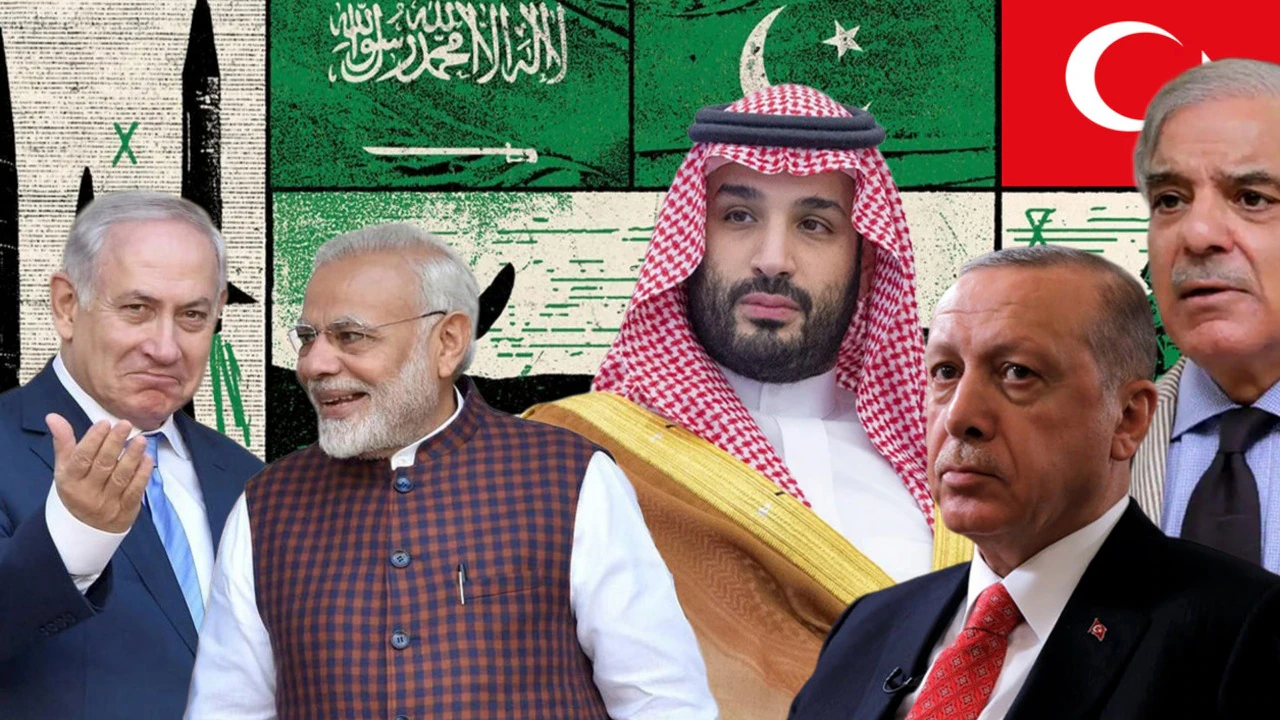
A new potential security alignment involving Turkey, Pakistan, and Saudi Arabia is garnering significant global and regional attention, with experts cautioning that this informal grouping could have far-reaching strategic implications, especially for India. Analysts have coined the term “Islamic NATO” to describe a collective defense arrangement reminiscent of NATO, comprising Islamic or Arab states.
Recent international media reports suggest that Turkey is on the verge of finalizing its inclusion in a defense alliance already established between Pakistan and Saudi Arabia. This existing agreement reportedly incorporates a collective security clause akin to NATO’s Article 5, which stipulates that an attack on one member triggers a collective response from all members.
The initiative gained traction in September of the previous year when discussions about a joint security framework took place during an emergency summit of the Arab League and the Organisation of Islamic Cooperation. Following this, Pakistan and Saudi Arabia publicly announced a “strategic mutual defense agreement,” stating that aggression against one would be viewed as aggression against the other—language mirroring NATO’s commitment to collective defense.
Turkey’s potential involvement would significantly enhance the alliance’s scope and capabilities. With one of the largest militaries in NATO and a rapidly growing indigenous defense industry, Turkey is seen by analysts as a valuable ally for Pakistan and Saudi Arabia, thanks to their overlapping strategic interests in South Asia, West Asia, and parts of Africa. Turkey brings military experience and advanced defense production, Pakistan contributes manpower and missile capability alongside its nuclear deterrent, while Saudi Arabia offers substantial financial resources. Together, these three countries would form a formidable strategic triangle.
Turkey’s interest in joining this alliance is also linked to increasing uncertainty regarding long-term U.S. security guarantees and shifting geopolitical priorities in the region. With a multi-faceted approach, the alignment seeks to address perceived vulnerabilities in the face of emerging global dynamics.
For India, the potential formation of this alliance raises alarms. In May 2025, during Operation Sindoor, India and Pakistan were involved in a brief military confrontation, with Indian officials accusing Pakistan of using Turkish-origin drones. Turkey’s vocal criticism of India’s actions and public support for Pakistan during this confrontation has intensified New Delhi’s apprehensions about the strengthening relations between Ankara and Islamabad.
Indian defense analysts express concern that a formalized security alliance combining Turkish military technology, Pakistani nuclear capabilities, and Saudi financial backing could disrupt the existing strategic balance not only in South Asia but also in West Asia and the Eastern Mediterranean.
Though the concept of an “Islamic NATO” is gaining attention, some experts remain skeptical about its practicality. They argue that countries in the Gulf might hesitate to engage in automatic military responses that could entangle them in conflicts unrelated to their national interests, such as those involving Israel or regional rivalries.
Nevertheless, recent regional conflicts and vulnerabilities have begun to shift long-standing security assumptions in parts of the Arab world. This has led to discussions about enhanced self-reliance and collective defense mechanisms.
As this situation evolves, the military convergence among Turkey, Pakistan, and Saudi Arabia is being closely monitored by Indian officials. The developments are seen as part of a broader trend of emerging security blocs that could complicate regional stability, prompting India to adopt calibrated diplomatic and military measures in response.
The shifting landscape underscores the necessity for India to bolster its own strategic partnerships, improve indigenous defense capabilities, and remain vigilant to new power configurations forming in its extended neighborhood.