




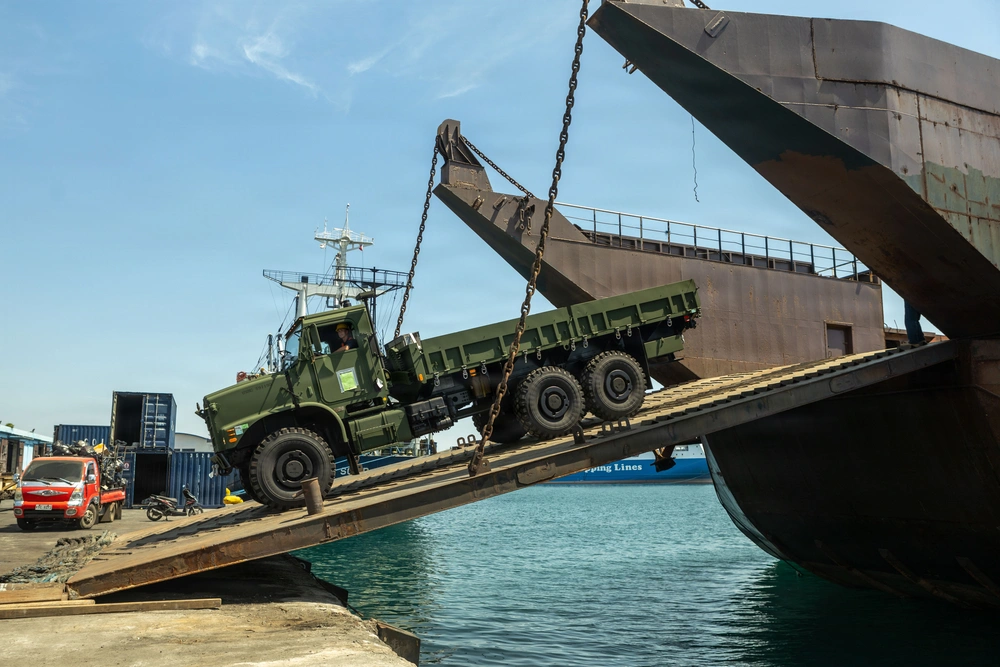
Thousands of American and Philippine troops, alongside a notable deployment of Japanese forces, commenced their annual military exercises on Monday, amidst the ongoing tensions from wars in the Middle East. This year’s exercises, known as Balikatan, or “Shoulder to Shoulder,” mark a significant moment with the inclusion of 1,400 Japanese military personnel, a first in the event’s history.
The exercises are set to occur over 19 days and will encompass live-fire drills in areas of strategic importance, particularly in the northern Philippines, which directly faces the Taiwan Strait, and in disputed waters of the South China Sea. These regions have become flashpoints for tensions between China and the Philippines, with both nations having experienced confrontations in recent months.
Colonel Dennis Hernandez, the Philippine exercise spokesman, highlighted that the Japanese forces would showcase their capabilities by utilizing a Type 88 cruise missile to strike a target ship near northern Paoay. In total, the military drills involve approximately 17,000 soldiers, airmen, and sailors, including contributions from Australia, New Zealand, France, and Canada.
Colonel Robert Bunn, the US exercise spokesman, underscored the importance of the exercises, describing them as a demonstration of the strong alliance between the US and the Philippines and their shared commitment to maintaining a free and open Indo-Pacific region. He assured that the US troop deployment would remain substantial despite the ongoing military operations in the Middle East, although he refrained from specifying exact numbers.
Balikatan is timely, coming just as a ceasefire between Iran and the US, along with Israel, approaches its end after weeks of conflict initiated by surprise strikes on February 28. The repercussions of this conflict are being felt globally, with energy crises challenging import-reliant nations like the Philippines.
As military pressure escalates from China surrounding Taiwan, Philippine President Ferdinand Marcos has noted the potential implications for the Philippines, indicating that any conflict over Taiwan would inevitably involve his nation. Earlier this year, joint patrols by US, Japanese, and Philippine aircraft across the Bashi Channel highlighted efforts to enhance interoperability among allied forces in complex maritime scenarios.
President Marcos has reinforced the importance of the 1951 mutual defense treaty with the US as a cornerstone of Philippine national security, and he has actively sought to strengthen defense ties with Western allies to counter growing Chinese assertiveness. In recent years, the Philippines has signed various agreements with countries like Japan, New Zealand, Canada, and France, aimed at fostering participation in joint military exercises.
As part of this year’s Balikatan, American forces may have the opportunity to fire Tomahawk and NMESIS anti-ship missiles. Integrated air and missile defense systems, as well as counter-drone technology, will also be tested during the exercises. Naval maneuvers are planned in undisclosed waters off the main Philippine island of Luzon, with Japan contributing a tank landing ship, a destroyer, and a helicopter destroyer. The US will deploy a cutter and a dock landing ship, joining two Philippine frigates and another vessel from Canada, emphasizing the collaborative nature of these multinational military efforts.


