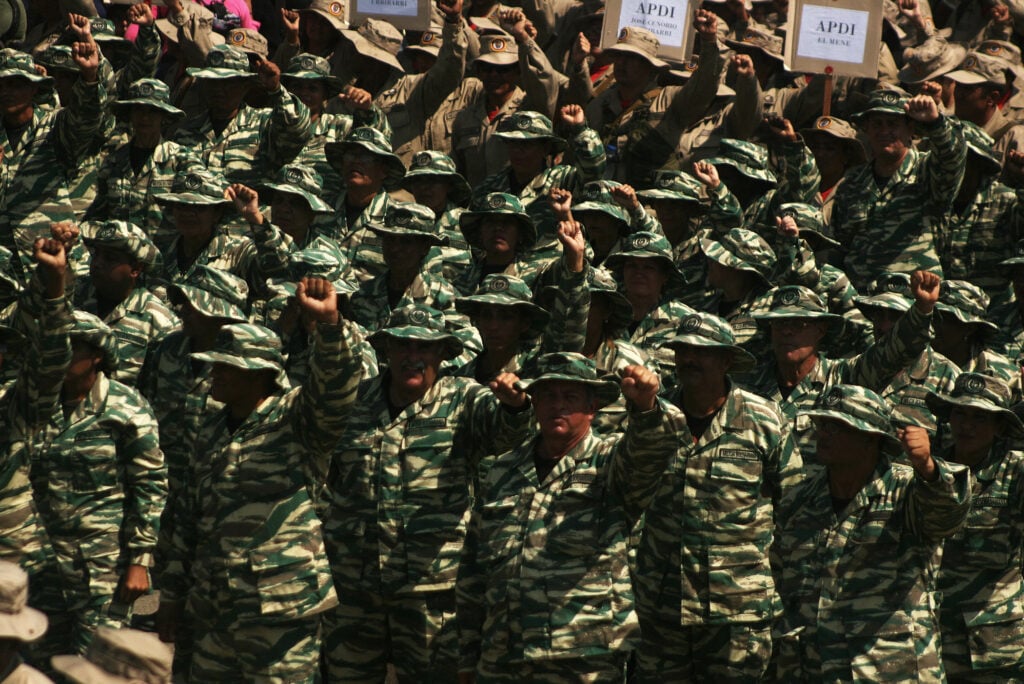
In a significant display of military readiness, the Venezuelan army swore in 5,600 additional soldiers on Saturday, amid escalating military pressure from the United States. This move follows recent actions by the U.S., which has deployed a fleet of warships and the world’s largest aircraft carrier to the Caribbean, ostensibly to combat drug trafficking.
The U.S. has intensified its military operations in the region, carrying out strikes on more than 20 vessels, resulting in the deaths of at least 87 individuals. Washington has accused Venezuelan President Nicolas Maduro of leading the so-called “Cartel of the Suns,” a designation that the U.S. classified as a terrorist organization just last month. Maduro, for his part, asserts that the U.S. military presence is a thinly veiled attempt to overthrow his government and appropriate Venezuela’s vast oil reserves.
Colonel Gabriel Rendon, speaking at a ceremony held at Fuerte Tiuna, the country’s largest military complex in Caracas, emphasized Venezuela’s commitment to resistance against what he described as an imperialist invasion. “Under no circumstances will we allow an invasion by an imperialist force,” he declared.
Official figures indicate that Venezuela maintains a military force of approximately 200,000 troops, supplemented by an additional 200,000 police officers. This latest recruitment effort appears to be a direct response to the heightened tensions with the U.S. and increasing domestic unrest.
Adding to the national turmoil, a former opposition governor, Alfredo Diaz, reportedly died in prison on the same day as the military swearing-in ceremony. Diaz had been detained on charges of terrorism and incitement amid a crackdown following last July’s contentious elections, in which Maduro claimed a third term amidst widespread allegations of fraud. His death marks at least the sixth loss of an opposition member behind bars since November 2024, according to human rights organizations.
Diaz had served as the governor of Nueva Esparta from 2017 to 2021 and was said to have spent the last year in isolation, having only received a single visit from his daughter. Alfredo Romero, director of the NGO Foro Penal, which advocates for political prisoners, noted that there are currently at least 887 political prisoners in Venezuela.
In reaction to the ongoing repression, opposition leader and Nobel Peace Prize laureate Maria Corina Machado condemned the circumstances surrounding the deaths of political prisoners during what she termed “post-electoral repression.” In a statement released alongside opposition candidate Edmundo Gonzalez Urrutia, she highlighted the dire conditions facing political prisoners — including denial of medical care, inhumane treatment, isolation, and torture — as indicative of a systematic pattern of state repression.