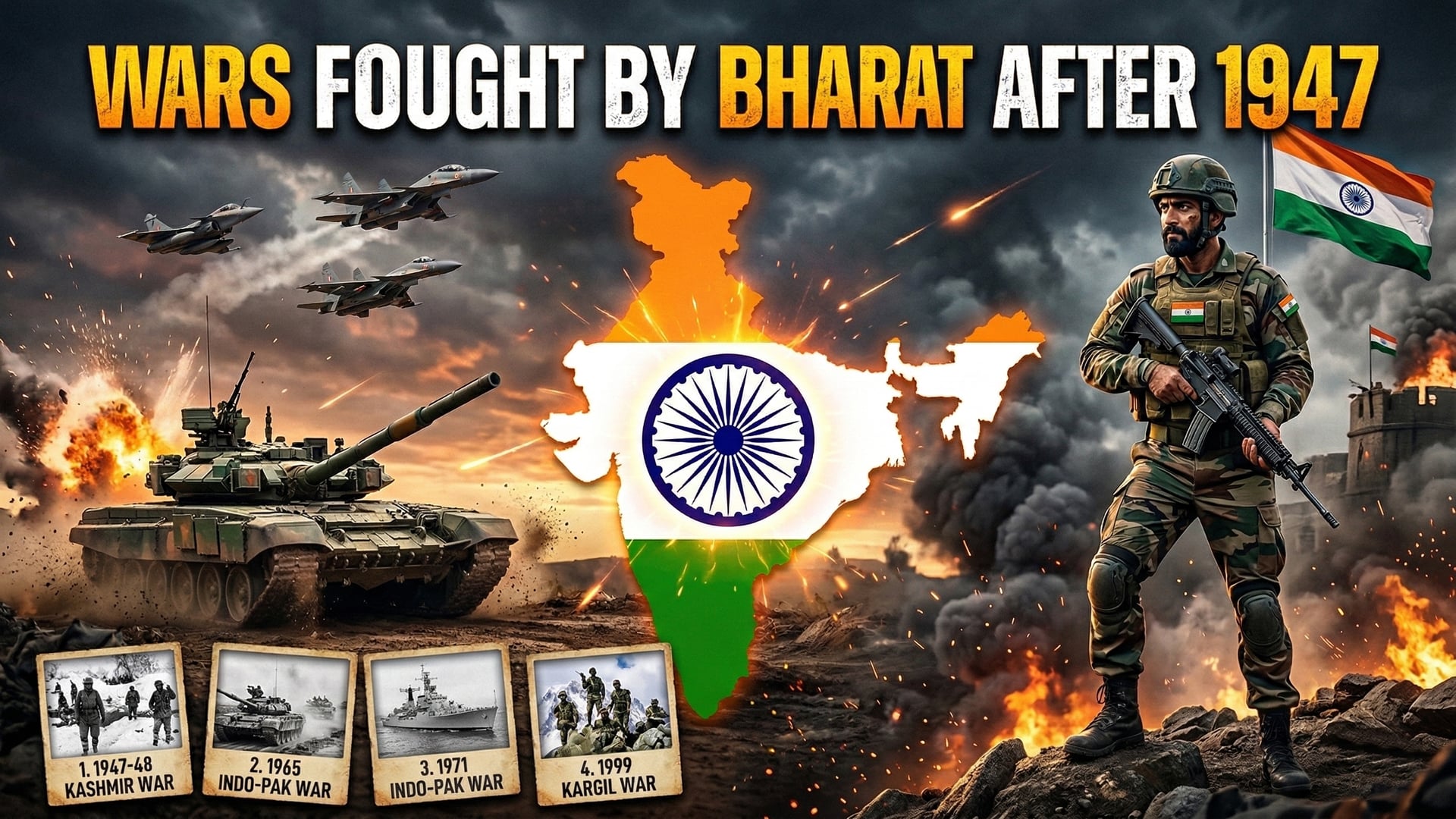
After gaining independence in 1947, India has fought several wars and military operations to protect its sovereignty, territorial integrity, and national security. These conflicts were mainly fought with neighboring countries such as Pakistan and China, while some operations targeted terrorism and cross-border threats. Below is an overview of the major wars and important military operations conducted by India after independence, including the recent Operation Sindoor.
Wars Fought by Bharat (India) After 1947
1. Indo-Pak War of 1947–48 (First Kashmir War)
The first war fought by India after independence occurred soon after the partition of India and Pakistan in 1947.
Causes
- Pakistan-backed tribal militias invaded the princely state of Jammu and Kashmir in October 1947.
- The Maharaja of Kashmir, Hari Singh, requested military assistance from India and signed the Instrument of Accession, making Kashmir part of India.
Key Events
- Indian troops were airlifted to Srinagar to defend the region.
- Fierce battles were fought in Kashmir throughout 1947 and 1948.
Outcome
- A UN-brokered ceasefire came into effect in January 1949.
- The region was divided along the Line of Control (LoC) between India and Pakistan.
2. Sino-Indian War (1962)
The 1962 war between India and China was fought over disputed border regions.
Causes
- Border disputes in Aksai Chin and Arunachal Pradesh (then NEFA).
- Rising tensions due to China building a road in Aksai Chin.
Key Events
- China launched a major offensive in October 1962.
- Fighting occurred in both eastern and western sectors.
Outcome
- China declared a unilateral ceasefire in November 1962.
- China retained control of Aksai Chin, while India strengthened its border defense afterward.
3. Indo-Pak War of 1965
This war was fought mainly over the Kashmir region.
Causes
- Pakistan launched Operation Gibraltar, sending infiltrators into Kashmir to incite rebellion.
Key Events
- India responded with a full-scale military operation across the international border.
- Major tank battles occurred in Punjab and Kashmir.
Outcome
- The war ended with the Tashkent Agreement (1966) mediated by the Soviet Union.
4. Indo-Pak War of 1971 (Bangladesh Liberation War)
This war led to the creation of a new country, Bangladesh.
Causes
- Political repression and humanitarian crisis in East Pakistan (now Bangladesh).
- Millions of refugees fled into India.
Key Events
- India supported the Bangladeshi freedom movement.
- War began in December 1971 after Pakistan launched air strikes on Indian air bases.
Outcome
- Pakistan’s forces in East Pakistan surrendered on 16 December 1971.
- Bangladesh became an independent nation.
5. Kargil War (1999)
The Kargil War was fought between India and Pakistan in the mountainous region of Kargil in Jammu and Kashmir.
Causes
- Pakistani soldiers and militants infiltrated across the Line of Control and occupied Indian positions.
Key Events
- India launched Operation Vijay to recapture the peaks.
- Intense fighting took place in high-altitude areas.
Outcome
- Indian forces successfully regained most of the occupied territory.
- Pakistan faced international pressure to withdraw.
6. Other Important Military Operations
Apart from major wars, India has conducted several strategic military operations, including:
- Operation Meghdoot (1984) – Secured the Siachen Glacier.
- Operation Pawan (1987–1990) – Indian Peace Keeping Force mission in Sri Lanka.
- Surgical Strikes (2016) – Targeted terrorist launch pads across the LoC.
- Balakot Air Strike (2019) – Air strikes on terrorist camps in Pakistan.
7. Operation Sindoor (2025)
Operation Sindoor is one of India’s recent military counter-terrorism operations.
Background
In April 2025, a terrorist attack in Pahalgam, Jammu and Kashmir, killed several civilians. In response, India launched Operation Sindoor to target terrorist infrastructure across the border.
Key Features of the Operation
- Conducted jointly by the Indian Army, Navy, and Air Force.
- Precision strikes targeted nine terrorist camps in Pakistan and Pakistan-occupied Kashmir.
- Advanced weapons such as loitering munitions, cruise missiles, and smart bombs were used.
Objective
The main goal was to destroy terrorist infrastructure linked to groups responsible for attacks in India, while avoiding escalation with the Pakistani military.
Outcome
- Several terror camps were destroyed in a short operation lasting around 25 minutes.
- The operation demonstrated India’s precision strike capability and coordinated military response.
Conclusion
Since independence, India has fought several wars and carried out many military operations to safeguard its territory and national interests. From the Indo-Pak wars and the Sino-Indian conflict to modern counter-terrorism missions like Operation Sindoor, these events highlight India’s evolving military strategy and commitment to national security.
India continues to strengthen its armed forces and defense technology to respond effectively to both conventional wars and modern security threats such as terrorism and hybrid warfare.