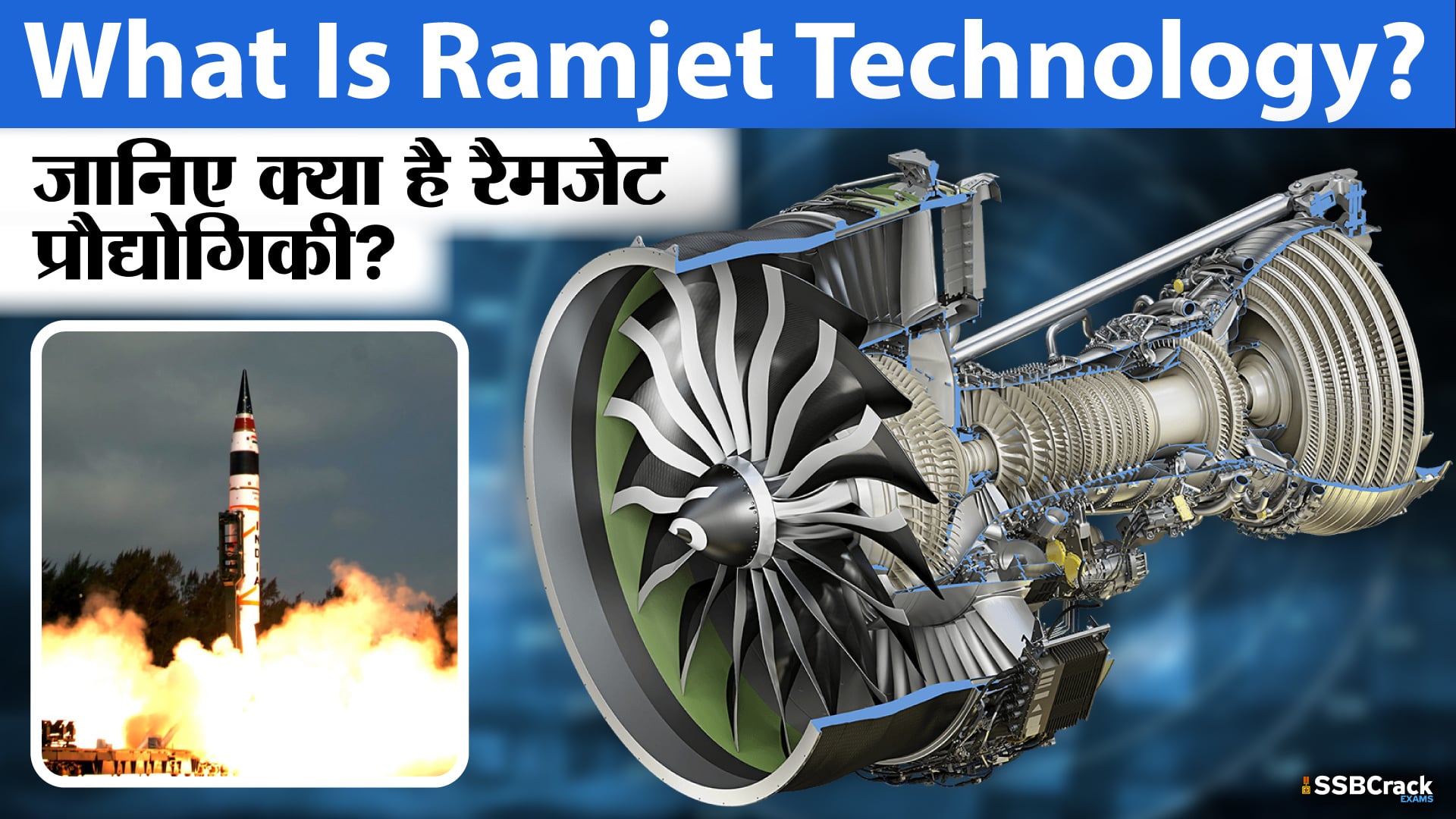
Ramjet technology is an advanced form of air-breathing jet propulsion used mainly in high-speed missiles and experimental aircraft. Unlike conventional jet engines, a ramjet has no moving parts such as compressors or turbines. It uses the forward motion of the vehicle itself to compress incoming air before combustion.
What is Ramjet Technology?
Ramjets are designed to operate efficiently at supersonic speeds, generally above Mach 2 (twice the speed of sound).
How Does a Ramjet Work?
The working of a ramjet engine is based on a simple principle:
- Air Intake: As the vehicle moves at very high speed, air enters the engine intake.
- Air Compression: The fast motion of the vehicle naturally compresses the air inside the engine—no mechanical compressor is needed.
- Fuel Injection: Fuel is injected into the compressed air.
- Combustion: The fuel-air mixture ignites, producing high-pressure exhaust gases.
- Thrust Generation: These gases exit through the nozzle at high speed, generating thrust and pushing the vehicle forward.
Because ramjets rely on high incoming air speed, they cannot operate from rest and need an initial booster, such as a rocket, to reach working speed.
Key Features of Ramjet Technology
- Air-breathing engine (uses atmospheric oxygen)
- No rotating or moving parts
- Efficient at high supersonic speeds
- Simple design compared to turbojet engines
- Requires an external launch system to start
Types of Ramjet Engines
- Conventional Ramjet: Operates at supersonic speeds but slows air to subsonic levels for combustion.
- Scramjet (Supersonic Combustion Ramjet): Allows combustion while air remains supersonic, enabling hypersonic speeds (Mach 5 and above).
- Solid Fuel Ducted Ramjet (SFDR): Uses solid fuel and is commonly applied in modern missiles.
Applications of Ramjet Technology
- Military Missiles: Used in long-range and high-speed cruise missiles.
- Hypersonic Research: Forms the basis for next-generation space and defense systems.
- Advanced Weapon Systems: Provides extended range and sustained high speed.
India’s successful tests of Solid Fuel Ducted Ramjet (SFDR) technology highlight its growing capabilities in this advanced propulsion field.
Advantages of Ramjet Technology
- High speed and long range
- Better fuel efficiency at supersonic speeds
- Reduced mechanical complexity
- Lighter engine structure
Limitations of Ramjet Technology
- Cannot function at low speeds
- Requires a booster for launch
- Limited use in civilian aviation
- Effective only at high altitudes and speeds
Conclusion
Ramjet technology represents a significant advancement in propulsion systems, especially for defense and hypersonic research. By eliminating complex mechanical components and utilizing high-speed airflow for compression, ramjets enable vehicles to travel faster and farther. With continued research and successful tests, ramjet engines are expected to play a crucial role in the future of missile and aerospace technology.