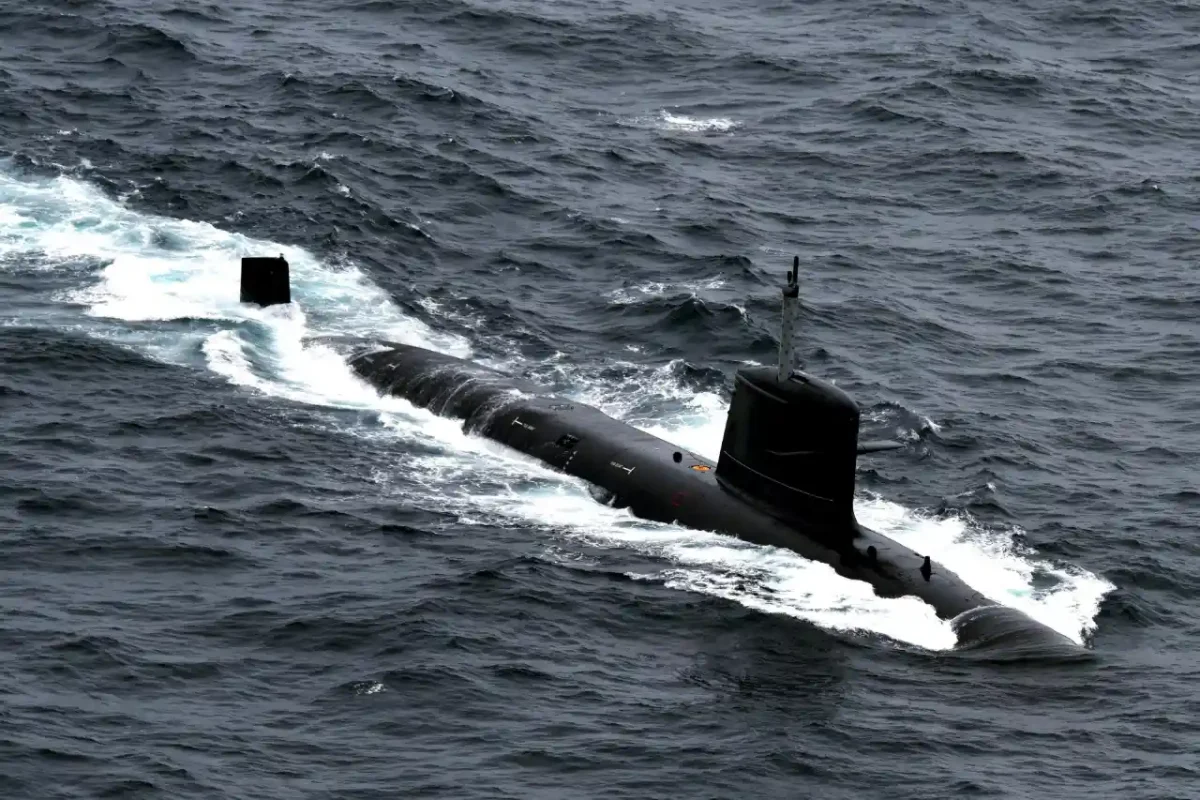
If you are preparing for NDA, CDS or the Indian Navy Entrance Test (INET) and see yourself in the Indian Navy one day, submarines are a topic you cannot skip. They are the most secretive part of any navy. A submarine can stay hidden under the sea for days, watch enemy movements, sink ships, lay mines and, in the case of nuclear ballistic missile submarines, guarantee that India can always strike back if it is ever attacked with nuclear weapons.
Questions on submarine classes, their builders and recent commissionings appear regularly in defence GK sections, and Interviewing Officers at the Services Selection Board (SSB) often test Navy aspirants on the fleet they want to join. As of November 2026, the Indian Navy operates three nuclear-powered ballistic missile submarines (SSBNs) of the Arihant class and 16 conventional diesel-electric submarines (SSKs) across three classes: six Kalvari-class boats, six Sindhughosh-class boats and four Shishumar-class boats.
Here are 10 Indian Navy submarines and their capabilities, covering every class now in service. The numbering is only for easy reading and is not a ranking. Where details of strategic submarines are classified, we have stuck to what has been officially stated or widely reported.
1. INS Arihant (S2)
Class: Arihant class, nuclear-powered ballistic missile submarine (SSBN)
Builder: Ship Building Centre, Visakhapatnam, under the Advanced Technology Vessel (ATV) project
Launched: 26 July 2009
Commissioned: 2016
Propulsion: Pressurised water reactor developed with the Bhabha Atomic Research Centre (BARC)
Armament: Nuclear-capable K-15 Sagarika submarine-launched ballistic missiles (reported)
INS Arihant, whose name means ‘destroyer of enemies’, is India’s first indigenously built nuclear-powered submarine. It was developed under the highly secretive ATV project, with design inputs from the Navy and DRDO, the nuclear reactor from BARC and major hull and engineering work by Indian industry. Its launch in July 2009 was timed with the tenth anniversary of the Kargil victory.
The submarine’s biggest contribution is strategic. With Arihant, India completed its nuclear triad, meaning it can deliver nuclear weapons from land, air and sea. In November 2018, the government announced that Arihant had completed its first deterrence patrol, and in October 2022 it carried out a successful launch of a submarine-launched ballistic missile in the Bay of Bengal.
For exams, remember that the sea-based leg of the triad matters most for a country with a ‘No First Use’ policy, because a hidden submarine gives an assured second-strike capability that an enemy cannot easily destroy.
2. INS Arighaat (S3)
Class: Arihant class SSBN
Builder: Ship Building Centre, Visakhapatnam
Commissioned: 29 August 2024 at Visakhapatnam, in the presence of Defence Minister Rajnath Singh
Displacement: About 6,000 tonnes (reported)
Propulsion: Nuclear reactor, an improved version of the one fitted on Arihant (reported)
Armament: Nuclear-capable K-15 and longer-range K-4 ballistic missiles (reported)
INS Arighaat is the second boat of the Arihant class. It is broadly similar in size and layout to Arihant, but it carries more indigenous technology and systems, reflecting the experience gained from building and operating the first boat.
Media reports in late 2024 said a K-4 missile, with a reported range of about 3,500 km, had been test-fired from Arighaat in the Bay of Bengal. Longer-range missiles allow an SSBN to cover more targets while staying in safer waters closer to home, which makes the deterrent more survivable.
3. INS Aridhaman (S4)
Class: Arihant class SSBN (enlarged third boat)
Builder: Ship Building Centre, Visakhapatnam
Commissioned: 3 April 2026 at Visakhapatnam (not formally announced; confirmed through official hints and media reports)
Displacement: About 7,000 tonnes, roughly 1,000 tonnes more than the first two boats (reported)
Propulsion: Nuclear reactor (pressurised water reactor)
Armament: Twice as many vertical launch tubes as Arihant and Arighaat, for K-15 or K-4 missiles (reported)
INS Aridhaman is the newest and largest submarine of the Indian Navy. It was commissioned quietly at Visakhapatnam in April 2026, with Defence Minister Rajnath Singh posting a short message, “Shabd nahi, shakti hai, ‘Aridhaman’”, which was widely seen as confirmation. With its induction, India has three operational ballistic missile submarines for the first time.
Aridhaman is longer and heavier than its two predecessors because it carries an extra section of missile tubes. This means it can carry more long-range missiles, strengthening the sea-based leg of India’s nuclear deterrent. Reports say a further boat of the class has already been launched.
4. INS Kalvari (S21)
Class: Kalvari class (Project-75), based on the French Scorpene design
Builder: Mazagon Dock Shipbuilders Limited (MDL), Mumbai, with technology transfer from Naval Group of France
Commissioned: 14 December 2017 by Prime Minister Narendra Modi
Length: About 67.5 metres
Propulsion: Diesel-electric (diesel generators charge large battery banks)
Armament: Six 533 mm tubes for up to 18 weapons: heavyweight torpedoes or SM39 Exocet anti-ship missiles; can also lay mines
INS Kalvari is the lead boat of the Navy’s most modern conventional submarine class. Its name means ‘tiger shark’, and it revives the name of India’s very first submarine, the Foxtrot-class INS Kalvari, commissioned in 1967. The commissioning of the new Kalvari in 2017 ended a long gap in which India had not inducted a new conventional submarine for many years.
Kalvari-class boats are designed for anti-ship and anti-submarine warfare, intelligence gathering, area surveillance and mine-laying. Their stealth comes from advanced acoustic silencing, low radiated noise and a hydrodynamically optimised hull. They can fire torpedoes and tube-launched anti-ship missiles both when submerged and on the surface.
An important future upgrade is Air Independent Propulsion (AIP). DRDO’s Naval Materials Research Laboratory has developed an indigenous AIP energy module, which is planned to be handed to MDL for integration on a Kalvari-class submarine from early 2027. AIP lets a diesel-electric submarine stay submerged much longer without surfacing to charge its batteries.
5. INS Khanderi (S22)
Class: Kalvari class (Scorpene design)
Builder: Mazagon Dock Shipbuilders Limited, Mumbai
Commissioned: 28 September 2019
Motto: “Akhand Abhedya Adrishya” (Indivisible, Invincible, Invisible)
Propulsion: Diesel-electric
Armament: Torpedoes, SM39 Exocet anti-ship missiles and mines
INS Khanderi, the second boat of the class, takes its name from the island fort of Khanderi built by Chhatrapati Shivaji Maharaj, whose navy is seen as a pioneer of Indian maritime power. The name was earlier carried by a Foxtrot-class submarine that served the Navy from 1968 to 1989.
Like its sister boats, Khanderi is built for stealth and endurance. Its compact size, quiet operation and modern combat management system make it well suited for operations in the Arabian Sea and the wider Indian Ocean, where it can shadow enemy ships, gather intelligence and protect India’s sea lanes.
6. INS Vagsheer (S26)
Class: Kalvari class, sixth and final boat of the first batch
Builder: Mazagon Dock Shipbuilders Limited, Mumbai
Commissioned: 15 January 2025 by Prime Minister Narendra Modi
Sister boats: INS Karanj (March 2021), INS Vela (November 2021) and INS Vagir (January 2023)
Propulsion: Diesel-electric
Armament: Up to 18 torpedoes or anti-ship missiles; mines
INS Vagsheer, named after the sandfish of the Indian Ocean, completed the six-boat Project-75 programme. It was commissioned in Mumbai on 15 January 2025 together with the destroyer INS Surat and the frigate INS Nilgiri. This was the first time a destroyer, a frigate and a submarine were commissioned into the Indian Navy together, and all three were built in India.
With Vagsheer, the Navy has six Kalvari-class submarines. The government has also been considering three more Scorpene-class boats at MDL, a proposal that was awaiting final clearance in November 2026. That would allow India to use the existing production line and experience while newer submarine projects move ahead.
7. INS Sindhukirti (S61)
Class: Sindhughosh class (Russian Kilo class, Project 877EKM)
Builder: Built in the Soviet Union
Commissioned: 1990 (per the Navy’s list; some sources give December 1989)
Displacement: About 3,000 tonnes
Performance: Diving depth of about 300 metres, top speed of 18 knots, solo endurance of 45 days (Indian Navy figures)
Armament: Torpedoes, mines and, after upgrades, Klub-S anti-ship cruise missiles
The Sindhughosh class is the Indian version of the Russian Kilo class, famous for being extremely quiet. India acquired ten of these boats between 1986 and 2000, and for decades they formed the backbone of the Navy’s underwater fleet. Six remain in service after the lead boat, INS Sindhughosh, was decommissioned in December 2025.
INS Sindhukirti is a good example of how the Navy keeps these boats combat-ready. Its earlier mid-life refit at Hindustan Shipyard Limited (HSL), Visakhapatnam, added the indigenous USHUS sonar and the capability to fire Klub missiles. A later ‘normal refit’ at HSL was completed in July 2025, ahead of schedule, and the submarine rejoined the fleet. This refit included modifying escape hatches for compatibility with Deep Submergence Rescue Vehicles.
8. INS Sindhushastra (S65)
Class: Sindhughosh class (Kilo)
Builder: Built in Russia
Commissioned: 19 July 2000
Displacement: About 3,000 tonnes
Propulsion: Diesel-electric
Armament: Torpedoes, mines and Klub-S cruise missiles
INS Sindhushastra is the tenth and last Kilo-class submarine acquired by India and the youngest boat of the class. The other five Sindhughosh-class boats still in service are INS Sindhuraj, INS Sindhuratna, INS Sindhukesari, INS Sindhukirti and INS Sindhuvijay.
Kilo-class boats are larger than the Kalvari class and carry a heavy weapon load. The upgraded boats can launch Klub-S cruise missiles from their torpedo tubes, giving them a strike capability against ships and land targets. However, most of the class is now well over three decades old, which is why new submarine programmes are so important for the Navy.
9. INS Shishumar (S44)
Class: Shishumar class, Indian variant of the German Type 209/1500
Builder: Howaldtswerke-Deutsche Werft (HDW), Kiel, Germany
Commissioned: 22 September 1986
Displacement: About 1,660 tonnes surfaced
Propulsion: Diesel-electric
Armament: Heavyweight torpedoes and mines
INS Shishumar, meaning ‘dolphin’, is the lead boat of the Navy’s German-designed submarine class. India signed the agreement with HDW in December 1981 for two boats to be built in Germany and two to be assembled at Mazagon Dock in Mumbai. Shishumar and its sister INS Shankush were built in Germany and commissioned in 1986.
A notable feature of this class is an integrated rescue (escape) sphere that can hold the entire crew in an emergency. To keep the ageing boats in service, the Navy has put them through a Medium Refit and Life Certification at MDL, and Shishumar completed its refit in 2023. The four boats of the class are based in Mumbai.
10. INS Shalki (S46)
Class: Shishumar class (Type 209/1500)
Builder: Mazagon Dock Limited, Mumbai
Commissioned: 7 February 1992
Distinction: First submarine ever built in India
Propulsion: Diesel-electric
Armament: Heavyweight torpedoes and mines
INS Shalki holds a special place in Indian naval history: it was the first submarine ever built in India. Shalki and its sister INS Shankul, commissioned in May 1994, were constructed at Mazagon Dock with German technology transfer. The skills that MDL developed on these boats later helped it build the six Kalvari-class submarines.
Shalki is still active more than three decades after commissioning and continues to take part in exercises and overseas deployments. In August 2024, it made a formal port call at Colombo, Sri Lanka, an example of how submarines also support India’s naval diplomacy in the Indian Ocean region.
Conclusion
The Indian Navy’s submarine arm combines two very different missions. The three Arihant-class SSBNs give India a credible nuclear second-strike capability, while the 16 conventional submarines of the Kalvari, Sindhughosh and Shishumar classes hunt ships and submarines, gather intelligence and guard India’s maritime interests. The journey from building the first Indian submarine, INS Shalki, in 1992 to commissioning the 7,000-tonne INS Aridhaman in 2026 shows how far Indian shipbuilding has come.
At the same time, many conventional boats are ageing, and the Navy is waiting on new programmes, including the six-submarine Project-75(I) with Germany’s TKMS and MDL, three additional Scorpenes and the indigenous AIP module. For NDA, CDS and INET aspirants, remember the class names, their origin, one or two key boats and their commissioning years, and be ready to explain why submarines matter. That clarity helps in the written exam, group discussions and the SSB interview.
Frequently Asked Questions (FAQs)
1. How many submarines does the Indian Navy have in November 2026?
The Navy operates three nuclear-powered ballistic missile submarines (Arihant, Arighaat and Aridhaman) and 16 conventional submarines: six Kalvari class, six Sindhughosh class and four Shishumar class.
2. What is the difference between an SSBN and an SSK?
An SSBN is a nuclear-powered submarine that carries ballistic missiles for nuclear deterrence and can stay submerged for very long periods. An SSK is a conventional diesel-electric attack submarine that must surface or snorkel regularly to recharge its batteries.
3. Which was the first submarine built in India?
INS Shalki, a Shishumar-class (Type 209) boat built by Mazagon Dock in Mumbai and commissioned on 7 February 1992.
4. What is Project-75?
Project-75 is the programme under which MDL built six Kalvari-class submarines based on the French Scorpene design. The first, INS Kalvari, was commissioned in 2017 and the last, INS Vagsheer, in January 2025.
5. What is Air Independent Propulsion (AIP)?
AIP is a technology that allows a conventional submarine to stay submerged much longer without surfacing to charge batteries. DRDO has developed an indigenous AIP module planned for integration on a Kalvari-class submarine.