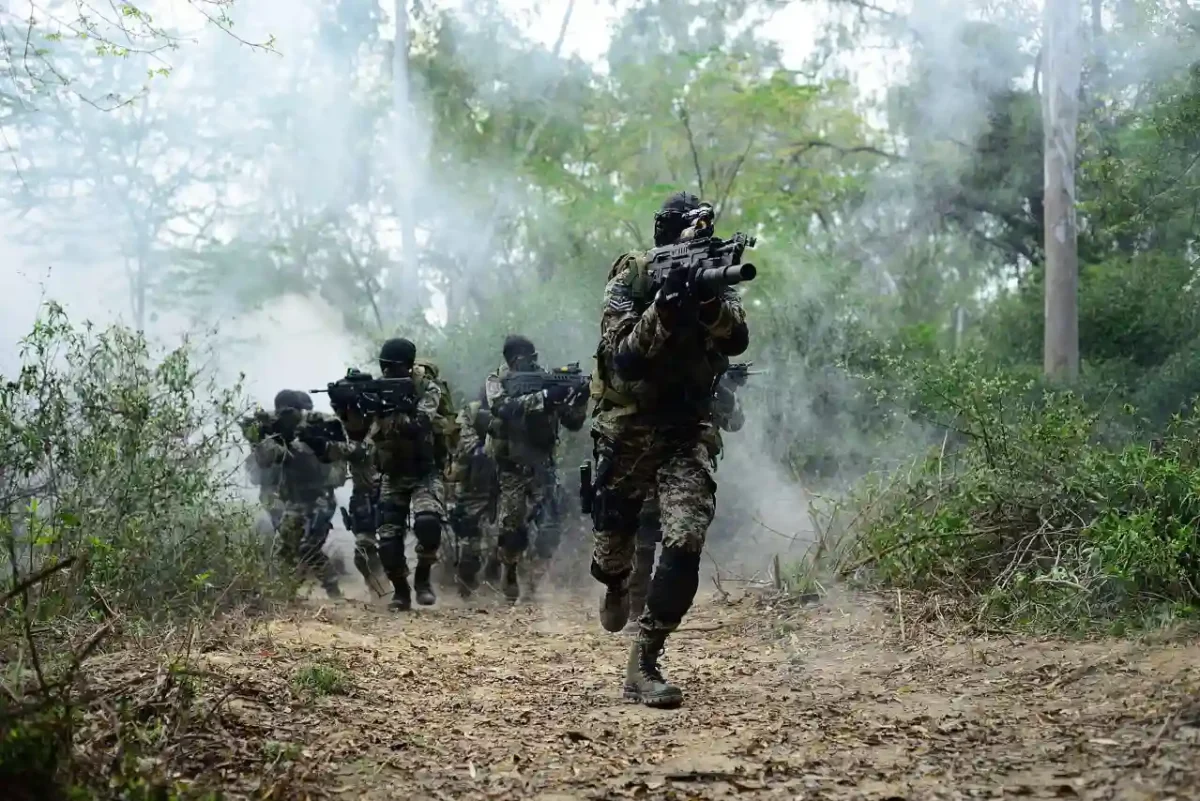
Every defence aspirant has heard stories of commandos who march through the night with heavy loads, jump out of aircraft and fight in jungles, deserts and the sea. Those skills are not born; they are built through some of the hardest training programmes in the country. In India, commando training is run not only by the Army, Navy and Air Force but also by the National Security Guard, the Central Armed Police Forces and state police special units.
This article explains 10 of the toughest commando training programmes in India: where they are run, who can volunteer, what the training involves and why so many volunteers fail to finish. The list mixes armed forces, central and state forces, so you get the full picture. The order is for readability and is not an official ranking. Many training details are kept confidential for security reasons, so this guide sticks to what has been officially stated or widely reported.
1. Para (Special Forces) Probation, Indian Army
Force: Indian Army, Parachute Regiment (Special Forces)
Who can volunteer: Serving officers and soldiers who meet the medical and fitness standards
Duration: Commonly about 90 days, longer in some cases
Earns: Maroon beret, Special Forces tab and the Balidaan badge after further training
The Para SF probation is the gateway to the Indian Army’s Special Forces battalions. There is no direct civilian entry. A candidate first joins the Army, then volunteers. Probation is commonly described as lasting around 90 days and is designed to test whether a volunteer can keep going when exhausted, hungry and short of sleep.
Volunteers face long speed marches with heavy loads, endurance runs, obstacle courses, firing under stress, navigation and constant pressure from instructors. Many drop out on their own and the attrition rate is reported to be very high. Those who are judged suitable then move on to the basic parachute course and further special forces training. A volunteer who does not make it simply returns to the parent unit, which is why the probation is called a test of character as much as of fitness.
For aspirants, the key takeaway is that Para SF selection begins only after you have joined the Army through a regular entry such as NDA, CDS or recruitment rallies.
2. MARCOS Selection and Training, Indian Navy
Force: Indian Navy, Marine Commando Force (MARCOS)
Who can volunteer: Serving naval officers and sailors
Basic training base: INS Abhimanyu, Mumbai
Overall training: Commonly described as about two to three years, including probation
MARCOS are trained to fight at sea, from the sea and on land, which makes their training one of the most demanding in India. Selection is voluntary. It is widely reported to start with a three-day pre-selection of physical and aptitude tests, followed by a selection phase that includes a version of the famous “Hell Week”, with very little sleep and continuous physical tasks.
Candidates who get through then begin basic special forces training at INS Abhimanyu in Mumbai. Over the following phases they learn weapons handling, close-quarter battle, unarmed combat, ship boarding drills and small-boat skills. They complete a parachute course at the Paratroopers Training School in Agra and a diving course at the Navy’s Diving School in Kochi. All MARCOS are trained in free-fall parachuting, including HALO (high altitude, low opening) and HAHO (high altitude, high opening) jumps.
Advanced training reportedly includes counter-insurgency and jungle warfare, desert and high-altitude training, anti-piracy and anti-hijack drills and combat diving. A large share of volunteers do not complete the full programme.
3. Garud Commando Force Training, Indian Air Force
Force: Indian Air Force, Garud Commando Force
Who can join: Airmen recruited directly for the Garud trade through Airmen Selection Centres; officers from the Ground Duty branches
Training centre: Garud Regimental Training Centre (GRTC), Air Force Station Chandinagar, Uttar Pradesh
Duration: About 72 weeks of basic training, often called the longest among Indian special forces
The Garud Commando Force was raised to protect critical air force assets and carry out special operations linked to air power, such as combat search and rescue and airfield defence. Unlike Para SF and MARCOS, Garud airmen are recruited straight into the Garud stream through Airmen Selection Centres, so their long training also includes basic airman training.
The first phase is a three-month probation built around tough physical training, and it has a high attrition rate. Those who clear it go on to special operations training, the basic airborne course at the Paratroopers Training School in Agra, and specialised modules such as jungle and snow survival, demolition and counter-insurgency, including attachments to Army training schools.
On completion, successful trainees receive the maroon beret, the Garud proficiency badge and Special Forces tabs at a ceremonial parade at the GRTC. Their passing-out demonstrations typically include combat firing, hostage rescue, slithering, rappelling and military martial arts.
4. NSG Black Cat Training, Manesar
Force: National Security Guard (NSG), under the Ministry of Home Affairs
Who can join: Personnel on deputation from the Indian Army, CAPFs and state police
Training base: NSG’s training establishment at Manesar, Haryana
Basic course: Reported to last about 90 days, followed by specialised training
The NSG is India’s federal counter-terrorism force, popularly called the Black Cats. Nobody joins the NSG directly. Personnel come on deputation from the Army and from police forces, and the force keeps a young profile by sending them back to their parent organisations after a few years.
The basic course at Manesar is widely reported to last about 90 days. Only those who complete it are inducted and sent for further specialised training. The NSG’s tests include a demanding obstacle course followed by target shooting, designed to check how well a commando performs under stress and exhaustion. The NSG has also adopted the Vienna Test System for psychological assessment of candidates.
In 2026 the NSG ran its first Mahila Commando Conversion Course, a 12-week residential programme at its training academy in Manesar for women personnel from state police forces and CAPFs. The first batch completed the course in November 2026, a milestone worth noting for current affairs.
5. Commando Course, Junior Leaders Wing, Belagavi
Force: Indian Army (open to officers and soldiers; foreign trainees also attend)
Institution: Commando Wing of the Infantry School’s Junior Leaders Wing, Belagavi, Karnataka
Links to: Ghatak platoons of infantry battalions
Focus: Endurance, small-team tactics, survival and leadership under stress
The Commando Course at Belagavi is one of the most respected courses in the Indian Army. It is not a special forces selection course; it trains young officers and soldiers from across the Army in commando skills that they take back to their units. Many of the men who serve in an infantry battalion’s Ghatak platoon, its strike team, have completed this course.
The course is known for intensive physical conditioning, long marches, obstacle courses, survival training and tactical exercises in hilly, forested terrain. Students are pushed to make sound decisions while tired and hungry. Young officers are often encouraged to attempt it early in their careers, and earning a good grade on this course is a matter of pride.
The course also trains students from friendly foreign countries. The course that ended in June 2026, for example, included trainees from Bhutan, Sri Lanka, Nepal and the Maldives.
6. Special Frontier Force Training
Force: Special Frontier Force (SFF)
Raised: 1962, after the war with China
Headquarters: Chakrata, Uttarakhand
Known for: Mountain warfare and airborne capability
The Special Frontier Force is one of India’s most secretive units. It was raised in 1962 and is headquartered at Chakrata in Uttarakhand. Its operational details are classified, but it is known for specialising in mountain and high-altitude warfare and for being parachute-qualified.
Because the SFF operates in some of the harshest terrain in the world, its training is built around endurance at altitude, mountain craft and airborne operations. The SFF has also helped train other units; for example, the Garud Commando Force’s special operations training has drawn on assistance from the SFF.
Aspirants should know the SFF for general knowledge and interviews, but should not expect detailed public information about its selection or courses.
7. CoBRA Pre-Induction Training, CRPF
Force: Central Reserve Police Force (CRPF), Commando Battalion for Resolute Action (CoBRA)
Institution: CoBRA School of Jungle Warfare and Tactics (CSJWT), Belagavi, Karnataka
First pre-induction course: Began on 27 June 2012
Focus: Jungle warfare for anti-Naxal operations
CoBRA is the CRPF’s specialist force for jungle operations against Left Wing Extremism. Its flagship training institution, the CoBRA School of Jungle Warfare and Tactics in Belagavi, sits in the forested Western Ghats, which give trainees realistic jungle terrain.
According to the CRPF, the school was first raised as the National Institute of Jungle Craft, ran its first pre-induction training for CoBRA commandos in June 2012, and was later renamed CSJWT and made a permanent institution. Its main courses are pre-induction training for new CoBRA commandos and re-orientation training for serving ones. It has also run advanced combat sniper courses and trained personnel from the SSB, NSG and Karnataka Police in jungle warfare.
Training covers jungle survival, river crossing, casualty evacuation, battle inoculation and long patrols in thick vegetation, preparing commandos for operations that can last days at a stretch.
8. Greyhounds Training, Andhra Pradesh and Telangana
Force: Greyhounds, a police special forces unit of Andhra Pradesh and Telangana
Raised: 1989, by IPS officer K.S. Vyas
Speciality: Jungle warfare and counter-insurgency against Maoists
Age profile: Commandos are kept young, with personnel reported to move back to regular police at 35
The Greyhounds are widely regarded as one of the most successful anti-Maoist forces in India. The force was raised in 1989 by K.S. Vyas, who designed its training around guerrilla-style jungle warfare. Its success inspired other forces, including Odisha’s Special Operations Group and Maharashtra’s C-60, and CoBRA is also said to be modelled on similar lines.
Greyhounds training focuses on fieldcraft, weapons handling, very high physical fitness and mental alertness. Commandos are expected to trek 20 to 30 km through hilly jungle for a single operation and to stay in the forest for several days, sometimes living on dry rations because a cooking fire could give away their position.
After the bifurcation of Andhra Pradesh in 2014, the original training centres in Hyderabad went to Telangana, and Andhra Pradesh has been developing its own facilities near Visakhapatnam.
9. Basic Parachute Course, Paratroopers Training School, Agra
Run by: Indian Air Force
Location: Agra, Uttar Pradesh
Who attends: Paratroopers and special forces of all three services and other forces, and selected NCC cadets
Course: About three weeks of ground training followed by five jumps, including a night jump
Almost every commando programme in this list passes through the Paratroopers Training School (PTS) in Agra. Para SF volunteers, MARCOS and Garud trainees all complete their basic airborne training here, which is why PTS is often called the home of military parachuting in India.
The basic course is commonly described as about three weeks long. The first part is intensive ground training on landing rolls, aircraft exits, harness drills and emergency procedures. Trainees then make five static-line jumps, including one at night, to earn their parachute wings. Selected NCC cadets also attend a para basic course here.
While the course is shorter than the others in this list, the first exit from an aircraft door is a real test of nerve, and failure to jump means failure on the course.
10. Combat Diving Training, Naval Diving School, Kochi
Run by: Indian Navy
Location: Kochi, Kerala
Who trains here: MARCOS and other selected personnel, including Garud trainees
Focus: Underwater skills for combat and special operations
For maritime special forces, diving is a core combat skill. The Navy’s Diving School in Kochi trains MARCOS in diving as part of their qualification, and Garud commandos have also trained at the Navy’s diving school.
Combat diving demands calm under water, strong swimming, careful navigation and strict discipline with equipment. Trainees learn to operate in low visibility, over long distances and in cold, tiring conditions. Any panic under water can be dangerous, so the training tests mental control as much as physical fitness.
For Navy aspirants, this is a reminder that MARCOS training goes well beyond fitness on land; strong swimming ability is essential before volunteering.
Conclusion
India’s commando training programmes differ in purpose. Para SF, MARCOS and Garud train military special forces; the NSG trains counter-terrorism specialists; and CoBRA and the Greyhounds prepare commandos for long jungle operations against insurgents. Yet they share the same foundation: voluntary entry, brutal physical and mental testing, high attrition and a focus on teamwork under stress.
For defence aspirants, the path to any of these units begins with a regular entry into the armed forces, a CAPF or a state police force. Build your fitness, swimming and endurance early, keep a strong record in your unit, and remember that these programmes reward determination as much as strength. The facts in this list are also useful for the SSB interview, GD topics and general knowledge papers.
Frequently Asked Questions
1. Which commando training is the longest in India?
The Garud Commando Force’s basic training is commonly described as about 72 weeks, often called the longest among Indian special forces because it also includes basic airman training.
2. Can a civilian directly join Para SF, MARCOS or the NSG?
No. Para SF and MARCOS take volunteers from serving Army and Navy personnel, and the NSG takes personnel on deputation from the Army, CAPFs and state police. Garud is the exception: airmen can be recruited directly into the Garud trade.
3. Where is the NSG trained?
The NSG’s main training establishment is at Manesar in Haryana, where its basic course is reported to last about 90 days.
4. Where do Indian commandos learn to parachute?
Most complete the basic parachute course at the Indian Air Force’s Paratroopers Training School in Agra.
5. Where is CoBRA training held?
CoBRA commandos train at the CRPF’s CoBRA School of Jungle Warfare and Tactics in Belagavi, Karnataka.