Indian Art and Culture is a steady source of marks in the general knowledge paper. The NDA General Ability Test, the CDS General Knowledge paper, AFCAT general awareness, the UPSC Civil Services preliminary exam, SSC and state PSC exams regularly ask about temple styles, famous monuments, classical dances and their states, musicians and their instruments, painting schools, handicrafts, festivals and UNESCO heritage listings.
This article brings together 100 of the most important Indian Art and Culture GK questions on these high-frequency themes. The set is divided into four parts: Architecture, Temples and Monuments (questions 1 to 25), Dance, Music and Theatre (26 to 50), Painting, Sculpture, Crafts and Literature (51 to 75), and Religion, Philosophy, Festivals and Cultural Institutions (76 to 100). It follows our Indian History, Indian Geography, Indian Polity, Indian Economy, General Science and Environment and Ecology sets, so you can revise all seven subjects in the same way.
The questions are based on the NCERT books, especially the Class 11 Fine Arts book An Introduction to Indian Art and the history textbooks, along with standard facts about the Sangeet Natak Akademi, the Archaeological Survey of India and UNESCO listings. Read each question, try to recall the answer, and only then read the short explanation, which adds the related fact that examiners often turn into a second question.
Architecture, Temples and Monuments (Questions 1 to 25)
1. Which style of temple architecture is mainly found in North India?
Answer: The Nagara style. Nagara temples have a curved, beehive-like tower (shikhara) over the sanctum. The Dravida style is found in South India, and the Vesara style mixes features of both.
2. In a Dravida-style temple, what is the tall, ornamented gateway tower called?
Answer: The gopuram. In Dravida temples the tower over the sanctum is called the vimana, while the gopurams are the gateways in the outer walls. In later South Indian temples the gopurams often became taller than the vimana.
3. Which temple style combines features of the Nagara and Dravida styles?
Answer: The Vesara style. The Vesara style developed in the Deccan, mainly under the later Chalukyas and the Hoysalas. The Hoysala temples at Belur and Halebidu are well-known examples.
4. Who built the Sun Temple at Konark in Odisha?
Answer: King Narasimhadeva I of the Eastern Ganga dynasty. The 13th-century temple is designed as the chariot of the Sun God with 24 carved stone wheels pulled by seven horses. It is also called the Black Pagoda and is a UNESCO World Heritage Site.
5. The Kandariya Mahadeva Temple at Khajuraho was built by which dynasty?
Answer: The Chandela dynasty. The Khajuraho group of temples in Madhya Pradesh, built between about 950 and 1050 CE, is a classic example of the Nagara style and a UNESCO World Heritage Site. Kandariya Mahadeva is the largest temple of the group.
6. The monolithic Kailasa Temple (Cave 16) at Ellora was carved under which dynasty?
Answer: The Rashtrakuta dynasty. It was carved in the 8th century under the Rashtrakuta king Krishna I. The whole temple was cut out of a single rock from the top downwards.
7. The Shore Temple at Mahabalipuram was built by which dynasty?
Answer: The Pallava dynasty. It was built in the early 8th century under the Pallava king Narasimhavarman II (Rajasimha). The famous rock-cut rathas at Mahabalipuram are linked with the earlier king Narasimhavarman I, also called Mamalla.
8. Who built the Brihadeeswara Temple at Thanjavur?
Answer: Rajaraja Chola I. The temple was completed around 1010 CE and has one of the tallest vimanas of its time. It is part of the UNESCO site called the Great Living Chola Temples.
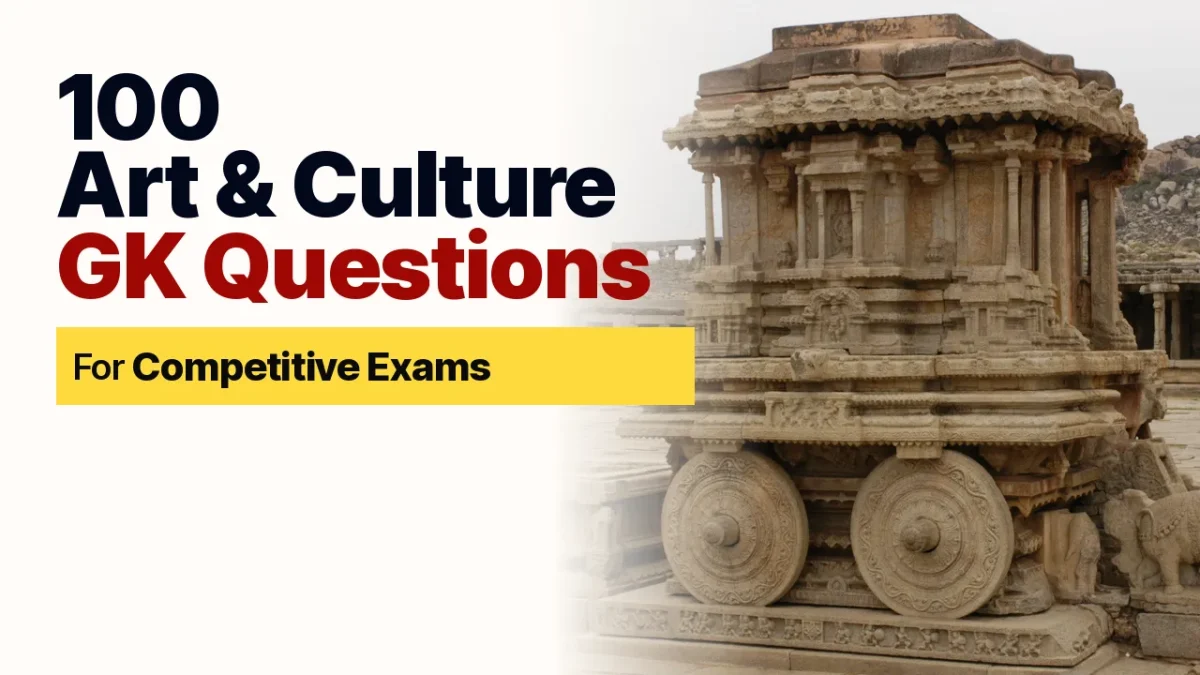
9. The famous stone chariot in the Vitthala Temple complex is located at which place?
Answer: Hampi in Karnataka. Hampi was the capital of the Vijayanagara Empire. The stone chariot is a shrine to Garuda and appears on the back of the new 50 rupee note.
10. The Dilwara temples at Mount Abu are sacred to which religion?
Answer: Jainism. The marble temples in Rajasthan were built between the 11th and 13th centuries and are famous for very fine carving. The Vimal Vasahi temple was built by Vimal Shah, a minister of the Chaulukya (Solanki) king Bhima I.
11. Who commissioned the Gomateshwara (Bahubali) statue at Shravanabelagola?
Answer: Chavundaraya, minister of the Western Ganga dynasty. The monolithic statue in Karnataka is about 57 feet (around 17 metres) tall and dates to about 983 CE. The Mahamastakabhisheka ceremony is held roughly once every 12 years.
12. The Great Stupa at Sanchi was originally commissioned by which ruler?
Answer: Ashoka. The brick stupa built in the 3rd century BCE was later enlarged in stone, and the four carved gateways (toranas) were added later. Sanchi in Madhya Pradesh is a UNESCO World Heritage Site.
13. The State Emblem of India is adapted from which Mauryan monument?
Answer: The Lion Capital of Ashoka at Sarnath. The emblem was adopted on 26 January 1950. The words Satyameva Jayate below it are taken from the Mundaka Upanishad.
14. Mauryan pillars were mostly made of which stone?
Answer: Chunar sandstone. The pillars were carved from single blocks of sandstone quarried at Chunar near Varanasi and given a mirror-like finish known as the Mauryan polish.
15. Who built the Buland Darwaza at Fatehpur Sikri?
Answer: Akbar. Akbar built this huge gateway to mark his victory over Gujarat in 1573. It is one of the highest gateways in the world.
16. The Gol Gumbaz at Vijayapura (Bijapur) is the tomb of which ruler?
Answer: Muhammad Adil Shah of the Adil Shahi dynasty. Completed in 1656, it has one of the largest domes in the world. Its whispering gallery carries even a soft sound across the dome.
17. Who built the Charminar in Hyderabad?
Answer: Muhammad Quli Qutb Shah. The Qutb Shahi ruler built the Charminar in 1591, around the time he founded the city of Hyderabad.
18. Who commissioned Humayun’s Tomb in Delhi?
Answer: Humayun’s wife Bega Begum. It was designed by the Persian architect Mirak Mirza Ghiyas and was the first garden-tomb on the Indian subcontinent. It is regarded as a forerunner of the Taj Mahal.
19. Who designed the Rashtrapati Bhavan in New Delhi?
Answer: Sir Edwin Lutyens. Lutyens planned much of New Delhi, while Herbert Baker designed the North Block and South Block of the Secretariat. Rashtrapati Bhavan was earlier called the Viceroy’s House.
20. Who was the architect of the Victoria Memorial in Kolkata?
Answer: Sir William Emerson. The memorial is built of white Makrana marble from Rajasthan and was opened to the public in 1921.
21. Who built the Jantar Mantar observatories?
Answer: Maharaja Sawai Jai Singh II of Jaipur. He built five observatories, at Delhi, Jaipur, Ujjain, Varanasi and Mathura, in the early 18th century. The Jantar Mantar at Jaipur is a UNESCO World Heritage Site.
22. Who built the Hawa Mahal in Jaipur?
Answer: Maharaja Sawai Pratap Singh. The five-storey palace of pink sandstone was built in 1799 and designed by Lal Chand Ustad. Its many small windows allowed royal women to watch street life without being seen.
23. The Gateway of India in Mumbai was built in which architectural style?
Answer: The Indo-Saracenic style. This style mixed Indian, Islamic and European features. The Gateway was designed by George Wittet to mark the visit of King George V and Queen Mary in 1911 and was completed in 1924.
24. The Rani ki Vav stepwell is located in which state?
Answer: Gujarat. It is at Patan and was built in the 11th century in memory of the Chaulukya (Solanki) king Bhima I, traditionally by his queen Udayamati. It became a UNESCO World Heritage Site in 2014 and appears on the 100 rupee note.
25. The Ramappa Temple, a UNESCO World Heritage Site since 2021, is located in which state?
Answer: Telangana. The 13th-century Kakatiya temple near Palampet is dedicated to Shiva and is unusual because it is named after its sculptor, Ramappa.
Dance, Music and Theatre (Questions 26 to 50)
26. How many Indian dance forms are recognised as classical by the Sangeet Natak Akademi?
Answer: Eight. They are Bharatanatyam, Kathak, Kathakali, Kuchipudi, Odissi, Manipuri, Mohiniyattam and Sattriya. The Ministry of Culture also includes Chhau, so some lists give nine.
27. Bharatanatyam is the classical dance of which state?
Answer: Tamil Nadu. It developed from the temple dance known as Sadir. Rukmini Devi Arundale did much to revive it and founded Kalakshetra in Chennai in 1936.
28. Kathakali, known for its elaborate make-up and costumes, belongs to which state?
Answer: Kerala. Kathakali dance-drama tells stories from the Ramayana and the Mahabharata. The poet Vallathol Narayana Menon founded the Kerala Kalamandalam in 1930 to promote it.
29. The classical dance Kuchipudi takes its name from a village in which state?
Answer: Andhra Pradesh. Kuchipudi village is in the Krishna district. A well-known item, Tarangam, is performed with the dancer standing on the rim of a brass plate.
30. Who introduced the Sattriya dance of Assam?
Answer: Srimanta Sankaradeva. The Vaishnava saint introduced it in the 15th and 16th centuries in the sattras (monasteries) of Assam. The Sangeet Natak Akademi recognised it as a classical dance in 2000.
31. Mohiniyattam, a graceful solo dance performed by women, belongs to which state?
Answer: Kerala. The name means the dance of the enchantress Mohini. It is known for its gentle, swaying lasya style.
32. Tribhanga and chowk are the basic postures of which classical dance?
Answer: Odissi. Odissi comes from Odisha and has its roots in temple traditions. Guru Kelucharan Mohapatra was one of its greatest exponents.
33. Which classical dance is closely associated with the Ras Lila of Radha and Krishna?
Answer: Manipuri. Manipuri dance comes from Manipur and is known for soft, flowing movements. Rabindranath Tagore helped make it popular by introducing it at Santiniketan.
34. Pandit Birju Maharaj was a famous exponent of which classical dance?
Answer: Kathak. He belonged to the Lucknow gharana. The other main Kathak gharanas are Jaipur and Banaras.
35. Who is the author of the Natya Shastra, the ancient treatise on drama, dance and music?
Answer: Bharata Muni. The Natya Shastra explains the theory of rasa (aesthetic emotion) and is often called the fifth Veda. It is the basic text for all Indian classical dance forms.
36. Bihu dance is associated with which state?
Answer: Assam. Bihu is performed during the Bihu festivals, especially Rongali (Bohag) Bihu, which marks the Assamese New Year in April.
37. Garba, inscribed on the UNESCO intangible heritage list in 2023, is a folk dance of which state?
Answer: Gujarat. Garba is performed in a circle around a lamp or an image of the goddess during Navratri.
38. Ghoomar is a folk dance of which state?
Answer: Rajasthan. Women in long, flowing ghagras perform Ghoomar by spinning in circles. It is linked with the Bhil community and was later adopted by Rajput royal families.
39. Chhau, a dance that often uses masks, is performed in which three states?
Answer: Odisha, Jharkhand and West Bengal. Its three styles are Mayurbhanj (Odisha), Seraikela (Jharkhand) and Purulia (West Bengal). Masks are used in the Seraikela and Purulia styles. UNESCO inscribed Chhau in 2010.
40. What are the two main systems of Indian classical music?
Answer: Hindustani music and Carnatic music. Hindustani music is mainly found in North India and Carnatic music in South India. Both are based on raga (melody) and tala (rhythm).
41. Who is called the father of Carnatic music?
Answer: Purandara Dasa. The 15th and 16th century composer set out the basic lessons that are still used to teach Carnatic music.
42. Who form the Trinity of Carnatic music?
Answer: Tyagaraja, Muthuswami Dikshitar and Syama Sastri. All three lived in the 18th and 19th centuries in Thiruvarur in Tamil Nadu. The Tyagaraja Aradhana festival is held every year at Thiruvaiyaru.
43. Which famous musician of Akbar’s court was one of his Navaratnas?
Answer: Tansen. Tansen was a master of the dhrupad style. His tomb is at Gwalior, where the Tansen Samaroh music festival is held every year.
44. Pandit Ravi Shankar was a famous player of which instrument?
Answer: Sitar. He made Indian classical music known around the world and received the Bharat Ratna in 1999.
45. Ustad Bismillah Khan is associated with which musical instrument?
Answer: Shehnai. He was from Varanasi and received the Bharat Ratna in 2001. He played the shehnai at the Red Fort on 15 August 1947.
46. Ustad Zakir Hussain was famous for playing which instrument?
Answer: Tabla. He was the son of the tabla maestro Ustad Alla Rakha and won several Grammy Awards.
47. Who was the first musician to receive the Bharat Ratna?
Answer: M.S. Subbulakshmi. The Carnatic vocalist received the Bharat Ratna in 1998. She had earlier received the Ramon Magsaysay Award in 1974.
48. Yakshagana, a traditional theatre form, belongs to which state?
Answer: Karnataka. Yakshagana is performed mainly in the coastal districts of Karnataka and combines dance, music, dialogue, costume and make-up.
49. Tamasha, a folk theatre form with lavani songs, belongs to which state?
Answer: Maharashtra. Tamasha mixes song, dance and comedy. Lavani is its best-known song and dance form.
50. Which Sanskrit theatre tradition of Kerala was proclaimed by UNESCO as a Masterpiece of the Oral and Intangible Heritage in 2001?
Answer: Koodiyattam (Kutiyattam). It is one of the oldest living theatre traditions in the world and was traditionally performed in temple theatres called koothambalams.
Painting, Sculpture, Crafts and Literature (Questions 51 to 75)
51. The Bhimbetka rock shelters, famous for prehistoric paintings, are in which state?
Answer: Madhya Pradesh. They were discovered by the archaeologist V.S. Wakankar in 1957 and became a UNESCO World Heritage Site in 2003.
52. Madhubani painting comes from which region?
Answer: The Mithila region of Bihar. It is also called Mithila painting and was traditionally done by women on walls and floors. It uses bright natural colours and double-line borders.
53. Warli painting is a tribal art of which state?
Answer: Maharashtra. The Warli tribe paints simple figures made of circles, triangles and lines, traditionally with white rice paste on mud walls.
54. Pattachitra, a cloth-based scroll painting, is mainly associated with which state?
Answer: Odisha. Pattachitra paintings often show stories of Lord Jagannath and are also made in West Bengal. Patta means cloth and chitra means picture.
55. Kalamkari, the art of hand painting or block printing on cloth, is mainly associated with which state?
Answer: Andhra Pradesh. Its two main styles are Srikalahasti, drawn freehand with a pen (kalam), and Machilipatnam, made with blocks.
56. Tanjore painting, known for its use of gold foil, belongs to which state?
Answer: Tamil Nadu. It developed in Thanjavur and usually shows Hindu gods with rich colours and gold leaf.
57. The Kangra school of painting flourished in which present-day state?
Answer: Himachal Pradesh. It is part of the Pahari schools and reached its height under Raja Sansar Chand in the late 18th century. It is known for themes of Radha and Krishna.
58. The Bani Thani painting, often called India’s Mona Lisa, belongs to which school?
Answer: The Kishangarh school of Rajasthani painting. It was painted by Nihal Chand in the 18th century under Raja Sawant Singh of Kishangarh.
59. Which school of sculpture shows strong Greco-Roman influence and used grey-blue schist?
Answer: The Gandhara school. It flourished in the north-west under the Kushanas and shows the Buddha with wavy hair and Greek-style robes.
60. The Mathura school of sculpture mainly used which material?
Answer: Spotted red sandstone. The Mathura school developed under the Kushanas and was largely Indian in style. It produced images of Buddhist, Jain and Hindu deities.
61. The Amaravati school of sculpture flourished under which dynasty?
Answer: The Satavahanas. It developed in the Krishna valley of Andhra Pradesh and used white marble-like limestone. Its sculptures are known for narrative scenes.
62. The famous bronze images of Nataraja are associated with which dynasty?
Answer: The Chola dynasty. Chola bronzes were made by the lost-wax (cire perdue) process. Nataraja shows Shiva as the cosmic dancer.
63. The bronze Dancing Girl of the Harappan civilisation was found at which site?
Answer: Mohenjo-daro. It was also made by the lost-wax method and is one of the earliest known bronze sculptures in India.
64. Raja Ravi Varma, known for his paintings of figures from Indian epics, came from which present-day state?
Answer: Kerala. He was born at Kilimanoor in the former Travancore state. He set up a printing press that made cheap prints of his paintings widely available.
65. Who painted Bharat Mata and led the Bengal School of Art?
Answer: Abanindranath Tagore. The Bengal School rejected Western academic styles and drew on Indian traditions such as Mughal and Ajanta painting.
66. Which artist decorated the original manuscript of the Constitution of India?
Answer: Nandalal Bose, with his students from Santiniketan. The English text was hand-written by Prem Behari Narain Raizada. Nandalal Bose also designed the emblems of the Bharat Ratna and Padma awards.
67. Which painter is known for the work Three Girls?
Answer: Amrita Sher-Gil. She was born in 1913 and died young in 1941. Her works have been declared National Art Treasures of India.
68. Pochampally ikat sarees come from which state?
Answer: Telangana. In ikat the yarn is tie-dyed before weaving. Pochampally ikat has a Geographical Indication (GI) tag.
69. Kanjeevaram silk sarees come from which state?
Answer: Tamil Nadu. They are woven at Kanchipuram and are famous for heavy silk and gold zari borders.
70. Chikankari embroidery is associated with which city?
Answer: Lucknow. Chikankari is delicate white-on-white thread work on fine cotton. It is traditionally linked with Mughal patronage.
71. Phulkari embroidery belongs to which state?
Answer: Punjab. Phulkari means flower work. Bright silk threads are used to cover cloth with flower patterns.
72. Bidriware, metal craft inlaid with silver, takes its name from which place?
Answer: Bidar in Karnataka. The objects are made from an alloy of zinc and copper, blackened and then inlaid with fine silver wire.
73. Kantha embroidery, made with simple running stitches, is mainly associated with which state?
Answer: West Bengal. Kantha was traditionally made by layering old saris and stitching them together. It is also practised in Bangladesh.
74. Who composed the Gita Govinda?
Answer: Jayadeva. The 12th-century Sanskrit poem describes the love of Radha and Krishna. Its songs, called ashtapadis, are sung in Odissi performances and at the Jagannath Temple in Puri.
75. Who wrote the Sanskrit play Abhijnanasakuntalam?
Answer: Kalidasa. Kalidasa is linked with the Gupta period. His other works include Meghaduta, Raghuvamsha and Kumarasambhava.
Religion, Philosophy, Festivals and Cultural Institutions (Questions 76 to 100)
76. Which school of Indian philosophy was founded by Kapila?
Answer: Sankhya. Sankhya is one of the six orthodox schools of Indian philosophy. The others are Yoga, Nyaya, Vaisheshika, Mimamsa and Vedanta.
77. Who wrote the Yoga Sutras?
Answer: Patanjali. The Yoga Sutras explain the eight limbs of yoga (ashtanga yoga), starting with yama and niyama and ending with samadhi.
78. Which philosophy is associated with Adi Shankaracharya?
Answer: Advaita Vedanta (non-dualism). Adi Shankaracharya set up four mathas at Sringeri, Dwarka, Puri and Jyotirmath to spread his teachings.
79. Who propounded the Vishishtadvaita (qualified non-dualism) philosophy?
Answer: Ramanujacharya. Ramanuja was an 11th and 12th century Vaishnava teacher from Tamil Nadu. Madhvacharya later propounded Dvaita (dualism).
80. What are the three parts of the Buddhist Tripitaka?
Answer: Vinaya Pitaka, Sutta Pitaka and Abhidhamma Pitaka. The Vinaya Pitaka contains rules for monks, the Sutta Pitaka contains the teachings of the Buddha, and the Abhidhamma Pitaka deals with philosophy. They are written in Pali.
81. In which language are the Jain canonical texts (Agamas) written?
Answer: Ardhamagadhi Prakrit. The Jain texts were compiled at councils, and the final compilation was made at the council held at Vallabhi in Gujarat.
82. Who compiled the Adi Granth, the holy book of the Sikhs, in 1604?
Answer: Guru Arjan Dev. Guru Gobind Singh later added the hymns of Guru Tegh Bahadur and declared the Granth Sahib the eternal Guru of the Sikhs.
83. Who wrote the Tamil classic Tirukkural?
Answer: Thiruvalluvar. The Tirukkural has 1,330 short couplets on virtue, wealth and love. It is one of the most important works of Tamil literature.
84. The Bijak contains the teachings of which Bhakti saint?
Answer: Kabir. Kabir criticised rituals and caste and taught devotion to one formless God. His dohas (couplets) are still widely quoted.
85. Mirabai, the Bhakti poet, was a devotee of which god?
Answer: Lord Krishna. Mirabai was a Rajput princess linked with Mewar in Rajasthan. Her bhajans are sung across India.
86. The Hornbill Festival is celebrated in which state?
Answer: Nagaland. It is held every year from 1 to 10 December at Kisama heritage village near Kohima and showcases the culture of the Naga tribes.
87. Onam, the harvest festival linked with King Mahabali, is celebrated in which state?
Answer: Kerala. Onam is known for boat races (vallam kali), floral designs (pookalam) and the Onam feast (onasadya).
88. Pongal is the harvest festival of which state?
Answer: Tamil Nadu. Pongal is celebrated in mid-January. The bull-taming sport Jallikattu is held during the festival.
89. The Hemis festival, with masked dances, is held in which Union Territory?
Answer: Ladakh. It is held at Hemis Monastery to mark the birth anniversary of Guru Padmasambhava.
90. In which year was the Kumbh Mela inscribed on UNESCO’s Intangible Cultural Heritage list?
Answer: 2017. The Kumbh Mela is held at four places: Prayagraj, Haridwar, Ujjain and Nashik.
91. Which festival of Kolkata was added to UNESCO’s Intangible Cultural Heritage list in 2021?
Answer: Durga Puja. UNESCO recognised Durga Puja in Kolkata for the way it brings together art, craft and community life.
92. Which language was the first to be declared a classical language of India, in 2004?
Answer: Tamil. Sanskrit, Telugu, Kannada, Malayalam and Odia followed. In October 2024, Marathi, Pali, Prakrit, Assamese and Bengali were added, taking the total to 11.
93. Which is India’s national academy of letters?
Answer: The Sahitya Akademi. It was set up in 1954 and gives the Sahitya Akademi Award every year to outstanding books in recognised Indian languages.
94. Which national academy is responsible for music, dance and drama?
Answer: The Sangeet Natak Akademi. It was set up in 1952 and inaugurated in 1953, making it the first of the three national academies.
95. Which national academy promotes the visual arts such as painting and sculpture?
Answer: The Lalit Kala Akademi. It was set up in 1954 and organises the National Exhibition of Art and the Triennale India.
96. Who is known as the father of Indian archaeology and was the first head of the Archaeological Survey of India?
Answer: Alexander Cunningham. The Archaeological Survey of India (ASI) was set up in 1861. It works under the Ministry of Culture.
97. Under which law does the ASI protect monuments of national importance?
Answer: The Ancient Monuments and Archaeological Sites and Remains Act, 1958. The Act regulates construction near protected monuments and sets up prohibited and regulated areas around them.
98. Which four Indian sites were the first to be added to the UNESCO World Heritage List in 1983?
Answer: Agra Fort, the Ajanta Caves, the Ellora Caves and the Taj Mahal. The Ajanta Caves are famous for Buddhist murals, while the Ellora Caves have Buddhist, Hindu and Jain caves side by side.
99. Which town in West Bengal, linked with Rabindranath Tagore, became a UNESCO World Heritage Site in 2023?
Answer: Santiniketan. Debendranath Tagore set up an ashram there in 1863, and Rabindranath Tagore founded Visva-Bharati there in 1921.
100. In which year was Yoga inscribed on UNESCO’s Intangible Cultural Heritage list?
Answer: 2016. The International Day of Yoga is observed every year on 21 June, following a United Nations resolution adopted in 2014.
Quick Revision Tips
- Make one table of classical dances and their states: Bharatanatyam (Tamil Nadu), Kathak (North India), Kathakali and Mohiniyattam (Kerala), Kuchipudi (Andhra Pradesh), Odissi (Odisha), Manipuri (Manipur) and Sattriya (Assam). Dance-and-state matches are among the most common questions.
- Learn temple styles with one example each: Nagara (Kandariya Mahadeva, Khajuraho; Sun Temple, Konark), Dravida (Brihadeeswara, Thanjavur; Shore Temple, Mahabalipuram) and Vesara (Hoysala temples at Belur and Halebidu). Add the dynasty that built each one.
- Revise paintings and crafts as pairs of name and state: Madhubani (Bihar), Warli (Maharashtra), Pattachitra (Odisha), Kalamkari (Andhra Pradesh), Tanjore (Tamil Nadu), Phulkari (Punjab), Chikankari (Uttar Pradesh), Bidriware (Karnataka) and Pochampally ikat (Telangana).
- Keep a list of musicians with their instruments: Ravi Shankar (sitar), Bismillah Khan (shehnai), Zakir Hussain (tabla), Hariprasad Chaurasia (flute), Shivkumar Sharma (santoor) and Amjad Ali Khan (sarod). Examiners often give the name and ask for the instrument.
- Note India’s UNESCO intangible heritage items with their years, such as Koodiyattam (2001), Chhau (2010), Yoga (2016), Kumbh Mela (2017), Durga Puja in Kolkata (2021) and Garba (2023), and add new items from current affairs as they are announced.
Conclusion
Indian Art and Culture questions are mostly direct and factual, so steady revision brings quick marks. If you can recall these 100 questions, you will have covered a large share of the static art and culture portion asked in NDA, CDS, AFCAT, UPSC, SSC and state PSC papers. Read this list along with the NCERT Fine Arts book and the culture chapters of the history textbooks, keep a separate note of new UNESCO listings, GI tags and cultural awards from current affairs, and come back to the sections where you made mistakes.
FAQs
1. How many Art and Culture questions are asked in NDA, CDS and AFCAT?
The number changes from paper to paper, so it is better not to prepare for a fixed count. Art and Culture questions appear regularly in the NDA General Ability Test, the CDS General Knowledge paper and AFCAT general awareness, often mixed with history and static GK.
2. Which NCERT books are useful for Indian Art and Culture?
The Class 11 Fine Arts book An Introduction to Indian Art is the most useful, along with the Class 12 book Themes in Indian History and the culture sections of the Class 6 to 8 history books. Together they cover architecture, sculpture, painting and religious movements.
3. Which topics of Art and Culture are most important for defence exams?
Classical and folk dances with their states, temple architecture and famous monuments, painting schools, handicrafts, musicians and their instruments, festivals, Bhakti and Sufi saints, and UNESCO World Heritage Sites are the most frequently asked areas.
4. How should I prepare current affairs related to art and culture?
Keep a monthly note of new UNESCO World Heritage Sites and intangible heritage items, new GI tags, classical language decisions and national awards such as the Sangeet Natak Akademi and Sahitya Akademi awards. Link each new fact to the static fact you already know.
5. How should I revise these 100 Art and Culture GK questions?
Read one section at a time, cover the answers and test yourself, then mark the questions you got wrong. Revise the marked questions again after two or three days, and use the Quick Revision Tips tables for last-minute revision before the exam.