




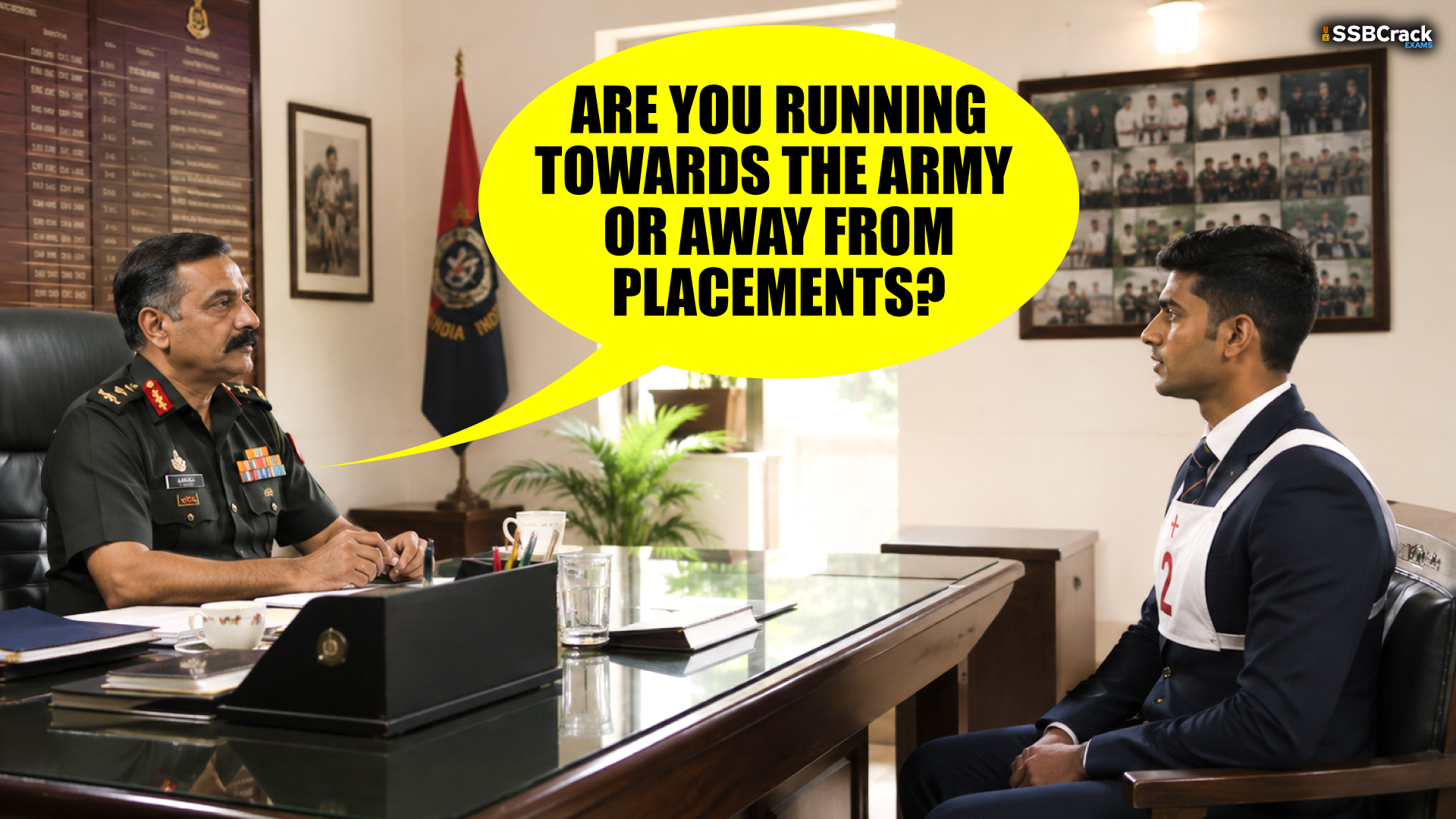
Engineering graduates often enter the SSB interview believing that their technical knowledge will give them an advantage. While your academic background certainly matters, the SSB is far more interested in understanding your leadership potential, decision-making ability, teamwork, adaptability, and overall personality. Your engineering degree demonstrates your capability to solve technical problems, but the SSB aims to assess whether you possess the qualities required to become an effective officer in the Armed Forces.
Here are 20 important SSB interview questions specifically tailored for B.Tech graduates, along with the reason behind each question, guidance on answering it, and a sample response.
1. After investing four years in engineering, why do you want to join the Armed Forces?
Why It Is Asked
To assess your motivation and commitment toward a military career.
How to Answer
Explain how engineering and military service complement each other and highlight your desire to serve the nation.
Sample Answer
“Sir, engineering has strengthened my analytical thinking and problem-solving abilities. However, I have always been drawn toward leadership, responsibility, and service to the nation. The Armed Forces provide an opportunity to combine technical competence with leadership in a challenging and meaningful environment.”
2. Why should the Armed Forces select an engineer instead of someone with a military family background?
Why It Is Asked
To assess confidence and self-belief.
How to Answer
Focus on your strengths rather than comparing yourself negatively or positively with others.
Sample Answer
“Sir, selection should depend on an individual’s qualities rather than background. My engineering education has developed my analytical skills, teamwork, adaptability, and problem-solving abilities, which can contribute effectively to military leadership.”
3. Which engineering project taught you the most important leadership lesson?
Why It Is Asked
To evaluate practical leadership experiences.
How to Answer
Describe a real project where you handled challenges and coordinated people.
Sample Answer
“During my final-year project, our team faced repeated technical setbacks. I coordinated responsibilities, motivated team members, and ensured deadlines were met. It taught me that leadership involves keeping the team focused and confident during difficult situations.”
4. If offered a ₹25 lakh corporate package and a commission in the Armed Forces simultaneously, what would you choose?
Why It Is Asked
To understand your priorities and motivation.
How to Answer
Be honest while demonstrating clarity of purpose.
Sample Answer
“I would choose the Armed Forces because my primary motivation is leadership, service, and personal growth. While financial security is important, I value purpose, responsibility, and the opportunity to contribute to the nation more.”
5. Tell me about a technical failure you experienced and how you handled it.
Why It Is Asked
To assess resilience and problem-solving ability.
How to Answer
Explain the situation, your actions, and the lessons learned.
Sample Answer
“During a robotics project, our prototype repeatedly failed before demonstration. Instead of blaming individuals, we systematically identified the faults and corrected them. The experience taught me perseverance and effective teamwork.”
6. Which engineering subject did you dislike the most and why?
Why It Is Asked
To test honesty and self-awareness.
How to Answer
Answer truthfully without criticizing teachers or institutions.
Sample Answer
“I initially found Signals and Systems challenging because of its abstract concepts. However, I worked consistently to improve my understanding and eventually performed satisfactorily.”
7. If your commanding officer asks you to work in a field completely unrelated to your engineering specialization, how would you react?
Why It Is Asked
To assess adaptability.
How to Answer
Show willingness to learn and adjust.
Sample Answer
“I would treat it as an opportunity to expand my skills. The Armed Forces require adaptability, and I would focus on learning quickly and performing my duties effectively.”
8. What is one engineering concept that has helped you in daily life?
Why It Is Asked
To assess practical application of education.
How to Answer
Connect engineering learning with everyday situations.
Sample Answer
“Engineering taught me structured problem-solving. Whenever I face a challenge, I break it down into smaller components, analyze possible solutions, and proceed systematically.”
9. Why do many engineering graduates struggle in leadership positions despite being technically strong?
Why It Is Asked
To assess understanding of leadership.
How to Answer
Balance technical expertise with interpersonal skills.
Sample Answer
“Technical knowledge alone does not guarantee leadership success. Leadership also requires communication, emotional intelligence, empathy, and the ability to motivate people.”
10. What innovation would you introduce in military training if given the opportunity?
Why It Is Asked
To evaluate creativity and awareness.
How to Answer
Suggest a practical and realistic innovation.
Sample Answer
“I would introduce AI-driven simulation systems that create realistic operational scenarios and enhance decision-making training while minimizing risks.”
11. If your engineering degree suddenly became invalid tomorrow, what skills would still make you valuable?
Why It Is Asked
To assess confidence beyond academic qualifications.
How to Answer
Highlight transferable skills.
Sample Answer
“My communication skills, leadership abilities, discipline, teamwork, adaptability, and problem-solving approach would remain valuable regardless of my degree.”
12. What is the biggest engineering challenge India may face in the next decade?
Why It Is Asked
To assess awareness and analytical thinking.
How to Answer
Support your answer with logical reasoning.
Sample Answer
“I believe sustainable infrastructure and energy management will be major challenges as India continues to grow rapidly in terms of population and industrialization.”
13. During a group project, what role do you naturally assume?
Why It Is Asked
To understand your team dynamics.
How to Answer
Describe your actual behavior.
Sample Answer
“I usually take the role of coordinator because I enjoy organizing work, resolving issues, and ensuring that the team progresses toward its objective.”
14. If your project guide takes credit for your work, how would you handle it?
Why It Is Asked
To assess maturity and professionalism.
How to Answer
Show emotional balance and professionalism.
Sample Answer
“I would respectfully discuss the issue and seek clarification. Maintaining professionalism and constructive communication would be my priority.”
15. Which is more dangerous in engineering and military operations: Lack of knowledge or Overconfidence?
Why It Is Asked
To assess judgment and reasoning.
How to Answer
Provide balanced reasoning.
Sample Answer
“Overconfidence can be more dangerous because it often leads people to ignore risks and stop learning. Lack of knowledge can usually be addressed through training and preparation.”
16. If you could redesign engineering education in India, what would you change?
Why It Is Asked
To assess observation and innovation.
How to Answer
Offer constructive suggestions.
Sample Answer
“I would emphasize practical learning, industry exposure, leadership development, interdisciplinary education, and problem-solving through real-world projects.”
17. Suppose your engineering team is divided into two groups with conflicting ideas. What would you do?
Why It Is Asked
To assess conflict-resolution ability.
How to Answer
Focus on collaboration and objective decision-making.
Sample Answer
“I would encourage open discussion, evaluate both viewpoints objectively, and select the solution that best serves the project’s objectives.”
18. What would your project teammates say is your greatest contribution?
Why It Is Asked
To assess self-awareness and teamwork.
How to Answer
Use genuine examples.
Sample Answer
“They would probably say that I helped maintain coordination, ensured timely completion of tasks, and kept communication effective throughout the project.”
19. If you were given ₹50 crore to solve one engineering problem in India, what would you choose?
Why It Is Asked
To assess vision and social awareness.
How to Answer
Think beyond personal interests.
Sample Answer
“I would invest in affordable clean-water technologies because access to safe drinking water remains a significant challenge affecting millions of people.”
20. Engineers are trained to solve problems. What is one problem in society that cannot be solved by technology alone?
Why It Is Asked
To assess depth of thought and social understanding.
How to Answer
Highlight the importance of human values.
Sample Answer
“Social prejudice and discrimination cannot be solved solely through technology. They require education, empathy, awareness, and cultural transformation.”
Bonus Out-of-the-Box Questions Frequently Asked to B.Tech Graduates
If your life were a final-year project, what would be its title?
What It Reveals: Creativity and self-awareness.
Which engineering branch would best describe your personality and why?
What It Reveals: Ability to connect personal traits with professional concepts.
If humans were machines, what would be the most common design flaw?
What It Reveals: Insight into human behavior.
Would you rather command a technologically advanced unit with poor morale or a basic unit with excellent morale?
What It Reveals: Leadership philosophy.
If failure were an engineering subject, what grade would you give yourself and why?
What It Reveals: Reflection, resilience, and learning mindset.
Special Tips for B.Tech Graduates
• Expect detailed questions about your projects, internships, and technical subjects.
• Be prepared to explain engineering concepts in simple and practical language.
• Relate engineering experiences to leadership, teamwork, and decision-making.
• Avoid creating the impression that you are joining the Armed Forces merely because of limited corporate opportunities.
• Demonstrate flexibility and adaptability beyond your engineering specialization.
• Show that you are an engineer capable of leading people, not just solving technical problems.
Conclusion
The SSB is not searching for the most academically brilliant engineer. It is looking for individuals who possess the Officer Like Qualities required to lead men and women under challenging circumstances. Use your engineering background as evidence of your analytical abilities, but let your personality, leadership experiences, integrity, confidence, and adaptability take center stage during the interview. Stay authentic, remain confident, and remember that your character will always matter more than your résumé. Jai Hind!


