




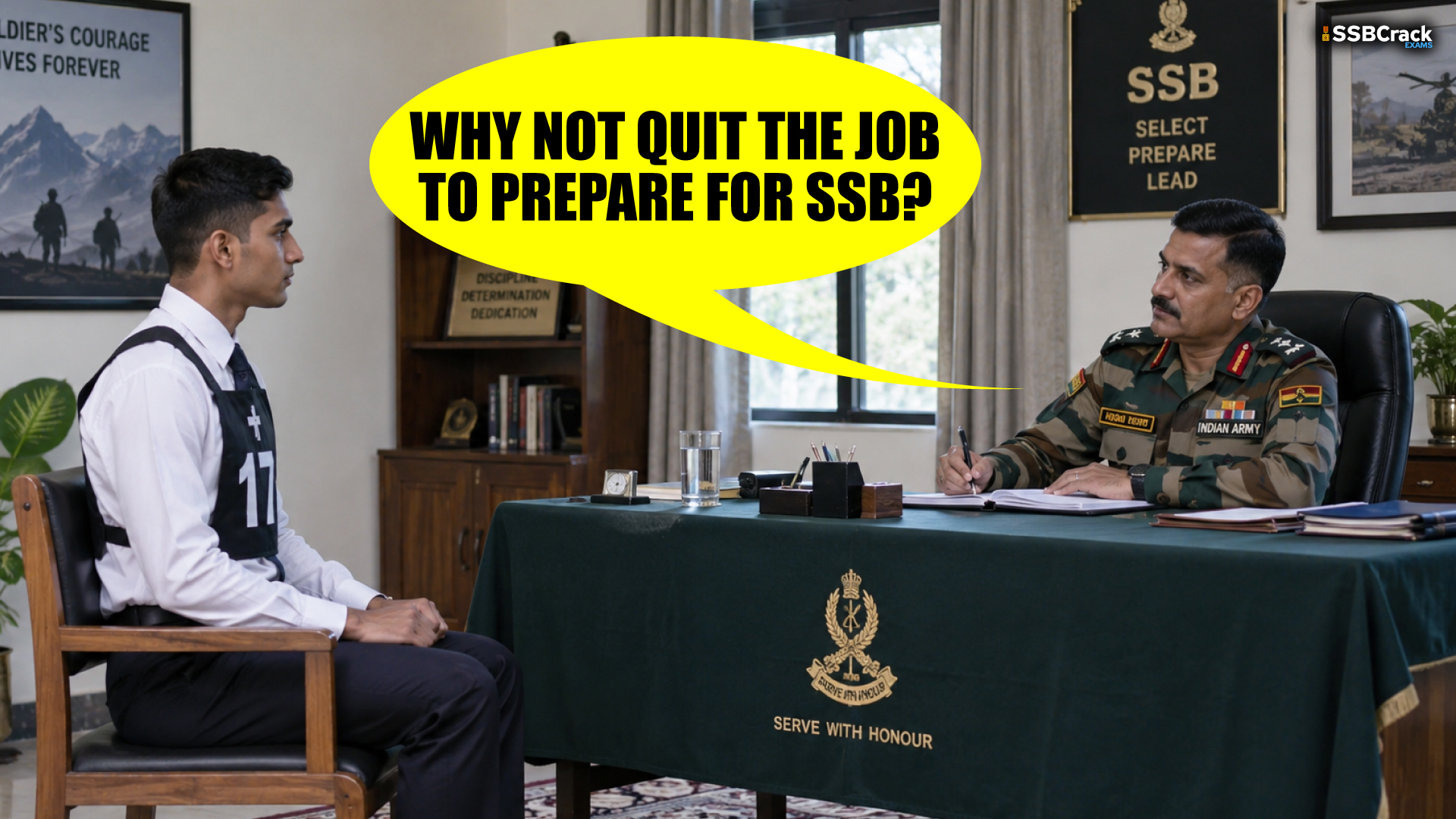
Are you preparing for SSB while working a night-shift job? If yes, the Interviewing Officer may be interested in knowing how you manage your sleep, health, work responsibilities, preparation and personal life.
A night-shift job can create a completely different routine from that of a regular candidate. So, in today’s article, we will discuss 20 important SSB Interview questions that you may face if you are working night shifts while preparing for the Armed Forces.
For every question, we will discuss why the Interviewing Officer may ask it, how you should approach it, and a sample answer. Remember, do not memorise these answers. Use them as a framework and answer according to your actual experience.
1. Why are you working a night shift while preparing for SSB?
Why is it asked?
The interviewer wants to understand your motivation for taking the job and whether you can manage your responsibilities alongside your career goal.
How to answer:
Be honest about why you took the job. Explain how you are balancing it with your long-term goal.
Sample Answer:
“I took up this job because I wanted to gain professional experience and become financially responsible while continuing my preparation for the Armed Forces. The night shift is challenging, but it has taught me to manage my time carefully and remain disciplined.”
2. How do you manage your SSB preparation with a night-shift schedule?
Why is it asked?
This question examines your planning, time management and consistency.
How to answer:
Explain your actual routine. Avoid claiming that you study for unrealistic numbers of hours.
Sample Answer:
“My preparation is planned around my work schedule. After completing my shift, I give priority to proper rest. After waking up, I dedicate a fixed period to SSB preparation. I divide my preparation into areas such as current affairs, communication, psychological tests and physical fitness rather than trying to cover everything every day.”
3. What time do you usually sleep and wake up?
Why is it asked?
The interviewer may want to understand whether you have a stable routine despite working at night.
How to answer:
Know your actual schedule. Give a clear and realistic answer.
Sample Answer:
“My working hours are at night, so I generally sleep during the daytime after returning from work. I try to maintain reasonably consistent sleeping and waking hours even on my days off so that my routine does not become irregular.”
4. Doesn’t working at night affect your physical fitness?
Why is it asked?
The question may explore how you maintain your physical fitness despite an unconventional work schedule.
How to answer:
Explain when and how you exercise. Do not claim that night shifts have no effect whatsoever.
Sample Answer:
“It can make maintaining a routine more challenging, but I make physical fitness a regular part of my schedule. Depending on my shift and sleep, I exercise after waking up. I focus on activities such as running, basic strength exercises and mobility work.”
5. How do you maintain your energy during a night shift?
Why is it asked?
The interviewer may be examining your ability to handle demanding working conditions.
How to answer:
Focus on practical habits such as proper rest, food, hydration and routine rather than depending entirely on stimulants.
Sample Answer:
“I try to maintain my energy mainly through adequate rest, proper meals and hydration. I also avoid wasting my breaks unnecessarily and try to remain physically active. I believe maintaining a disciplined routine is more sustainable than depending only on caffeine or other short-term solutions.”
6. Have you ever missed SSB preparation because you were tired after your night shift?
Why is it asked?
This tests honesty and your ability to recognise and manage your limitations.
How to answer:
It is acceptable to admit that fatigue has affected your routine. Explain what you did to improve your schedule.
Sample Answer:
“Yes, initially I sometimes felt too tired to study effectively after a night shift. I realised that forcing myself to study while exhausted was not productive. So, I started prioritising proper sleep and moved my serious preparation to the period when I was more alert.”
7. How do you prepare for the SSB interview when most of your day is spent sleeping and working?
Why is it asked?
The interviewer wants to assess your ability to utilise limited time efficiently.
How to answer:
Show that you focus on quality and consistency rather than simply counting study hours.
Sample Answer:
“I focus on consistent preparation rather than studying for very long hours. I use my active hours efficiently and divide my preparation into manageable sessions. For example, I may read current affairs in one session and practise communication or psychological tests in another.”
8. Do you think your night-shift job is affecting your personality?
Why is it asked?
The interviewer may be trying to understand whether you have developed any useful qualities or faced any challenges because of your work routine.
How to answer:
Give a balanced response. Mention both challenges and learning.
Sample Answer:
“Yes, in some ways it has made me more disciplined and independent. Working when most people are sleeping has also taught me to stay focused without depending on external motivation. At the same time, I have had to become more conscious about managing my sleep and maintaining social interaction.”
9. How do you manage your social and family life while working nights?
Why is it asked?
This can help the interviewer understand your interpersonal adjustment and ability to balance responsibilities.
How to answer:
Show that you make time for important relationships without pretending that your routine has no difficulties.
Sample Answer:
“My schedule is different from that of my family and friends, so I have to plan my interactions. I usually spend time with them when I am free and communicate regularly. My family also understands my work schedule, so we coordinate accordingly.”
10. What difficulties have you faced because of your night-shift job?
Why is it asked?
The interviewer wants to know whether you can identify challenges and adapt to them.
How to answer:
Mention genuine difficulties and explain how you manage them.
Sample Answer:
“The main challenges are maintaining a consistent sleep routine and coordinating my personal activities with my work schedule. Initially, it was difficult, but I gradually developed a fixed routine and started planning important activities around my working hours.”
11. What would you do if your night shift clashes with an important SSB preparation activity?
Why is it asked?
This tests prioritisation, planning and communication.
How to answer:
Show that you plan ahead and communicate responsibly rather than abruptly abandoning your work.
Sample Answer:
“If I know about the activity in advance, I would plan my schedule accordingly and discuss it with the concerned person at work if necessary. If the responsibility is unavoidable, I would fulfil it and adjust my preparation. I believe planning ahead can prevent most such conflicts.”
12. Does working at night make it difficult for you to concentrate?
Why is it asked?
The interviewer may be checking your ability to maintain concentration under challenging circumstances.
How to answer:
Do not claim that you never feel tired. Explain how you manage concentration.
Sample Answer:
“Sometimes fatigue can affect concentration, especially after a demanding shift. I therefore avoid doing serious preparation when I am extremely tired. I prefer studying after proper rest, when my concentration is better. This has made my preparation more productive.”
13. What have you learned from working during the night?
Why is it asked?
The officer wants to know whether you can learn from your professional environment.
How to answer:
Mention qualities you have actually developed through your experience.
Sample Answer:
“Night-shift work has taught me discipline, alertness and responsibility. There are times when fewer people are available for support, so I have learned to handle my responsibilities independently and remain focused on the task.”
14. How do you handle an emergency at work during a night shift?
Why is it asked?
This question may explore your response to unexpected situations and your ability to remain calm.
How to answer:
Explain a logical approach: understand the situation, prioritise, inform the appropriate person and act within your responsibility.
Sample Answer:
“I would first understand the nature of the emergency and identify what needs immediate attention. I would inform the appropriate senior or responsible person and then take whatever action is within my role. I would try to remain calm because panic can make the situation worse.”
15. Have you ever made a mistake because you were tired during a night shift?
Why is it asked?
This question tests self-awareness and accountability.
How to answer:
If you have made a mistake, admit it and explain how you prevented repetition.
Sample Answer:
“There was a situation when fatigue made me less attentive and I had to correct a minor mistake in my work. I took responsibility for it and realised that I needed to be more careful with important tasks, particularly when I was tired. Since then, I make a conscious effort to double-check critical work.”
16. Why don’t you leave the night-shift job and focus completely on SSB?
Why is it asked?
The interviewer may want to understand your priorities and commitment to your current responsibilities.
How to answer:
Do not criticise your job. Explain why continuing it is meaningful to you at present.
Sample Answer:
“My current job provides me with valuable professional experience and financial independence. I also believe that learning to balance work with preparation is itself a useful experience. As long as I can manage both responsibly, I would like to continue working while preparing.”
17. Suppose you are extremely tired but your team needs you during your shift. What will you do?
Why is it asked?
This tests your sense of responsibility, teamwork and judgement.
How to answer:
Show that you will take responsibility while also recognising situations where fatigue could affect safety or performance.
Sample Answer:
“If the task is within my responsibility, I would support my team and complete it properly. However, if fatigue reaches a point where it could compromise safety or the quality of critical work, I would communicate the situation to my senior rather than hiding it. Responsible teamwork also means communicating limitations when necessary.”
18. What do you do on your weekly off?
Why is it asked?
The interviewer may use this to understand your lifestyle, priorities and ability to recover and utilise free time.
How to answer:
Give a balanced answer involving rest, preparation, fitness, family and hobbies.
Sample Answer:
“On my weekly off, I try to recover from the work schedule first. I also spend some time on SSB preparation, physical activity and family responsibilities. If I have pending work or preparation targets, I complete them, but I also make sure I get sufficient rest.”
19. If you are selected for the Armed Forces, will you be able to adjust from night shifts to military training?
Why is it asked?
The interviewer may be testing your adaptability to a completely different routine and environment.
How to answer:
Do not claim that military training will be easy. Emphasise your willingness to adapt and learn.
Sample Answer:
“Yes, I understand that military training will have its own demanding schedule and that I will have to adapt to it. My current night-shift experience has already taught me that routines can be demanding and that discipline is important. I would approach military training with the willingness to learn and adjust.”
20. If you don’t clear SSB, will you continue your night-shift job?
Why is it asked?
This question examines your attitude towards setbacks and whether you have a practical backup plan.
How to answer:
Show determination without sounding unrealistic. Explain how you would continue your responsibilities while improving yourself.
Sample Answer:
“Yes, if I do not clear SSB, I would continue with my current responsibilities while analysing the areas where I need improvement. If I remain eligible and genuinely want to pursue the Armed Forces, I would prepare again. I would not allow one unsuccessful attempt to stop me from progressing in other areas of my life.”
Quick Tips for Night-Shift Candidates
1. Know your routine.
The interviewer can ask detailed questions about your shift timings, sleep, meals, exercise and preparation schedule.
2. Don’t glorify sleep deprivation.
Avoid saying that you can function perfectly with very little sleep. A disciplined candidate should understand the importance of adequate rest.
3. Be honest about fatigue.
Admitting that night shifts can be tiring does not make you weak. Explain how you manage the challenge responsibly.
4. Know your job thoroughly.
Be ready for questions about your role, responsibilities, colleagues, workplace challenges and what you have learned.
5. Prepare real examples.
If you claim that your job has improved your teamwork or responsibility, be prepared to explain exactly how.
6. Don’t memorise these sample answers.
The Interviewing Officer is interested in your real personality and experiences. A memorised answer may sound unnatural and can invite difficult follow-up questions.
7. Be ready for follow-up questions.
If you say, “Night shifts have made me disciplined,” the officer may immediately ask, “Give me an example.” Always prepare your own real-life examples.
Closing Lines
So, these were 20 important SSB Interview questions for candidates preparing alongside a night-shift job.
Remember, working a night shift is not something you need to defend or exaggerate. What matters is how you manage your responsibilities, maintain your routine, deal with fatigue, learn from your experiences and continue working towards your goal.
Don’t memorise these sample answers. Instead, understand the intention behind each question and prepare answers based on your own life and experiences.
If you are preparing for SSB while working a night shift, stay disciplined, manage your time wisely and keep improving yourself every day.
Keep working hard, stay consistent, and give your best at the SSB.


