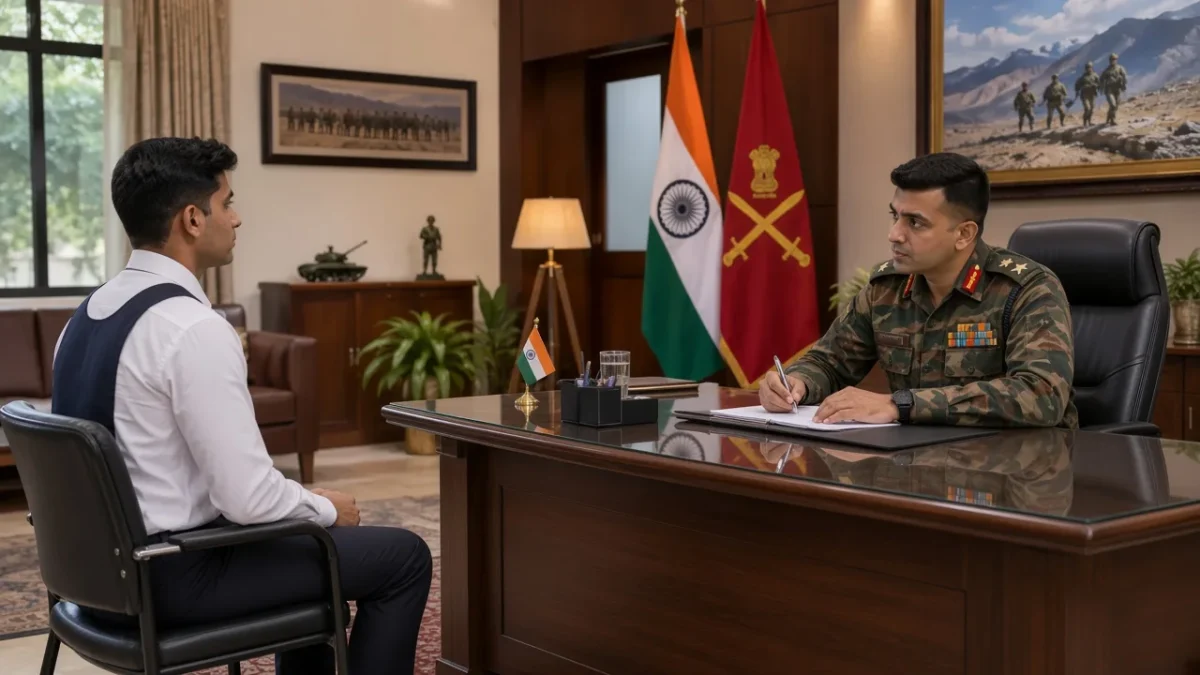
The Services Selection Board (SSB) Personal Interview is conducted by an Interviewing Officer (IO), usually the President or Deputy President of the Board. It is a structured conversation, typically lasting around 30 to 60 minutes, based on the candidate’s Personal Information Questionnaire (PIQ) form.
The IO is not looking for a perfect speech. The aim is to see whether the candidate shows Officer Like Qualities (OLQs) in a natural way — including effective intelligence, power of expression, sense of responsibility, self-confidence, social adaptability, courage and determination. Questions often begin with simple rapport-building and then move into academics, family, motivation, current affairs and stress situations.
For NDA, CDS, AFCAT and other entries, the interview follows the same broad pattern. The 15 questions below are among the most commonly asked in the SSB Personal Interview. They are not an official list, but they are the ones aspirants should prepare thoroughly.
1. Tell me about yourself
This is usually an opening question. The IO uses it to settle you down, check your power of expression, and see whether your story matches the PIQ form. It also gives a first impression of self-confidence and organising ability: can you present your life in a clear, ordered way without rambling?
Keep it short and chronological: hometown, education, notable responsibilities or sports, and why you are at the SSB. A useful approach is: “I am from [place]. I completed [education]. Apart from studies I have [specific activity]. I am here because I want to serve as an officer in the [service].” Avoid reciting your entire bio-data or starting with a memorised speech that does not sound like you.
2. Why do you want to join the Armed Forces?
This is the core motivation question. The IO wants to know whether the desire to serve is genuine and thought through, not based only on films, uniform, or family pressure. It assesses sense of responsibility, determination and self-awareness.
Give two or three honest, specific reasons, and link them to something you have actually done — NCC, sport, a leadership role or consistent preparation. Do not say only “I want to serve the nation” without explaining what that means for you. Avoid criticising civilian careers, or repeating coaching-centre lines that you cannot defend in a follow-up.
3. Why this service, and not the other two?
If you have chosen the Army, Navy or Air Force, the IO will often ask why not the other services. The question tests whether you have done basic homework and can reason clearly. Effective intelligence, reasoning ability and self-confidence are in focus.
Show that you understand the broad role of each service and then give a personal reason for your choice, without running down the other two. A calm approach is: “I respect all three services. I prefer the [service] because [specific reason], and that is why I have prepared for this entry.” The common mistakes are having no answer, mixing up service roles, or saying you will “join anything” with no thought behind it.
4. What if you are not recommended? What is your backup plan?
This question checks maturity, not lack of ambition. The IO wants to see determination without desperation, and a sensible sense of responsibility towards your own future. Candidates who have no plan, or who collapse at the idea of failure, often appear less prepared for a service career.
Be honest and practical. You can say that you will work on the gaps, attempt the SSB again if eligible, and meanwhile continue your education or a realistic alternative career. That shows both persistence and balance. Do not say you have “no Plan B” as a way of sounding dedicated, and do not sound as if the Armed Forces were only a casual option. Avoid blaming the Board in advance.
5. Tell me about your family
The IO already has family details on the PIQ form. The purpose is to understand your background, your relationships, and whether you are socially adapted and responsible at home. Follow-up questions may cover who influences you, how decisions are made, and whether there is any conflict.
Describe your family factually: who they are, what they do, and what you have learnt from them. If asked who influenced you most, give a reason, not a slogan. Do not exaggerate income or status, hide details that are already on the PIQ, or speak poorly of parents or siblings. If there is a difficulty at home, mention it briefly and factually, and show how you have responded, rather than asking for sympathy.
6. What are your strengths and weaknesses?
This is a test of self-awareness, honesty and power of expression. The IO is less interested in a flattering list than in whether you know yourself and are working on your shortcomings. Sense of responsibility and self-confidence are also being watched.
Choose strengths you can prove with a short example, such as consistency in sport, willingness to take responsibility, or staying calm under pressure. For a weakness, pick something real but not disqualifying, and show what you are doing about it. For example: “I used to struggle with public speaking, so I have been practising in class and in group discussions.” Avoid fake weaknesses such as “I work too hard,” and never claim that you have no weakness at all.
7. Why did you choose this stream, and how do you explain your marks?
Academic questions check consistency with the PIQ and your ability to take responsibility for your record. A dip in marks, a change of subject, or a gap year will almost certainly be discussed. The IO looks at reasoning ability, honesty and determination.
Explain choices and results without excuses. If marks fell, state the reason briefly — illness, a weak subject, or poor time management — and what you changed afterwards. If you chose a stream because of interest or eligibility for an entry, say so clearly. Do not blame teachers, paper “strictness” or bad luck, and do not invent achievements. The IO can and does compare your answers with mark sheets and the PIQ.
8. What are your hobbies, and how seriously do you pursue them?
Hobbies are not small talk. They reveal liveliness, organising ability and whether you actually do what you have written on the PIQ. The IO may ask for details — a book you read, a place you trekked, or how often you play a sport — to test sincerity.
Write only hobbies you can discuss, with recent details: how often you play, a book you actually finished, or a trip you really made. Do not list fashionable hobbies you cannot support, or claim a skill you do not have. A simple, genuine interest is better than an impressive but hollow list.
9. Tell me about a time you took responsibility or led others
Leadership in the SSB is not only about holding a formal post. The IO is looking for initiative, ability to influence a group, organising ability and sense of responsibility, even in a school team, NCC troop, family situation or college event.
Use one real example and keep it structured: the situation, what you did, and the result. For instance, organising a college function, helping a teammate, or taking charge when a plan went wrong. Do not invent a story, take all the credit, or describe leadership as simply “I shouted orders.” If you have not been a captain or prefect, a smaller but genuine example of responsibility is far stronger than a made-up title.
10. Tell me about a failure, and what you learnt from it
This question assesses courage, determination and maturity. Everyone fails; the IO wants to know whether you can accept it, learn, and try again without becoming bitter or broken. It also tests honesty, because many candidates refuse to admit any failure at all.
Pick a real setback — an exam, a match, a responsibility you did not handle well — and focus on what you changed afterwards. A sound approach is: what happened, what was your part in it, and what you do differently now. Do not choose a story that only blames others, and do not offer a fake failure that is actually a success in disguise. Avoid sounding as if one defeat ended your confidence.
11. What do you know about current national or defence affairs?
An officer is expected to be aware of the country he or she may serve. These questions test effective intelligence, reasoning ability and genuine interest, not the ability to recite headlines.
Prepare from reliable daily news, and be ready to explain one or two issues in your own words: what happened, why it matters, and a balanced opinion. If you do not know something, say so honestly rather than guessing. Do not bluff, repeat extreme social-media claims, or pretend to have expert knowledge you cannot defend. The IO can go deeper on any topic you raise.
12. Why should we recommend you?
This is a direct test of self-confidence and self-awareness. The IO is not asking you to boast. The question is whether you can, calmly and without arrogance, explain what you would bring as a trainee officer.
Link your answer to evidence: fitness, a habit of taking responsibility, teamwork, or consistency in preparation. Keep it modest and specific. For example: “I am physically fit, I have led small teams in [activity], and I have prepared seriously for this entry. I am ready to be trained.” Do not claim that you already have all 15 OLQs, compare yourself with other candidates, or give a long emotional speech with no examples.
13. What do you know about academy training and an officer’s life?
This checks whether your motivation is informed. The IO may ask about the Indian Military Academy, Officers Training Academy, Naval Academy or Air Force Academy, the approximate length of training, or the demands of service life, including postings and risk. Reasoning ability and sense of responsibility are in play.
Know the basics of the academy for your entry and be honest about the hard parts — discipline, physical training, separation from family, and operational risk — while showing that you still want the job. Do not invent training routines or speak only of adventure and status. If you are unsure of a detail, it is better to admit it than to guess.
14. How do your parents feel about your decision to join?
Service life affects the family. The IO uses this question to assess social adaptability, cooperation and sense of responsibility. Opposition at home is not automatically a rejection, but hiding it, or appearing indifferent to your parents, can hurt your impression.
Tell the truth. If your parents support you, explain how you discussed the decision with them. If they are worried, show that you have listened, explained the career calmly, and still take their concerns seriously. Do not pretend there is full support if there is not, and do not speak of ignoring your family. The IO is looking for a balanced, adult relationship, not a slogan about sacrifice.
15. If you fail this SSB, what will you do next?
This often comes near the end and is close to the backup-plan question, but it is more personal. It tests determination, emotional stability and speed of decision. The IO wants to see whether you can take a setback without losing direction.
A clear approach is: accept the result, identify what you need to improve — fitness, communication, or knowledge — and say whether you will apply again if eligible. Then mention what you will do in the meantime, such as continuing your studies. Do not bargain, ask the IO to recommend you out of sympathy, or say that your life will be “finished” if you are not selected. Calm persistence is more officer-like than drama.
Conclusion
The SSB Personal Interview is not a memory test. The same themes appear again and again because they reveal whether you are honest, responsible, self-aware, and ready to be trained as an officer. Your answers must match the PIQ form and your real life. A short, specific example is always stronger than a borrowed speech.
Prepare these 15 questions in your own words, keep up with current affairs, and be ready for follow-ups. If you do not know something, say so. If you have a gap in your record, own it and show what you have done about it. That is the approach that stands up under an Interviewing Officer’s questioning.
Frequently Asked Questions
1. How long is the SSB Personal Interview?
It commonly lasts around 30 to 60 minutes, but there is no fixed official duration. Some interviews are shorter, and some run longer, depending on the candidate and the IO.
2. Who conducts the personal interview at the SSB?
The interview is conducted by an Interviewing Officer, usually the President or Deputy President of the Board. It is separate from the psychological tests and the Group Testing Officer tasks, though all three are considered together.
3. Are the questions the same for NDA, CDS and AFCAT candidates?
The style is similar across entries, but the content is adjusted to your age, education and PIQ. A Class 12 NDA candidate and a graduate CDS or AFCAT candidate will both be asked about motivation and family, while academic questions will differ.
4. Should I memorise sample answers?
No. Use sample answers only to understand the approach. The IO can ask unexpected follow-up questions, and a rehearsed speech usually breaks down. Prepare points from your own life and speak naturally.
5. What if I do not know the answer to a current-affairs question?
Say that you do not know, rather than guessing or bluffing. Honesty is part of what is being assessed. You should still prepare the main national and defence stories of the weeks before your SSB.
6. Can a weakness or a past failure lead to rejection?
Not by itself. What matters is whether you are aware of it and have tried to improve. Hiding a failure, or claiming that you have none, is usually more damaging than a frank answer.