




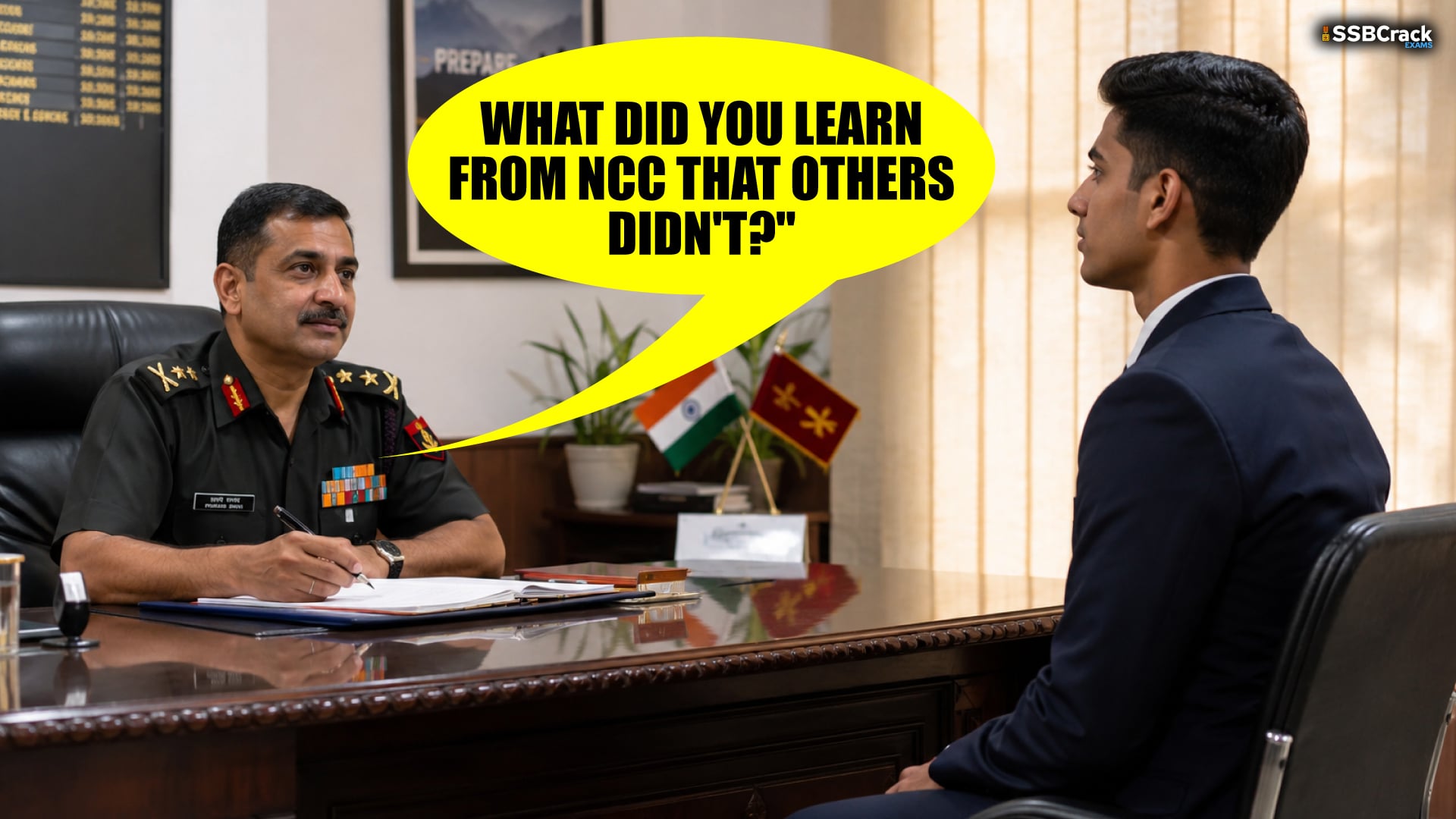
If you are an Ex-NCC Cadet appearing for the SSB Interview, you already possess a unique advantage. The National Cadet Corps is one of the largest youth organizations in the world and provides valuable exposure to discipline, leadership, teamwork, social service, adventure activities, and military training. As a result, Interviewing Officers often ask Ex-NCC Cadets questions that go beyond basic NCC knowledge. They want to understand how your NCC experiences shaped your personality, leadership abilities, decision-making skills, and Officer Like Qualities.
In this session, we will discuss 20 unique and interesting SSB Interview questions specifically designed for Ex-NCC Cadets. Along with each question, we will understand why it is asked, how to answer it effectively, and review a sample answer.
Question 1: What was the most valuable lesson NCC taught you that school or college could not?
Why is it asked?
To assess your learning from NCC experiences and personal growth.
How to answer:
Focus on practical lessons such as discipline, teamwork, leadership, or responsibility.
Sample Answer:
“NCC taught me the importance of leading by example. Whether during camps or drills, I realized that people follow actions more than instructions, which is a valuable leadership lesson.”
Question 2: Which NCC camp had the greatest impact on you and why?
Why is it asked?
To evaluate your experiences and ability to derive learning from them.
How to answer:
Discuss specific challenges, responsibilities, and lessons learned.
Sample Answer:
“The Annual Training Camp had the greatest impact on me because it exposed me to a disciplined lifestyle, teamwork, and living with people from diverse backgrounds.”
Question 3: If you could change one aspect of NCC training, what would it be?
Why is it asked?
To assess observation skills, analytical thinking, and initiative.
How to answer:
Offer constructive suggestions rather than criticism.
Sample Answer:
“I would increase the number of leadership simulation exercises because they provide practical opportunities to develop decision-making and team-management skills.”
Question 4: Describe a situation in NCC where you had to lead people older than you.
Why is it asked?
To assess leadership confidence and interpersonal skills.
How to answer:
Explain how you earned cooperation through communication and example.
Sample Answer:
“During a camp activity, I was appointed group leader and had cadets senior to me in age. I focused on clear communication and teamwork, which helped us complete the task successfully.”
Question 5: What was the toughest challenge you faced during NCC training?
Why is it asked?
To evaluate resilience and determination.
How to answer:
Describe the challenge, your actions, and the outcome.
Sample Answer:
“The toughest challenge was a long endurance march. Physical fatigue was significant, but I stayed focused on the objective and encouraged my teammates to keep moving.”
Question 6: What is one quality you developed in NCC that you lacked before joining?
Why is it asked?
To understand personal development.
How to answer:
Mention a genuine improvement.
Sample Answer:
“Before NCC, I was hesitant to speak in front of groups. NCC activities gradually improved my confidence and public speaking ability.”
Question 7: Have you ever disagreed with an NCC instructor or senior? How did you handle it?
Why is it asked?
To assess maturity and respect for authority.
How to answer:
Show respectful disagreement and constructive communication.
Sample Answer:
“I once had a different opinion regarding task allocation. I respectfully shared my viewpoint and accepted the final decision while ensuring the task was completed efficiently.”
Question 8: Which NCC activity did you enjoy the least and why?
Why is it asked?
To assess honesty and attitude toward challenges.
How to answer:
Be truthful but explain what you learned.
Sample Answer:
“I initially disliked route marches because they were physically demanding, but they helped me build stamina, discipline, and mental toughness.”
Question 9: If you were appointed Senior Under Officer, what would be your first priority?
Why is it asked?
To evaluate leadership priorities.
How to answer:
Focus on team development and discipline.
Sample Answer:
“My first priority would be improving communication between cadets and instructors while maintaining high standards of discipline and teamwork.”
Question 10: What is the difference between authority and leadership?
Why is it asked?
To assess understanding of leadership concepts.
How to answer:
Explain the distinction clearly.
Sample Answer:
“Authority comes from a position, while leadership comes from the ability to influence and inspire others. A good leader may not always hold authority, but earns respect through actions.”
Question 11: Tell us about a time when your NCC team failed.
Why is it asked?
To assess accountability and learning from setbacks.
How to answer:
Accept responsibility and highlight lessons learned.
Sample Answer:
“Our team did not perform well in a competition due to inadequate preparation. The experience taught us the importance of planning and coordination.”
Question 12: What social service activity conducted by NCC influenced you the most?
Why is it asked?
To evaluate social responsibility.
How to answer:
Discuss a meaningful experience and its impact.
Sample Answer:
“Participating in a cleanliness drive made me realize how small community efforts can create significant positive change.”
Question 13: How would you motivate a cadet who wants to quit training?
Why is it asked?
To assess empathy and leadership ability.
How to answer:
Focus on encouragement and understanding.
Sample Answer:
“I would understand the reason behind their frustration, share my own challenges, and remind them of the long-term benefits of perseverance.”
Question 14: What is more important in NCC—discipline or initiative?
Why is it asked?
To assess judgment and balance.
How to answer:
Explain how both complement each other.
Sample Answer:
“Both are important. Discipline provides structure, while initiative helps solve problems and take responsibility when situations demand action.”
Question 15: What did NCC teach you about teamwork?
Why is it asked?
To assess your understanding of group dynamics.
How to answer:
Use a real example.
Sample Answer:
“NCC taught me that every team member contributes differently. Success comes when everyone works toward a common objective while supporting one another.”
Question 16: If given command of a group during a difficult task, how would you ensure success?
Why is it asked?
To assess planning and leadership.
How to answer:
Discuss communication, delegation, and supervision.
Sample Answer:
“I would clearly explain the objective, assign tasks according to strengths, monitor progress, and maintain motivation throughout the activity.”
Question 17: What is one misconception people have about NCC?
Why is it asked?
To assess awareness and communication skills.
How to answer:
Provide a balanced explanation.
Sample Answer:
“Many people think NCC is only about drills and uniforms. In reality, it develops leadership, discipline, social responsibility, and confidence.”
Question 18: How has NCC prepared you for a career in the Armed Forces?
Why is it asked?
To evaluate the relevance of your NCC experience.
How to answer:
Connect NCC experiences with military values.
Sample Answer:
“NCC introduced me to discipline, leadership, physical fitness, teamwork, and responsibility, all of which are essential qualities for a future officer.”
Question 19: Which NCC motto or value do you relate to the most and why?
Why is it asked?
To understand your personal values.
How to answer:
Relate the value to your life experiences.
Sample Answer:
“I relate most to the NCC motto ‘Unity and Discipline’ because success in any organization depends on teamwork supported by disciplined effort.”
Question 20: If NCC had not been a part of your life, how would you be different today?
Why is it asked?
To assess self-awareness and the impact of your experiences.
How to answer:
Reflect honestly on your personal growth.
Sample Answer:
“Without NCC, I would probably be less confident, less disciplined, and less comfortable taking responsibility in challenging situations. NCC significantly shaped my personality.”
As an Ex-NCC Cadet, remember that the Interviewing Officer is not merely testing your knowledge of NCC ranks, camps, or certificates. They are trying to understand how NCC influenced your character, leadership style, social adaptability, determination, and sense of responsibility. Your experiences in NCC provide excellent examples to demonstrate Officer Like Qualities, but they must be presented honestly and confidently.
We hope these questions help you prepare effectively for your upcoming SSB Interview. Continue reflecting on your NCC experiences, learn from your successes and failures, and focus on demonstrating the values of leadership, discipline, courage, and service. These qualities will not only help you succeed in the SSB Interview but also prepare you for a rewarding career in the Armed Forces.
We wish you all the very best for your SSB journey. Stay motivated, stay disciplined, and keep striving for excellence.
Jai Hind!


