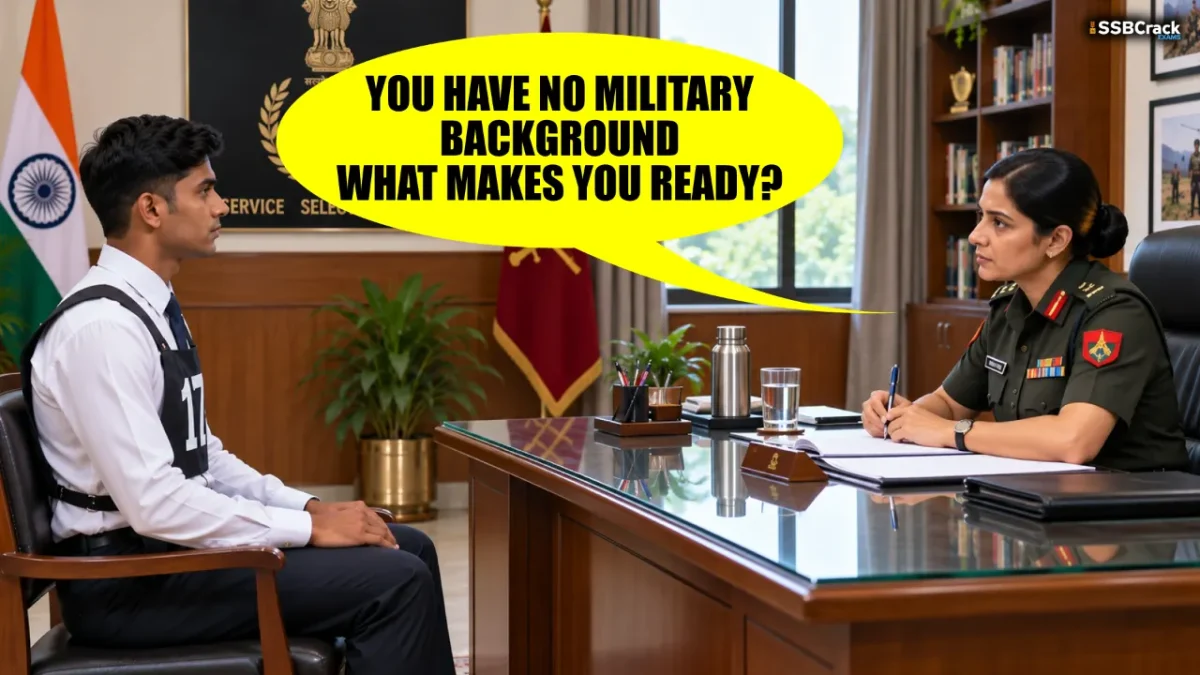
If you are preparing for the SSB Interview and you are the first person in your family aspiring to join the Armed Forces, then this video is especially for you.
When a candidate comes from a defence family, the Interviewing Officer may already expect some familiarity with military life through family experiences. But if you are a first-generation defence aspirant, you may have developed your interest in the Armed Forces through your own observations, education, interactions, reading, NCC, sports, role models or other experiences.
Therefore, the Interviewing Officer may ask you some very important questions about why you want to join the Armed Forces, how you developed this interest, what you know about military life, whether your family supports your decision, and whether you have realistically considered the challenges of the profession.
The officer may also test whether your motivation is based on genuine understanding or simply on the uniform, prestige, salary or influence of social media.
So, in this article, we will discuss 20 important SSB Interview questions for first-generation defence aspirants, along with why each question is asked, how you should answer it, and a sample answer.
Remember, don’t memorise these answers. Use them as references and prepare answers based on your own experiences and genuine motivation.
1. Why do you want to join the Armed Forces even though nobody in your family has served?
Why is this question asked?
The officer wants to understand whether your decision is genuinely your own and what experiences influenced your career choice.
How should you answer?
Don’t make the absence of a defence background the main point. Explain the experiences that created your interest.
Sample Answer
“Sir/Ma’am, although nobody in my immediate family has served in the Armed Forces, I developed an interest in the profession through ________. I became particularly attracted to the combination of leadership, responsibility, teamwork and challenging situations involved in military service. As I learned more about the profession, my initial interest developed into a serious career goal.”
2. When did you first become interested in the Armed Forces?
Why is this question asked?
The officer wants to know whether your motivation developed gradually or is a recent decision made without much thought.
How should you answer?
Give a specific period or incident if possible. Explain how your interest developed over time.
Sample Answer
“Sir/Ma’am, I became interested in the Armed Forces during my school years when I participated in ________. Initially, I was attracted by the disciplined lifestyle, but as I learned more about the profession, I became more interested in the leadership and responsibility involved. I gradually started reading about different services and career opportunities.”
3. Who inspired you to join the Armed Forces?
Why is this question asked?
The officer wants to understand the influence of role models on your career decision.
How should you answer?
You can mention a person, but don’t suggest that you are joining only because of that individual.
Sample Answer
“Sir/Ma’am, I was inspired by ________. What impressed me was not just his or her uniform or achievements, but the way they handled responsibility and remained committed to their team. That made me curious about the Armed Forces, and I later explored the profession more independently.”
4. If no one in your family is from the Armed Forces, how do you know that military life is suitable for you?
Why is this question asked?
This is a deeper question about your awareness of the profession and whether you have romanticised military life.
How should you answer?
Show that you have researched and understood both the positive and difficult aspects of military life.
Sample Answer
“Sir/Ma’am, I understand that I cannot know military life completely without experiencing it myself. However, I have tried to understand it through reliable sources, interactions with serving or retired personnel, and my preparation for the selection process. I am aware that it involves discipline, transfers, separation from family, physical and mental challenges and significant responsibility. These realities have not reduced my interest in the profession.”
5. What do you know about the Armed Forces?
Why is this question asked?
The officer wants to assess whether your interest is supported by basic knowledge.
How should you answer?
Know the basic structure, roles and responsibilities of the Army, Navy and Air Force, as well as the entry you are applying for.
Sample Answer
“Sir/Ma’am, India has three primary Armed Forces—the Army, Navy and Air Force. Each has different operational responsibilities, but all contribute to national security. I am particularly interested in the ________ because ________. I have also been learning about its training, responsibilities and career structure.”
6. What is the difference between being attracted to the Armed Forces and understanding the Armed Forces?
Why is this question asked?
The officer is testing your maturity and depth of motivation.
How should you answer?
Explain that attraction may begin the interest, but understanding requires awareness of responsibilities, risks and lifestyle.
Sample Answer
“Sir/Ma’am, attraction may be the reason someone initially becomes interested in the Armed Forces, but understanding requires knowing what the profession actually demands. It includes discipline, responsibility, teamwork, difficult decisions, transfers and sometimes separation from family. I have tried to understand these aspects rather than focusing only on the positive image of military service.”
7. How did your family react when you told them that you wanted to join the Armed Forces?
Why is this question asked?
The officer wants to understand your family environment and whether your career decision has been discussed at home.
How should you answer?
Be honest. Your family does not have to be immediately enthusiastic.
Sample Answer
“Sir/Ma’am, initially my parents had some concerns because nobody in our family has military experience. They were mainly concerned about the risks and lifestyle. I explained why I wanted to join and discussed the profession with them. Gradually, they became more comfortable with my decision and now support my preparation.”
8. Did your parents want you to choose another career?
Why is this question asked?
This question tests your ability to make independent career decisions while respecting your family’s opinion.
How should you answer?
Show that you listen to your parents but are capable of making your own informed decision.
Sample Answer
“Yes, Sir/Ma’am. My parents initially considered ________ to be a safer or more familiar career option. I listened to their concerns and explained why the Armed Forces appealed to me. After discussing the advantages and challenges, they agreed that I should pursue the career I genuinely wanted.”
9. What did you do to learn about the Armed Forces without having a defence background?
Why is this question asked?
The officer wants to see initiative and self-directed learning.
How should you answer?
Mention actual steps—reading, NCC, interactions with veterans or serving personnel, documentaries, official information, books or preparation activities.
Sample Answer
“Sir/Ma’am, since I did not have a family member who could explain military life from personal experience, I made an effort to learn independently. I read about the Armed Forces, followed reliable information about the services and interacted with people who had defence experience. My NCC experience and SSB preparation also helped me understand the responsibilities involved.”
10. Have you ever interacted with a serving or retired Armed Forces officer?
Why is this question asked?
The officer wants to know whether your understanding comes from real interactions or only from media and social media.
How should you answer?
If you have interacted with someone, describe what you learned. If you haven’t, say so honestly.
Sample Answer
“Yes, Sir/Ma’am. I interacted with a retired officer through ________. I asked about his experiences in training, leadership and postings. One thing that stayed with me was his emphasis on responsibility and taking care of the team. The interaction gave me a more realistic understanding of military life.”
11. What do you think will be the biggest challenge for you in military life?
Why is this question asked?
The officer wants to see whether you can anticipate difficulties and assess your own limitations.
How should you answer?
Choose a genuine challenge and explain how you plan to adapt.
Sample Answer
“Sir/Ma’am, since I have always lived close to my family, frequent postings and long periods away from home may initially be challenging. However, I understand that this is part of military life. I would have to develop greater emotional independence and focus on my responsibilities rather than allowing separation from family to affect my performance.”
12. What attracts you most about becoming an Armed Forces officer?
Why is this question asked?
This question helps the officer identify your primary motivation.
How should you answer?
Focus on meaningful aspects such as leadership, responsibility, teamwork, service and challenging work.
Sample Answer
“Sir/Ma’am, I am particularly attracted to the leadership and responsibility involved in being an officer. I like the idea of leading a team, making decisions under challenging circumstances and being responsible for both the task and the people working with me. The opportunity to serve the country is also an important motivation.”
13. Are you attracted by the uniform and status of an officer?
Why is this question asked?
The officer wants to distinguish genuine motivation from superficial attraction to prestige.
How should you answer?
It is fine to acknowledge that the uniform carries pride, but explain that it is not the main reason for your career choice.
Sample Answer
“Sir/Ma’am, I do feel that the uniform represents pride and responsibility, but it is not the main reason I want to join. What attracts me more is the role and responsibility associated with being an officer. Wearing the uniform would be meaningful to me because of the duties it represents, not simply because of its appearance or status.”
14. What if you discover that military life is much harder than you expected?
Why is this question asked?
The officer is assessing resilience, adaptability and realism.
How should you answer?
Show that you understand that expectations can differ from reality and that you are willing to learn.
Sample Answer
“Sir/Ma’am, I expect military life to be demanding, so I am not assuming that it will be easy. If I encounter difficulties that are greater than I expected, I would first understand what is required, learn from my seniors and work on my weaknesses. I believe adapting to difficult situations is part of professional growth.”
15. Why should we select someone without a defence background?
Why is this question asked?
The officer may be testing your confidence and whether you can identify your own strengths without comparing yourself negatively with defence-background candidates.
How should you answer?
Don’t argue that being a civilian-background candidate makes you better. Explain what you bring as an individual.
Sample Answer
“Sir/Ma’am, I don’t think my background alone makes me more or less suitable. What I can bring is my individual experience, my willingness to learn, my understanding of responsibility and my motivation for the profession. I have made a conscious effort to understand military life because I did not grow up around it, and I am prepared to continue learning.”
16. Do you think candidates from defence families have an advantage over you?
Why is this question asked?
The officer wants to assess your attitude towards other candidates and whether you make excuses based on background.
How should you answer?
Acknowledge that they may have greater exposure, but don’t use that as an excuse.
Sample Answer
“Sir/Ma’am, candidates from defence families may have greater familiarity with military life because of their family exposure. However, I don’t think that automatically determines their suitability or selection. I have tried to build my own understanding through preparation and experience, and I would prefer to focus on improving myself rather than comparing my background with someone else’s.”
17. What if your family becomes worried after you are selected?
Why is this question asked?
The officer wants to assess whether you understand the emotional impact of your career choice on your family.
How should you answer?
Show empathy while maintaining commitment to your career.
Sample Answer
“Sir/Ma’am, I would understand their concern because this would be a new experience for them as well. I would keep them informed about my training and responsibilities and reassure them through regular communication whenever possible. At the same time, I would remain committed to my professional responsibilities.”
18. If you are not selected, will you still consider another career?
Why is this question asked?
The officer wants to assess resilience, career planning and whether you have an unrealistic all-or-nothing attitude.
How should you answer?
The Armed Forces can be your first preference while still having a practical alternative.
Sample Answer
“Sir/Ma’am, the Armed Forces are my first preference, so if I am not selected, I would analyse my performance and work on my shortcomings if I decide to attempt again. At the same time, I would continue my education or pursue another suitable career. I don’t believe that one unsuccessful attempt should stop my overall progress.”
19. What is one misconception about the Armed Forces that you had before researching the profession?
Why is this question asked?
This is an excellent question for a first-generation aspirant because it tests self-awareness and whether you have genuinely learned about the profession.
How should you answer?
Give a real misconception and explain how your understanding changed.
Sample Answer
“Sir/Ma’am, earlier I thought that military life was mainly about physical fitness and discipline. As I learned more, I realised that officers also need strong decision-making, communication, administrative skills, emotional maturity and the ability to manage people. My understanding of the profession has therefore become much broader.”
20. Why should we believe that your desire to join the Armed Forces is genuine?
Why is this question asked?
This is a deeper motivational question. The officer wants to know whether you have thought seriously about your career choice.
How should you answer?
Don’t try to convince the officer through dramatic statements. Talk about your actions and preparation.
Sample Answer
“Sir/Ma’am, I think my actions are a better indication of my motivation than a prepared statement. I have consistently researched the profession, prepared for the selection process, worked on my physical fitness and tried to understand the responsibilities of an officer. I am also aware of the difficult aspects of military life, and knowing those realities has not reduced my interest. That is why I consider this a serious career goal.”
Important Tips for First-Generation Defence Aspirants
- Don’t feel inferior because you don’t come from a defence family. Your family background does not determine your suitability for the Armed Forces.
- Know why you want to join. Your answer should come from your own experiences and motivations.
- Understand military life realistically. Know about discipline, training, transfers, field postings, responsibility, teamwork and separation from family.
- Don’t rely only on movies or social media. They can create an incomplete picture of military life.
- Learn about the service you want to join. Know its basic role, structure, responsibilities and the entry through which you are appearing.
- Talk to people with genuine defence experience if possible. Their experiences can help you develop a realistic understanding.
- Be prepared to explain your motivation timeline. Know when your interest began and how it developed.
- Don’t say that you want to join only because of the uniform, salary, status or job security. These should not be presented as your primary motivation.
- Know your family’s opinion. Be prepared to explain how your parents reacted and what concerns they had.
- Don’t criticise your family for not understanding the Armed Forces. Remember that they may simply have less exposure to military life.
- Don’t compare yourself negatively with defence-family candidates. They may have greater exposure, but every candidate is assessed individually.
- Be honest about what you don’t know. It is better to say, “I am not sure, Sir/Ma’am,” than to give incorrect information confidently.
- Be prepared for difficult questions about military life. Think about how you would handle transfers, separation from family, demanding training and responsibility.
- Show initiative. Explain what you have personally done to learn about the profession.
- Don’t memorise these sample answers. Your first-generation background is unique, so your real experiences will make your answers more convincing.
Closing Lines
So, these were 20 important SSB Interview questions for first-generation defence aspirants.
Remember, being the first person in your family to aspire to join the Armed Forces is not a disadvantage.
In fact, it means that you have had to explore the profession, understand it and make your career decision without growing up with direct military experience at home.
But remember one important thing—the SSB Interview is not about proving that your background is better than someone else’s.
The Interviewing Officer wants to know why you want to become an officer, what you understand about the profession, how realistically you have considered its challenges, and whether your motivation is genuinely your own.
So, don’t try to imitate candidates from defence families. You don’t need to sound like someone who has grown up in a military environment.
Speak confidently about your own journey—how you discovered the Armed Forces, what attracted you, what you learned, what challenges you expect and why you are prepared to take them on.
And remember, one of the strongest answers you can give is not simply “I want to serve the country.”
Be prepared to explain what that means to you personally and why you have chosen the Armed Forces as the way in which you want to serve.
Keep preparing, stay confident, and remember—you don’t need a defence background to develop a defence mindset; you need genuine motivation, awareness, responsibility and the willingness to learn.
All the best for your SSB journey!