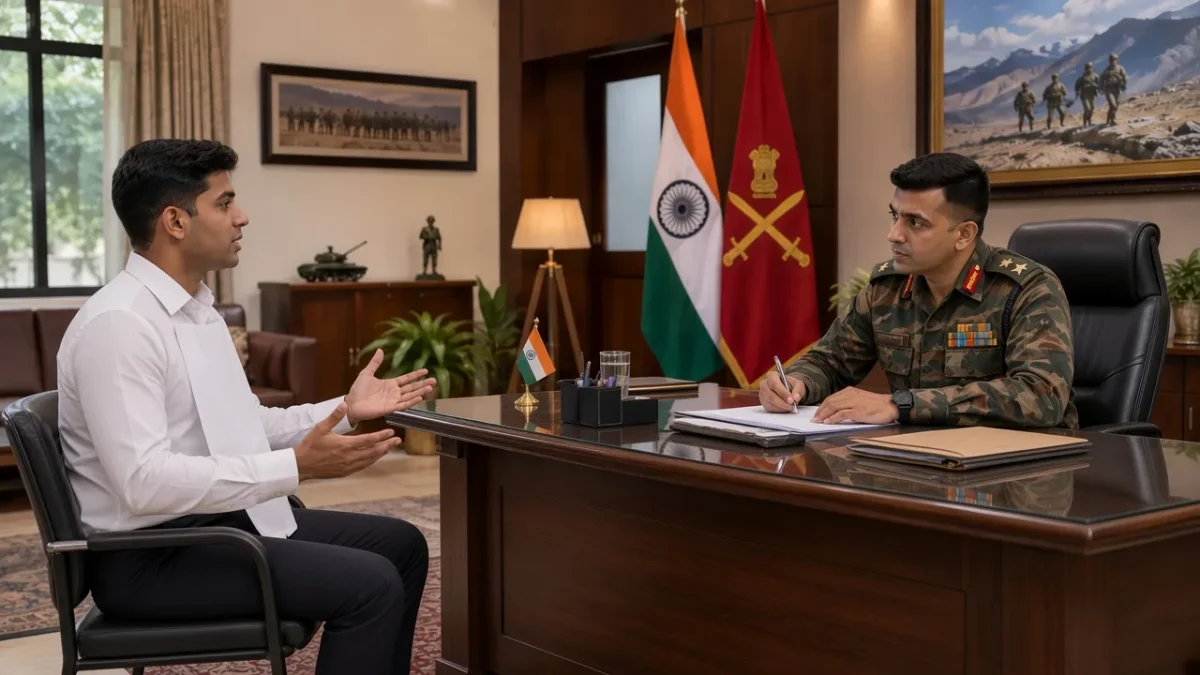
For many SSB aspirants, the group discussion is the first moment of real nerves in the GTO series. You walk onto the ground, sit in a circle with candidates you met only a day or two ago, and the Group Testing Officer (GTO) reads out a topic. Within seconds, half the group starts talking at once. Some candidates shout to be heard, some never get a word in, and only a few actually move the discussion forward.
The good news is that the SSB group discussion is not a debating competition and it does not reward the loudest voice. It is the opening task of the GTO series, designed to show the assessor how you think, express yourself and behave in a group. This guide explains how the GD is conducted and gives you 10 practical ways to improve your performance, whether this is your first SSB or you are a repeater looking to fix what went wrong last time.
How the SSB Group Discussion Works
| Aspect | What to expect |
|---|---|
| Stage | Stage II, as the first task of the GTO series (generally on the first day of group testing, which falls on Day 3 at most boards) |
| Number of GDs | Usually two discussions held one after the other |
| GD 1 | The GTO generally offers two topics and the group chooses one |
| GD 2 | The GTO gives one topic, often a social issue, with no choice |
| Duration | Roughly 20 minutes each, though timing can vary by board |
| Seating | Candidates sit in a circle, usually in order of chest numbers |
| Leader or conclusion | No leader is appointed and the group is not required to reach a single conclusion |
The GTO does not chair the discussion or give turns. The group has to manage itself, and that is exactly what is being observed. The GD also gives the GTO a first impression of every candidate, which is then confirmed or revised in the tasks that follow, such as the group planning exercise, progressive group task and group obstacle race.
1. Build a Strong Base Through Daily Reading
Why it matters: You cannot contribute sensibly to a topic you know nothing about
Qualities shown: Effective intelligence, reasoning ability, power of expression
GD topics usually come from current affairs, national issues, social questions and defence matters, with the occasional abstract topic. Candidates who read regularly can add facts, examples and balanced viewpoints, while those who do not are left repeating what others have said.
Read one good newspaper daily, focusing on the editorial and national pages. Keep a short notebook of key issues such as education, health, technology, environment, women’s empowerment, internal security and India’s neighbourhood. For each issue, note two or three points on both sides. This gives you raw material for almost any topic the GTO can offer.
Practical tip: Once a week, pick a topic from your notebook and explain it aloud in two minutes without notes. If you struggle, you know which areas need more reading.
2. Practise Speaking Before the SSB, Not at It
Why it matters: Fluency comes from repetition, not from the pressure of the GD circle
Qualities shown: Power of expression, self confidence
Many aspirants read widely but freeze when they have to speak in a group, because they have never practised it. The SSB is not the place to discover that you speak too fast, lose your train of thought or fill gaps with words like “basically” and “actually”.
Form a small discussion group with friends, classmates or NCC cadets and hold mock GDs regularly. Record a few sessions on your phone and listen back. Notice your pace, clarity and how often you interrupt. Simple, correct language is far better than complicated vocabulary used wrongly, so focus on being clear rather than impressive.
Practical tip: Practise in the language you will use at the SSB. If English is not your strongest language, speak slowly in short sentences instead of trying to sound fluent.
3. Use the First Minute Wisely
Why it matters: The opening shapes the direction of the whole discussion
Qualities shown: Initiative, speed of decision, effective intelligence
In the first GD, the group usually has to choose between two topics. This short phase is often chaotic, but it is also an opportunity. A calm candidate who quickly suggests a topic with a one-line reason and asks the group to agree shows initiative and speed of decision without dominating anyone.
Opening the discussion itself can be useful if you have something meaningful to say, such as defining the topic or framing its main aspects. However, starting first is not compulsory, and a weak or rushed opening helps nobody. It is better to make the second or third point clearly than to make the first point badly.
Practical tip: When the topic is announced, take a few seconds to jot down three key points mentally: what the topic means, one argument for and one against. Then enter the discussion with confidence.
4. Make Quality Points, Not Just More Points
Why it matters: Assessors note the value of what you say, not how long you speak
Qualities shown: Reasoning ability, effective intelligence
A common myth among aspirants is that you must speak as many times as possible. Speaking ten times with vague or repeated ideas creates a weaker impression than speaking four or five times with relevant, well-reasoned points. Each contribution should add something new to the discussion: a fact, an example, a fresh angle or a practical solution.
Structure each point simply: make the point, give a reason or example, and link it to the topic. For instance, on a topic about technology in education, instead of saying “technology is very important”, you might explain how digital classrooms can help students in remote areas, while noting that internet access and teacher training remain challenges.
Practical tip: Avoid quoting statistics unless you are sure of them. A wrong figure stated confidently can damage your credibility more than having no figure at all.
5. Listen Actively and Build on Others’ Ideas
Why it matters: A discussion is an exchange of ideas, not a series of speeches
Qualities shown: Cooperation, social adaptability, ability to influence the group
Candidates who are busy preparing their next point often miss what others are saying. Active listening allows you to respond to the discussion as it develops. When you agree with someone and add to their point, or politely point out a gap in an argument, you show that you are part of the group rather than competing against it.
Phrases such as “Building on what my friend said” or “I would like to add another side to this point” can help you enter smoothly, but use them naturally and do not overuse them.
Practical tip: Keep eye contact with the group, not with the GTO. Speak to your fellow candidates, because that is who you are discussing with.
6. Enter the Discussion Without Fighting for Space
Why it matters: Shouting over others signals poor social skills, while staying silent shows nothing at all
Qualities shown: Self confidence, social adaptability, cooperation
The most common difficulty in an SSB GD is getting a chance to speak when the discussion becomes a fish market. Raising your voice to cut through the noise may get you heard for a moment, but it also shows impatience and aggression. On the other hand, waiting for a perfect silence that never comes means you may not speak at all.
Watch for natural pauses, such as when a speaker finishes a sentence, and enter firmly but politely with a clear opening line. If two people start together, it is perfectly fine to let the other person go first and then speak right after. Persistence and composure are noticed more than volume.
Practical tip: Speak at a steady, slightly louder-than-normal volume from the start, especially outdoors, so you do not have to strain later.
7. Bring the Discussion Back on Track
Why it matters: Groups often drift into side issues, repetition or personal arguments
Qualities shown: Initiative, organising ability, ability to influence the group
One of the most valuable contributions in a GD is not a brilliant argument but a sensible intervention when the group loses direction. If the discussion has wandered away from the topic, or the same point is being repeated, a candidate who calmly summarises what has been covered and suggests the next aspect to discuss is showing leadership in a practical, team-oriented way.
For example, you might say that the group has discussed the economic side of the issue well, and suggest that it would be useful to look at the social or security aspects next.
Practical tip: Do not try to act as a chairperson or give turns to others. There is no formal leader in the SSB GD, and appointing yourself one usually backfires.
8. Stay Calm, Courteous and Balanced
Why it matters: Officers must handle disagreement without losing composure
Qualities shown: Self confidence, cooperation, social adaptability
Disagreements are natural in any discussion, and the GTO expects them. What matters is how you handle them. Personal remarks, mocking someone’s point, pointing fingers or getting visibly angry all create a poor impression. Disagree with the idea, not the person, and give a reason for your view.
It is also wise to take a balanced stand on sensitive topics. You can hold a clear opinion, but acknowledging valid points on the other side shows maturity. Avoid extreme, political or communal statements, and remember that a GD is not the place to prove that you are right at all costs.
Practical tip: If someone contradicts you sharply, respond with a calm, reasoned point and move on. Repeated back-and-forth with one candidate turns a group discussion into a private argument.
9. Watch Your Body Language
Why it matters: How you sit and react is visible to the GTO throughout
Qualities shown: Self confidence, liveliness
The GTO observes the whole group, including those who are not speaking. Sitting upright, keeping open and relaxed posture, nodding when you agree and looking at the speaker all show engagement. Fidgeting, crossing your arms defensively, staring at the ground or looking bored can suggest nervousness or disinterest.
Use natural hand gestures while speaking, but avoid pointing fingers at fellow candidates or banging your hand to emphasise a point. Your expressions should remain pleasant even when you disagree. A calm, lively presence often makes others listen to you more willingly.
Practical tip: Practise mock GDs on video and watch them with the sound off. You will quickly see habits you were not aware of.
10. Be Yourself and Stay Consistent
Why it matters: The GD is only one part of a larger, cross-checked assessment
Qualities shown: Sense of responsibility, determination, stamina
The SSB uses three independent techniques: psychology tests, GTO tasks and the personal interview. Assessors compare their observations at the conference. A candidate who plays a forced role in the GD, such as an artificially aggressive leader, usually shows a different personality in the other tasks and in the interview, and that inconsistency is noticed.
Your GD performance also connects to the rest of the GTO series. The way you behave in the discussion should match how you cooperate in the group planning exercise and the outdoor tasks. Treat the GD as an honest start to your GTO series, not as a one-off performance. If you have a difficult GD, do not let it affect the remaining tasks; one task does not decide your result.
Practical tip: Focus on contributing genuinely rather than on scoring. Natural, sensible participation is what the GTO hopes to see.
For a wider view of errors that cost candidates their recommendation, read our guide on the 10 mistakes that lead to rejection in the SSB interview. To understand the qualities behind every GTO task, see 15 important Officer Like Qualities every SSB aspirant must develop.
Conclusion
The SSB group discussion rewards candidates who think clearly, speak sensibly and work with the group rather than against it. You do not need to be the loudest or the first speaker. You need a sound base of general awareness, the habit of expressing ideas simply, and the maturity to listen, disagree politely and help the discussion move forward.
Start preparing well before your SSB date: read daily, practise mock discussions, and work on your listening and body language. These habits will not only help you in the GD but will also support you in the group planning exercise, the lecturette and the interview. Most importantly, be yourself. The GTO is looking for a future officer, not a performer.
Frequently Asked Questions
1. When is the group discussion held during the SSB?
The GD is the first task of the GTO series in Stage II. At most boards, the GTO series begins on Day 3, after the screening on Day 1 and the psychology tests on Day 2, though the exact schedule can vary between boards.
2. How many group discussions are there in the SSB?
There are usually two GDs, held one after the other. In the first, the group generally chooses one of two topics offered by the GTO. In the second, the GTO gives a single topic.
3. Is it necessary to start the group discussion?
No. Opening the GD can show initiative if you have a meaningful point, but a weak opening helps nobody. Clear, relevant contributions during the discussion matter more than who speaks first.
4. Does the group need to reach a conclusion?
No. There is no requirement for the group to agree on a final conclusion, and no leader is appointed. Trying to force a conclusion is not necessary.
5. What kind of topics come up in the SSB GD?
Topics are usually based on current affairs, national and social issues, and sometimes defence matters or general themes. Regular newspaper reading is the best preparation.