




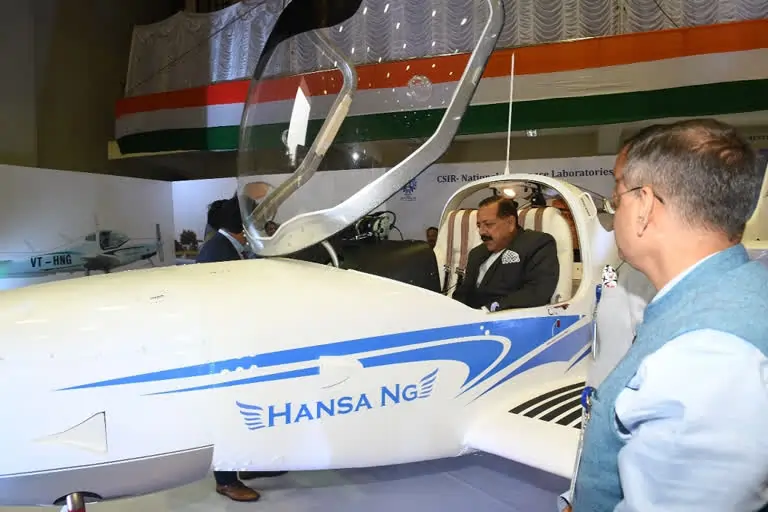
India has made significant advancements in its aviation and aerospace sectors with the official launch of the Hansa-3(NG), the nation’s first fully indigenous pilot trainer aircraft. The initiative, led by Union Minister Dr. Jitendra Singh, underscores a strong commitment to self-reliance in aviation training and aims to reduce the country’s dependency on foreign imports.
The Hansa-3(NG) has been developed by the CSIR–National Aerospace Laboratories (NAL) located in Bengaluru. This new aircraft represents the production-ready version of a comprehensive training aircraft program that has been in development since the early 1990s. The latest model boasts an advanced all-composite airframe, enhancing durability and reducing weight, which translates to improved performance compared to traditional metal airframes.
Production is currently underway in Kuppam, Andhra Pradesh, at a newly established facility by Pioneer Clean Amps, which has an investment of ₹150 crores. This facility is set to produce up to 100 aircraft annually, marking one of the largest manufacturing operations for indigenous trainer aircraft in the country.
The Hansa program was initiated in response to India’s increasing demand for civilian pilot training. The NG variant highlights years of improvements and modernization aimed at evolving the capabilities of pilot training within India.
In April of this year, a manufacturing agreement was formalized between CSIR-NAL and Pioneer Clean Amps, paving the way for large-scale production and a timely market introduction of the Hansa-3(NG).
Dr. Singh emphasized the urgent need for pilots in India, predicting that the country will require approximately 30,000 new pilots over the next 15–20 years due to the rapid growth of civil aviation. The Hansa-3(NG) is positioned as a vital component in developing a comprehensive indigenous pilot training system. It is expected to enhance training for Private Pilot License (PPL) and Commercial Pilot License (CPL) across various flying clubs, aviation schools, and civil aviation academies. The initiative is also anticipated to stimulate aviation entrepreneurship and create skill-based job opportunities.
This launch aligns with a broader governmental strategy to fortify India’s domestic aerospace capabilities, reinforcing the vision of Aatmanirbharta, or self-reliance, in the aviation industry. With a focus on domestic research and development alongside manufacturing, the aim is to foster a robust civil-military aviation synergy, positioning India as a competitive player in the global light aircraft market.
The introduction of the Hansa-3(NG) marks an important milestone for Indian aviation, signifying innovation, scale, and a growing confidence within the country’s aviation ecosystem.


