




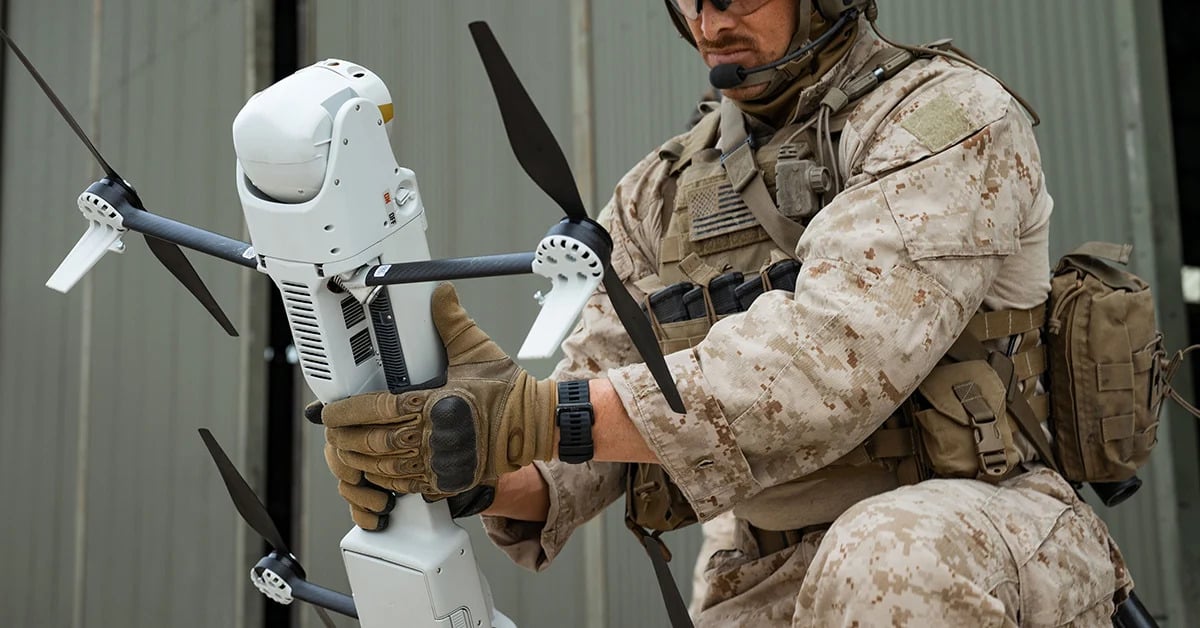
The US Marine Corps has taken a significant step in enhancing its precision strike capabilities by awarding a substantial contract to Teledyne FLIR Defense, worth $42.5 million. This contract mandates the provision of over 600 Rogue 1 loitering munition systems as part of the Organic Precision Fires-Light (OPF-L) program. Included in the delivery are ground control stations and training kits, with the fielding of these systems slated to begin this summer.
The contract follows an initial $12-million award for 127 Rogue 1 systems, which Teledyne has already fulfilled to assist in the testing and evaluation phases of the program. George Bobb, President and CEO of Teledyne Technologies, emphasized the significance of this achievement, remarking that this contract marks the company’s inaugural production-rate agreement within the loitering munition market since the initial test and evaluation contract awarded in 2024.
The OPF-L program aims to furnish rifle squads and platoons with a man-portable, loitering, beyond-line-of-sight precision strike capability. This system is designed to outperform direct-fire weapons, effectively minimizing both collateral damage and the risk of exposure to enemy fire.
Teledyne is presently in competition with industry competitors AeroVironment and Anduril for a potentially lucrative $249-million, five-year production contract for the OPF-L program. AeroVironment is proposing the Switchblade 300 Block 20 munition, while Anduril offers its Bolt-M system. Both Rogue 1 and Bolt-M have been specifically designed for OPF-L, whereas the Switchblade 300 Block 20 incorporates several notable upgrades compared to its predecessor, such as improved armor penetration, better attack angles, enhanced battery life, extended flight endurance, and an upgraded long-range radio link.
Rogue 1 stands out with its vertical takeoff and landing capabilities and supports a variety of modular, mission-specific payloads that can be tailored for different target types. These include options for explosively formed penetrators, forward-fragmenting payloads, and non-lethal trainer payloads. The system integrates an advanced fuzing mechanism, allowing for safe recovery and reuse of the munition in cases where targets are disengaged or missions are aborted. This feature is expected to alleviate the physical load on Marines and enhance overall tactical flexibility.
Further enhancing its operational capabilities, Rogue 1 is equipped with advanced electro-optical sensors alongside FLIR Boson 640+ thermal cameras, enabling day and night long-range reconnaissance and surveillance. A unique coupling between the sensors and the warhead in the gimballed payload allows for highly precise targeting.
JihFen Lei, President of Teledyne FLIR Defense, expressed commitment to enhancing Marine effectiveness against emerging threats through the Rogue 1 platform, stating, “The accuracy and modularity of the Rogue 1 platform will enhance Marine lethality against whatever threats they may encounter in future conflicts.” He emphasized the company’s dedication to supporting the Marine Corps and swiftly implementing technological innovations crucial for battlefield success.


