




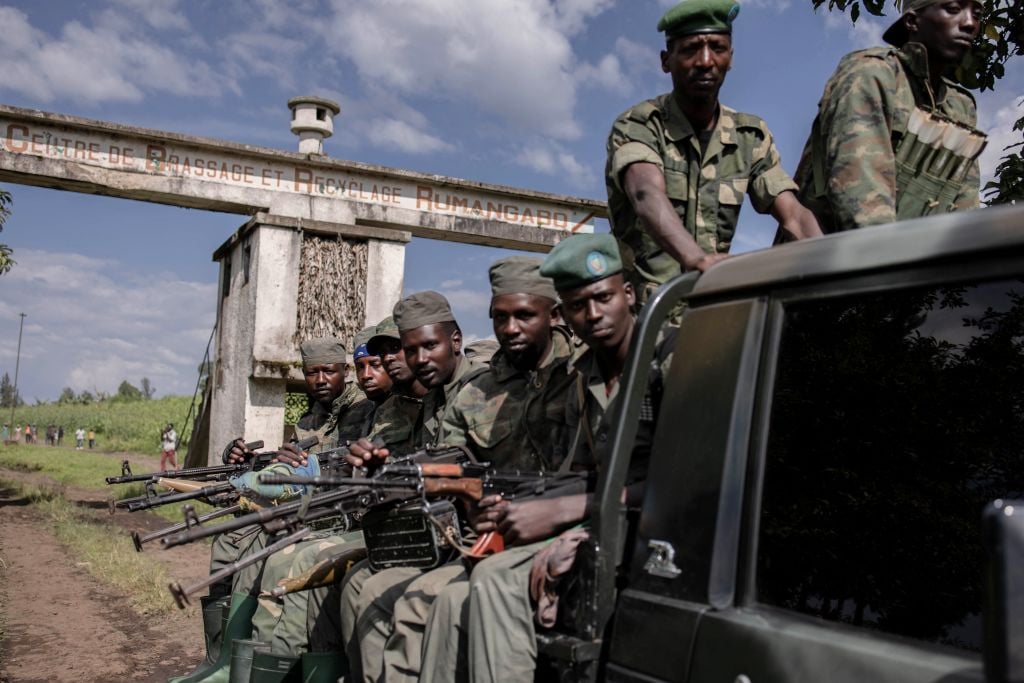
The government of the Democratic Republic of Congo (DRC) announced on Friday that it has accepted “the principle” of a ceasefire in its ongoing conflict with the Rwanda-backed M23 militia. However, the M23 has dismissed the government’s response, labeling it as an act of manipulation.
While no specific date for the ceasefire’s implementation was disclosed, the announcement comes in the wake of a call from Angola, which has taken on the role of mediator, urging both sides to respect a ceasefire that is expected to take effect from February 18.
For over three decades, the eastern part of the DRC, rich in natural resources, has seen persistent violence involving numerous armed groups. Angola’s recent mediation efforts have gained traction, with a ceasefire proposal being released on Wednesday. This move follows a statement last week concerning the deployment of UN peacekeepers to the eastern DRC, aimed at aiding the enforcement of any future ceasefire.
The M23 has targeted the region since its resurgence in 2021, and multiple ceasefires have been agreed upon and subsequently violated. The Congolese presidency expressed its commitment to achieving peace, stating that “the president of the republic has accepted the principle of a ceasefire.” Nevertheless, the M23 criticized the DRC government, claiming that while it professes to support Angola’s ceasefire initiative, it continues to carry out “indiscriminate attacks” in the region.
The M23’s resurgence has precipitated a sharp escalation of violence, particularly following the capture of Goma, North Kivu’s provincial capital, in January of last year. Soon after, Bukavu, the capital of South Kivu, fell to the militia. Despite various peace initiatives spearheaded by Qatar and the United States, the implementation of two separate accords has not halted the conflict.
Recent clashes have erupted in the South Kivu province, particularly near the town of Minembwe. Reports indicate that the Congolese army, supported by a local militia and Burundian troops, has been conducting operations against an armed group allied with the M23.
In its Friday statement, the Congolese government outlined a framework for a ceasefire, calling for an “immediate freezing of positions” and the cessation of military reinforcements and offensive operations. Furthermore, it demanded an end to all external support for armed groups operating on its territory.
On Thursday, the acting head of the UN mission in the DRC arrived in Goma via helicopter, a city that had been closed off since it was captured by the M23. The UN is set to launch an aerial reconnaissance mission in the town of Uvira in the coming days. MONUSCO, the UN peacekeeping mission, currently has around 7,000 personnel deployed in eastern DRC, with the nearest base located in Goma.
In parallel to these developments, the African Union has appointed Togolese leader Faure Gnassingbe to lead the peace talks, involving Angolan President Joao Lourenco in the negotiations. Previous mediation efforts led by Lourenco at the AU’s request in late 2024 collapsed before a summit meant to convene Congolese and Rwandan leaders.


