




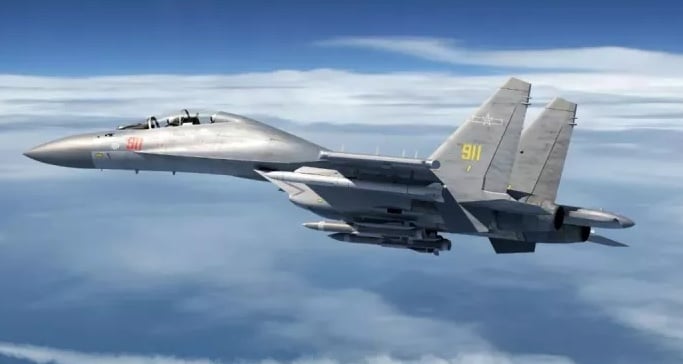
Modern air combat has undergone a profound transformation, shifting from close-range dogfights to engagements that often occur beyond visual range. In this new paradigm, long-range missile systems have become the defining factor in determining aerial superiority.
One significant player in this arena is China’s PL-17 missile, designed specifically to enhance the effectiveness of aerial operations by targeting high-value assets like tankers, surveillance platforms, and early warning aircraft under a strategy that aims to "kill the eyes and ears first."
Overview of the PL-17 Missile
The PL-17, classified as a very long-range air-to-air missile, is operated by the People’s Liberation Army Air Force (PLAAF). With an estimated length of 6 meters (19.6 feet) and a diameter of around 30 centimeters (11.8 inches), it boasts a formidable range of approximately 300 to 500 kilometers (186 to 311 miles) and can reach maximum speeds between Mach 4 (about 4,939 kilometers per hour or 3,069 miles per hour) and Mach 6 (7,409 kilometers per hour or 4,603 miles per hour). This missile is launched from advanced platforms such as the J-16 and other multirole fighters.
The PL-17 is engineered to engage high-value airborne targets such as Airborne Early Warning and Control (AEW&C) platforms, aerial refueling tankers, and reconnaissance assets, significantly extending engagement capabilities into contested battle spaces. Developed by the Aviation Industry Corporation of China, it represents a leap forward from earlier systems like the PL-12 and PL-15, focusing on range and advanced guidance to neutralize aircraft that are crucial for air operations.
In comparing the PL-17 to established Western counterparts like the AIM-120 AMRAAM, it becomes clear that the PL-17 prioritizes extreme engagement distances, diverging from the emphasis on close-range dogfighting.
Strategic Context and Development
The development of the PL-17 is part of a broader Chinese initiative aimed at extending the reach of its air combat systems beyond traditional visual-range constraints. With the increasing reliance on support aircraft as operational force multipliers, these platforms have emerged as high-priority targets in possible conflict scenarios. While the exact timeline for the missile’s development is classified, it is aligned with China’s anti-access/area denial (A2/AD) strategy, which seeks to push adversarial forces further from contested regions by threatening the aircraft that facilitate long-range operations.
Capabilities and Design Features
The PL-17 is distinguished by its large airframe designed for long-range propulsion, endurance, and efficiency. Although precise figures regarding its engagement range remain undisclosed, its architecture is focused on sustained performance and advanced targeting systems. It likely employs active radar or multi-mode seeker systems, optimally designed for engaging large, non-maneuvering airborne targets.
After launch, the missile enters a mid-course phase characterized by a high-altitude flight path that minimizes drag, thus maximizing range. Its guidance is facilitated through a combination of inertial navigation and potential mid-course updates sourced from offboard data, enabling it to engage targets beyond the line of sight effectively. In the terminal phase, the missile’s onboard seeker activates to hone in on designated targets, specifically aimed at disabling critical support aircraft.
Strengths and Limitations
The PL-17’s capabilities include an extensive reach against support aircraft, making it an effective tool for strategic disruption in air warfare. It offers networked targeting potential, allowing for engagements well beyond visual range, which provides a deterrent effect in contested zones.
However, it carries certain limitations, such as its specialized role which may render it less effective in close-range encounters with agile fighters. Its larger size can restrict internal storage options on stealth platforms, and its high reliance on external targeting networks necessitates robust sensor integration.
Operational Context
The PL-17 plays a crucial role in China’s broader strategy to extend air denial capabilities in regions such as the South China Sea and beyond the First Island Chain. By threatening key aerial support assets at considerable distances, it poses significant challenges for opposing forces in maintaining operational effectiveness. This approach marks a shift in air warfare, where the objective is not merely to engage enemy fighters but to degrade their supportive infrastructure—sensors, refueling assets, and command systems—thus undermining their operational capacity.
Future Prospects
As air combat continues to evolve into more networked, sensor-driven environments, systems like the PL-17 will increasingly emphasize reach and the ability to disrupt enemy capabilities over traditional dogfighting approaches. Future iterations of this missile are likely to enhance integration into expansive kill-chain networks, improving real-time targeting and engagement effectiveness.
While many specifics surrounding the PL-17 remain classified, its purpose is unmistakable: to target the most critical components of opponent air forces, thus fundamentally altering how military aircraft operate in contested skies.


